




Online Consultation
Please accurately enter the information below.
Quick Cost Consultation
Quick Consultation & Reservation
Cases finding
similar to my profile






Doctor's Note
Medical columns by our surgeons
Male Gynecomastia | Will Weight Loss Shrink Chest Size? Anatomically Tailored Treatments [Doctor's Note by Dr. Jihoon Moon]
2026-08-07
Male Gynecomastia | Will Weight Loss Shrink Chest Size? Anatomically Tailored Treatments [Doctor's Note by Dr. Jihoon Moon]
Will male gynecomastia resolve naturally with weight loss?
When chest volume is predominantly composed of adipose tissue,
it can decrease to a certain extent through weight loss.
However, if mammary glandular tissue and fibrous connective tissue have developed together,
or if the localized fat layer on the chest is exceptionally dense,
dieting alone will rarely achieve satisfactory changes.
▶ View Male Gynecomastia Clinical Cases
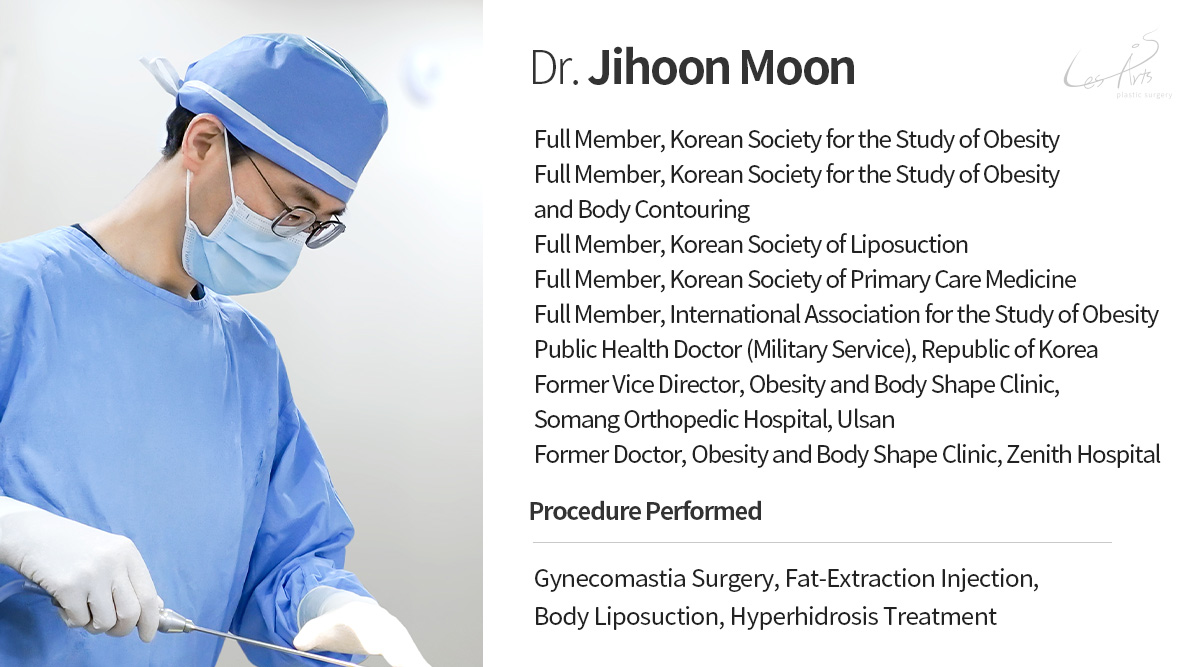
Hello, I am Dr. Jihoon Moon, Board-Certified Plastic Surgeon at Lesarts Plastic Surgery.
“If I lose weight, won't my chest shrink along with it?”
This is one of the most frequent questions we encounter during gynecomastia consultations.
The answer cannot be summarized into a single uniform conclusion.

[Gynecomastia and Dieting – Dr. Jihoon Moon, Lesarts Plastic Surgery]
While some individuals observe noticeable chest reduction after shedding body weight,
others find that surrounding fat diminishes while central chest projection
and volume remain virtually unchanged.
The reason for these differing clinical responses is that
gynecomastia is not determined solely by overall body weight
or simple fat accumulation.
In Korean adult males, the reported prevalence of gynecomastia ranges
from approximately 40% to as high as 60%.
While increasing overweight rates have contributed to these figures,
weight gain alone cannot account for all gynecomastia presentations.
Many people understand gynecomastia
simply as excess adipose tissue stored in the chest.
While fat certainly influences total chest volume,
it is insufficient to fully explain the comprehensive anatomical structure of gynecomastia.
The male chest fundamentally consists of adipose tissue and fibrous connective tissue,
and in cases of gynecomastia, mammary glandular tissue can also be confirmed.
The overall size and silhouette of the chest vary depending on the ratio of these three tissues,
as well as where and how broadly they are distributed.
Consequently, even among men with comparable body weight and body fat percentages,
one person may have an entirely flat anterior chest,
while another presents with conspicuous central chest protrusion.
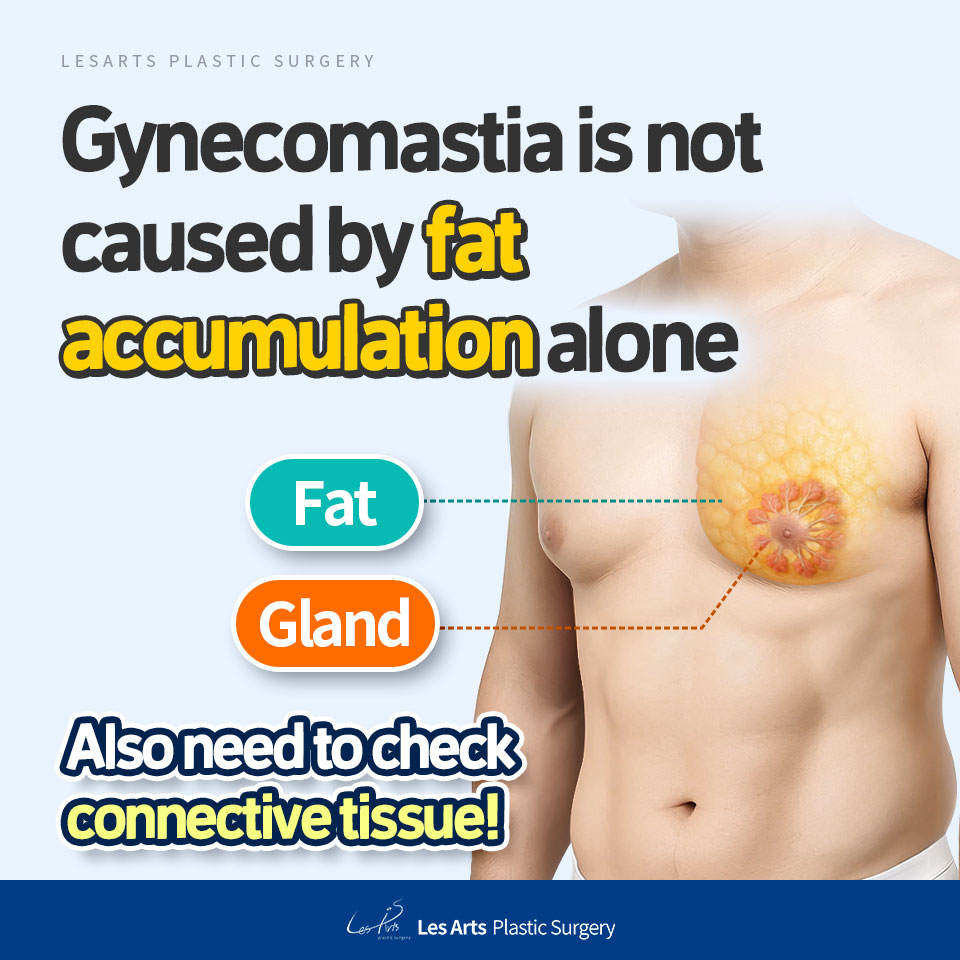
[Causes of Gynecomastia – Dr. Jihoon Moon, Lesarts Plastic Surgery]
Differences in male chest shape are not determined simply by
how much total body fat one carries throughout the physique.
The localized thickness of the chest fat layer, the presence of glandular tissue,
and the structural pattern of fibrous connective tissue collectively dictate the outcome.
High-resolution ultrasound imaging
demonstrates these structural differences with clinical clarity.
In men without gynecomastia, ultrasound typically shows
no identifiable mammary glandular proliferation.
Conversely, in patients with gynecomastia, prominent glandular tissue is confirmed
directly beneath the central subareolar region.
This stems not from higher overall body mass, but rather from
inherent anatomical variations in the tissues composing the chest.
It is often assumed that men with narrower waists or gentler body frames
naturally have more pronounced glandular breast development.
Yet clinical ultrasound diagnostic exams frequently reveal
negligible glandular tissue in such individuals, contrary to initial assumptions.
Having a smoother or softer aesthetic appearance does not imply
the presence of an endocrine disorder or congenital disease.
Diagnostic testing confirms normal physiological parameters in the vast majority of cases.
Ultimately, these variations are best understood not as medical pathologies, but as
subtle anatomical distinctions in individual fat patterning, connective tissue matrix,
and the degree of glandular expression.
The reason every man exhibits a distinct chest contour and body line
is the cumulative result of these nuanced
structural differences.
Gynecomastia is not a singular, uniform condition
composed of identical tissue proportions.
While some presentations are predominantly adipose (pseudogynecomastia),
others are primarily driven by glandular breast tissue (true gynecomastia).
Furthermore, mixed variants also exist where dense fibrous tissue forms
or where fat, glands, and fibrous septa are interwoven.
Therefore, even when external chest dimensions appear visually similar,
the actual tissue layers and surgical scope requiring resection differ substantially.
This is precisely why treatment strategies cannot be reliably determined
through self-diagnosis or body scale readings alone.
▶ View Diverse Gynecomastia Surgery Before & After Cases
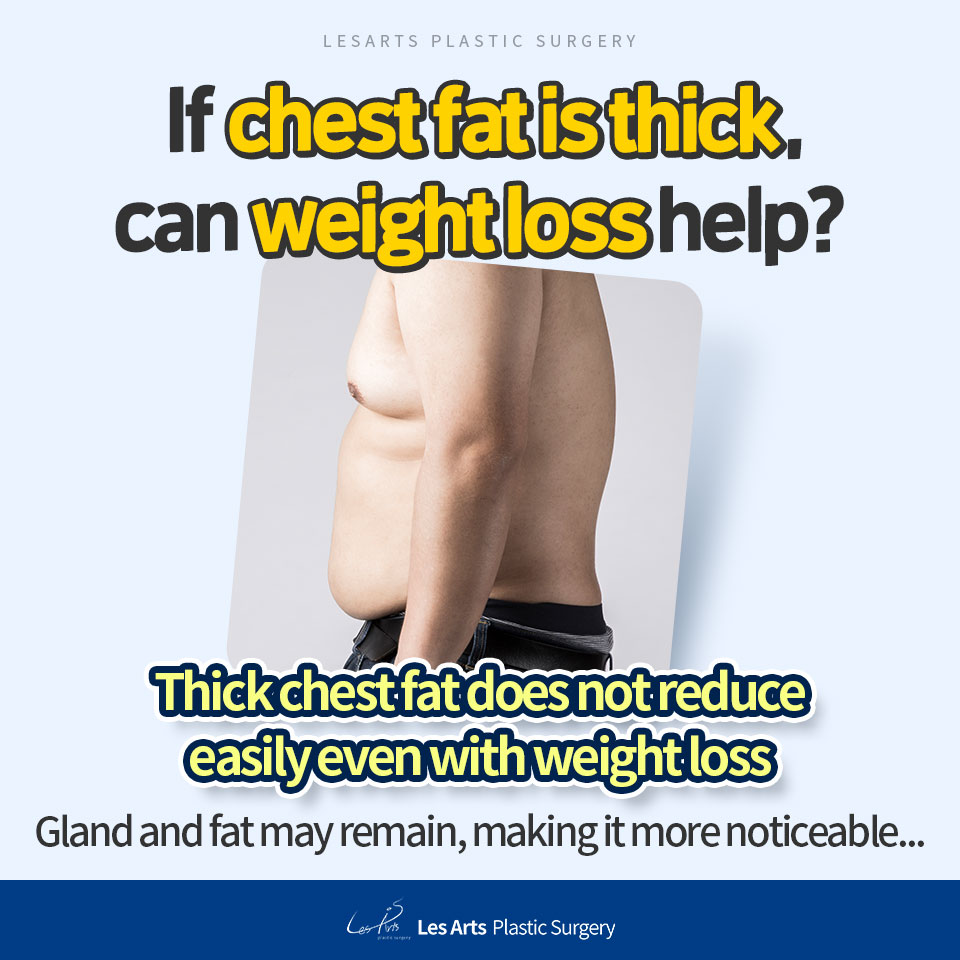
[Gynecomastia Subcutaneous Fat – Lesarts Plastic Surgery]
Along with glandular tissue, a critical factor to evaluate
in gynecomastia is the thickness of the chest fat layer.
Even with identical overall fat volumes, fat spread thinly and evenly across the pectorals
creates a completely different external contour compared to fat
densely accumulated in localized focal pockets.
In particular, when the localized chest fat layer is deeply thickened,
chest projection may not recede as desired even after substantial weight loss.
As adjacent adipose tissue around the abdomen and flanks burns off first,
the chest can appear comparatively more emphasized and prominent.
This explains why many individuals who exercise consistently and hit their goal weight
still feel that their anterior chest bulk and projection remain unaltered.
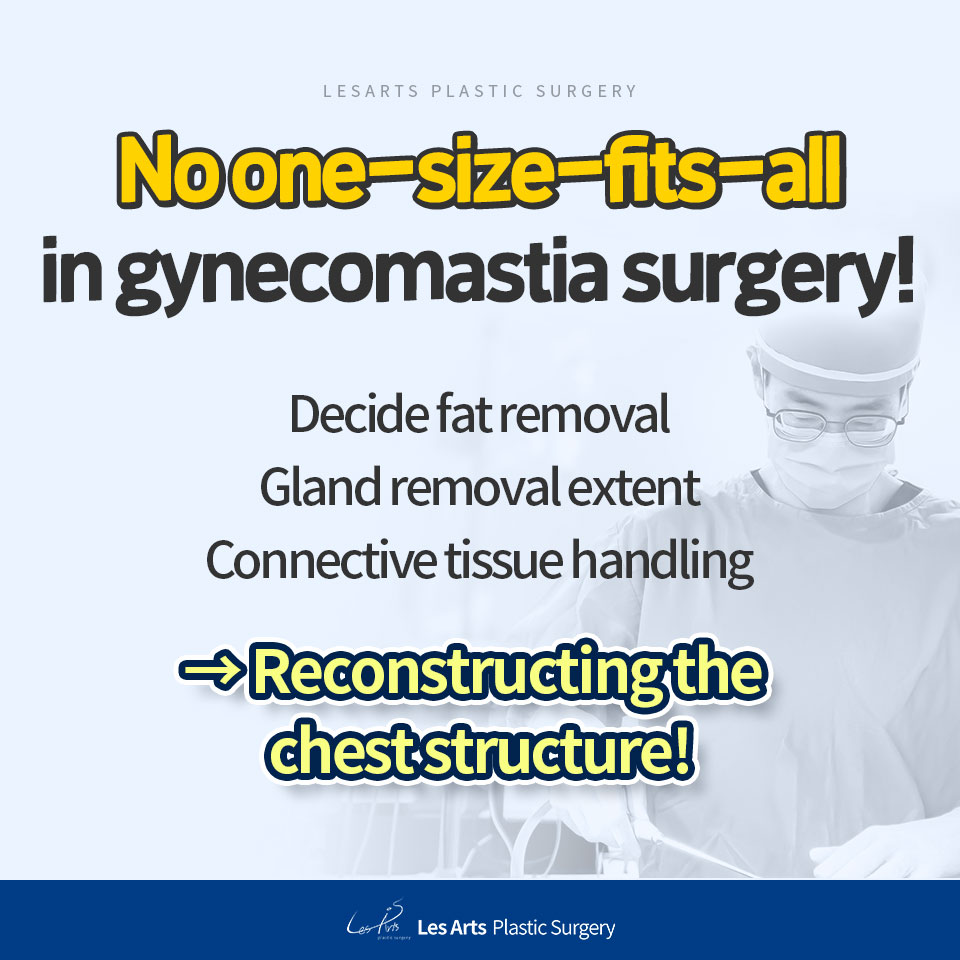
[Gynecomastia Treatment Modalities – Lesarts Plastic Surgery]
Because the tissue composition of gynecomastia varies widely,
the same surgical technique cannot be applied uniformly across all patients.
When adipose tissue is dominant, chest liposuction serves as the cornerstone procedure;
however, when glandular tissue is hypertrophic, surgical gland excision is essential.
If dense fibrous tissue is present,
targeted surgical release and re-sculpting must be planned.
Furthermore, residual tissue must be seamlessly blended and redraped to avoid
saucer depressions or abrupt step-offs in the site where the gland was excised.
Ultimately, the essence of gynecomastia treatment is not merely
extracting large volumes of fat or glandular tissue.
It lies in analyzing the precise ratios and anatomical distribution of tissues,
and restructuring the entire chest framework so that the central, lateral,
and inframammary regions flow naturally into a sculpted, masculine profile.
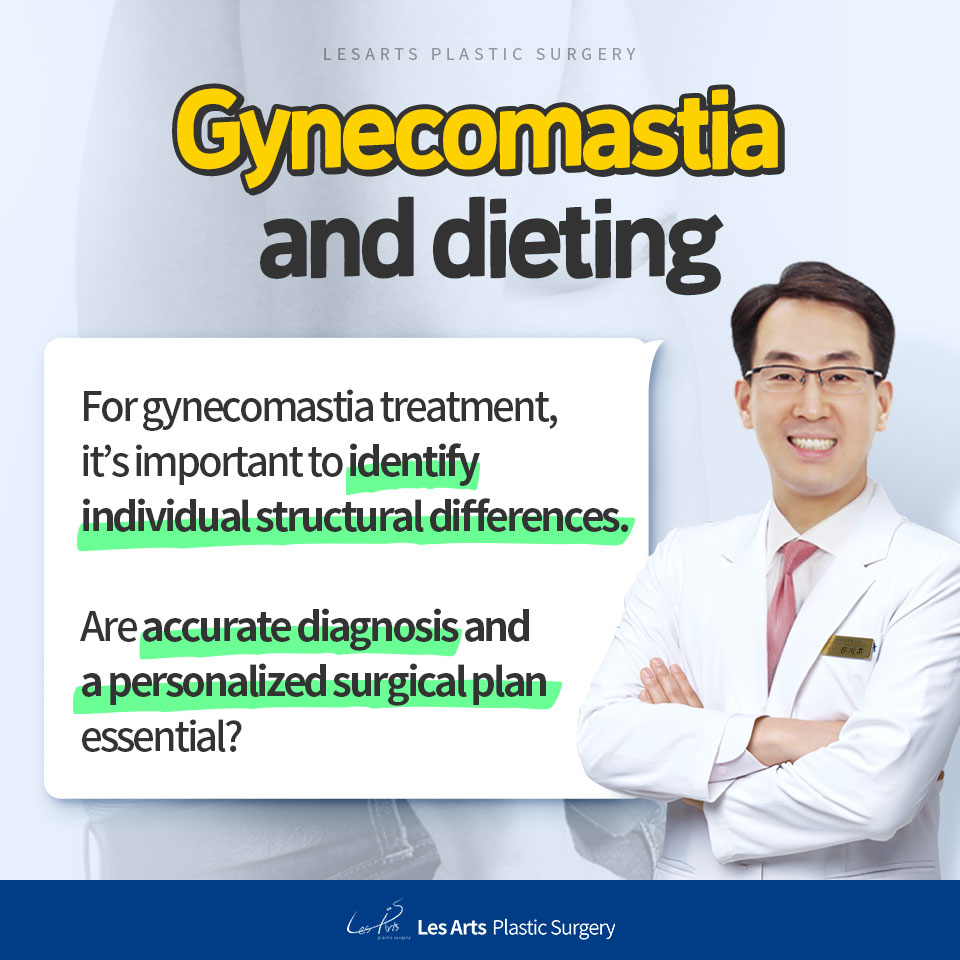
[Gynecomastia Surgery and Dieting – Dr. Jihoon Moon, Lesarts Plastic Surgery]
If chest prominence is mostly composed of fat,
weight loss can produce noticeable improvements.
However, when glandular proliferation or dense fibrous matrix is present,
or when thick, stubborn chest fat layers persist, dieting alone
will rarely reduce chest fullness to the desired contour.
Thus, to the question “Will losing weight make gynecomastia disappear?”,
we must conclude that the outcome depends entirely on your internal chest anatomy.
What determines this distinction is not overall body weight,
but the exact anatomical configuration of fat, glandular tissue, and fibrous connective tissue.
Male gynecomastia cannot be simplified into an issue of weight gain and fat accumulation alone.
Even at identical weights and body fat levels, differing fat thickness, glandular proliferation,
and fibrous tissue architecture can produce fundamentally different chest contours.
Therefore, if chest thickness and protrusion persist despite rigorous dieting,
rather than endlessly repeating cardio workouts, it is essential to evaluate your internal tissue composition.
Treatment pathways must be customized based on whether fat is the primary driver or whether glandular excision is required.
There is no single one-size-fits-all answer in gynecomastia surgery.
Through precise diagnostics, identifying individual chest anatomy
and tailoring liposuction boundaries, glandular resection volume, and tissue redraping
to your unique physique is paramount.
▶ Lesarts Plastic Surgery Official Website
Male Gynecomastia & Dieting FAQ
1. Can substantial weight loss completely resolve gynecomastia?
If fat constitutes the vast majority of chest volume,
weight reduction can produce partial improvement.
However, when glandular breast tissue or dense fibrous tissue is present,
dieting alone will not achieve satisfactory reduction.
2. Can lean men also develop gynecomastia?
Yes. Even with low body fat, if glandular tissue is hypertrophied
or if adipose tissue is focally concentrated in the chest,
anterior chest projection can appear prominent.
3. Why does the chest sometimes look more prominent after working out?
When surrounding torso fat burns off while thick chest fat layers
or non-reducible glandular tissues remain, the chest becomes comparatively more accentuated.
4. Is an ultrasound examination mandatory for gynecomastia?
Visual inspection and palpation alone cannot definitively differentiate the exact boundaries of glandular tissue.
Ultrasound imaging objectively verifies glandular dimensions and fat distribution,
providing essential data for precise surgical planning.
5. Is glandular tissue excised in every gynecomastia surgery?
It depends on the tissue composition of the chest.
In true gynecomastia with glandular hyperplasia,
surgical excision is required;
in fat-dominant pseudogynecomastia, calibrated liposuction
serves as the primary surgical modality.
Dr. Jihoon Moon


Cases finding
similar to my profile
Customer Diagnostics


Select the surgery and
area you are interestedto see real
before andafter changes.


we
make you,
the art
Clinic hours
MON - FRI
10 am – 7pm
SAT
10 am – 4pm
Holiday
SUN, HOLIDAY
Location
Lesarts Moon Clinic Tower 4-5F, 40, Nonhyeon-ro 168-gil,
Gangnam-gu, Seoul, Republic of Korea

Medical institution name Lesarts Plastic Surgery
Address Lesarts Moon Clinic Tower 4-5F, 40, Nonhyeon-ro 168-gil, Gangnam-gu, Seoul, Republic of Korea
Representative Moon sung jun
