




Online Consultation
Please accurately enter the information below.
Quick Cost Consultation
Quick Consultation & Reservation
Cases finding
similar to my profile






Doctor's Note
Medical columns by our surgeons
L-Type (Extended) Abdominoplasty: 7-Month Recovery and Transformation
2026-08-10
L-Type (Extended) Abdominoplasty: 7-Month Recovery and Transformation
Can severe abdominal skin laxity after massive weight loss be resolved through diet and exercise alone?
Even after significant weight loss, overstretched abdominal skin
rarely retracts back to its original elasticity on its own.
Particularly when severe laxity extends across the flanks, an L-type extended abdominoplasty
can simultaneously excise redundant skin across both the abdomen and flanks.
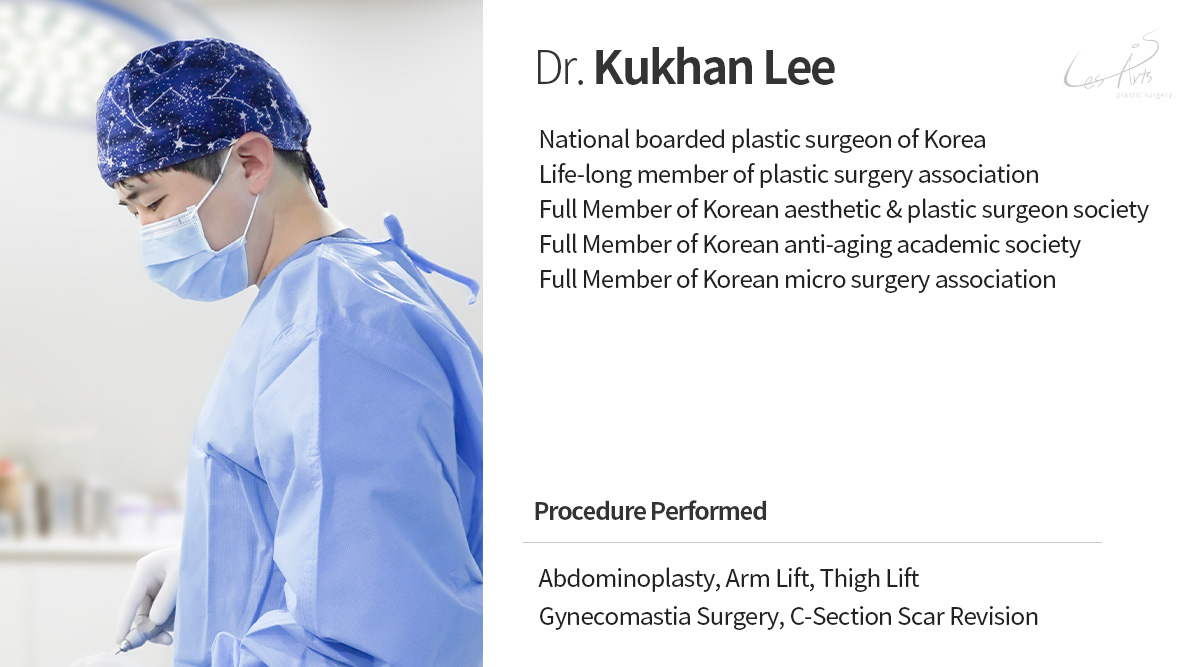
Hello, I am Dr. Kukhan Lee, Board-Certified Plastic Surgeon.
During rapid cycles of massive weight gain and subsequent loss,
changes are not limited to scale numbers; severe skin laxity and sagging can develop across multiple body areas.
The abdomen in particular is exceptionally vulnerable to drastic weight fluctuations,
meaning that even after successful weight loss,
overstretched skin rarely returns to its pre-expansion baseline.
This redundant, hanging abdominal skin causes not only cosmetic dissatisfaction
but also functional discomfort in daily life.
Overlapping skin folds can create intertrigo and hygiene issues,
and the inability to achieve a desired silhouette in clothing
causes significant psychological distress for many.
In this clinical review, we examine the postoperative changes confirmed
through a 7-month recovery follow-up of an L-type extended tummy tuck
performed on a patient with severe abdominal laxity following massive weight fluctuations.
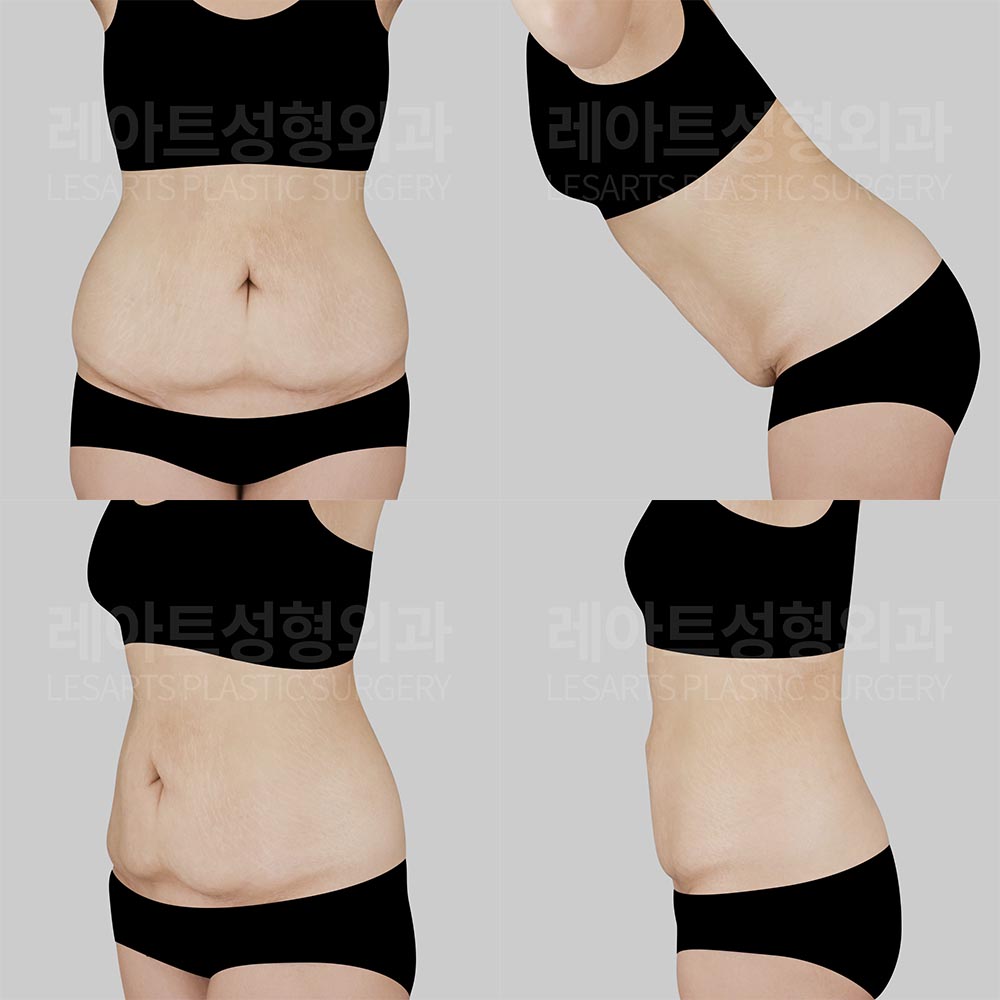
At initial consultation, the patient's physical measurements were
165 cm / 69.4 kg.
She was nulliparous (no history of pregnancy or childbirth) with no previous abdominal surgeries.
However, her history of weight fluctuations was exceptionally substantial.
Her weight reached approximately 80 kg during high school
and escalated rapidly up to a maximum of 130 kg in her early 20s.
Through disciplined lifestyle management, she successfully achieved massive weight loss down to her current weight;
nonetheless, the extreme skin expansion and deflation severely compromised tissue elasticity,
leaving extensive hanging skin folds that caused profound emotional stress.
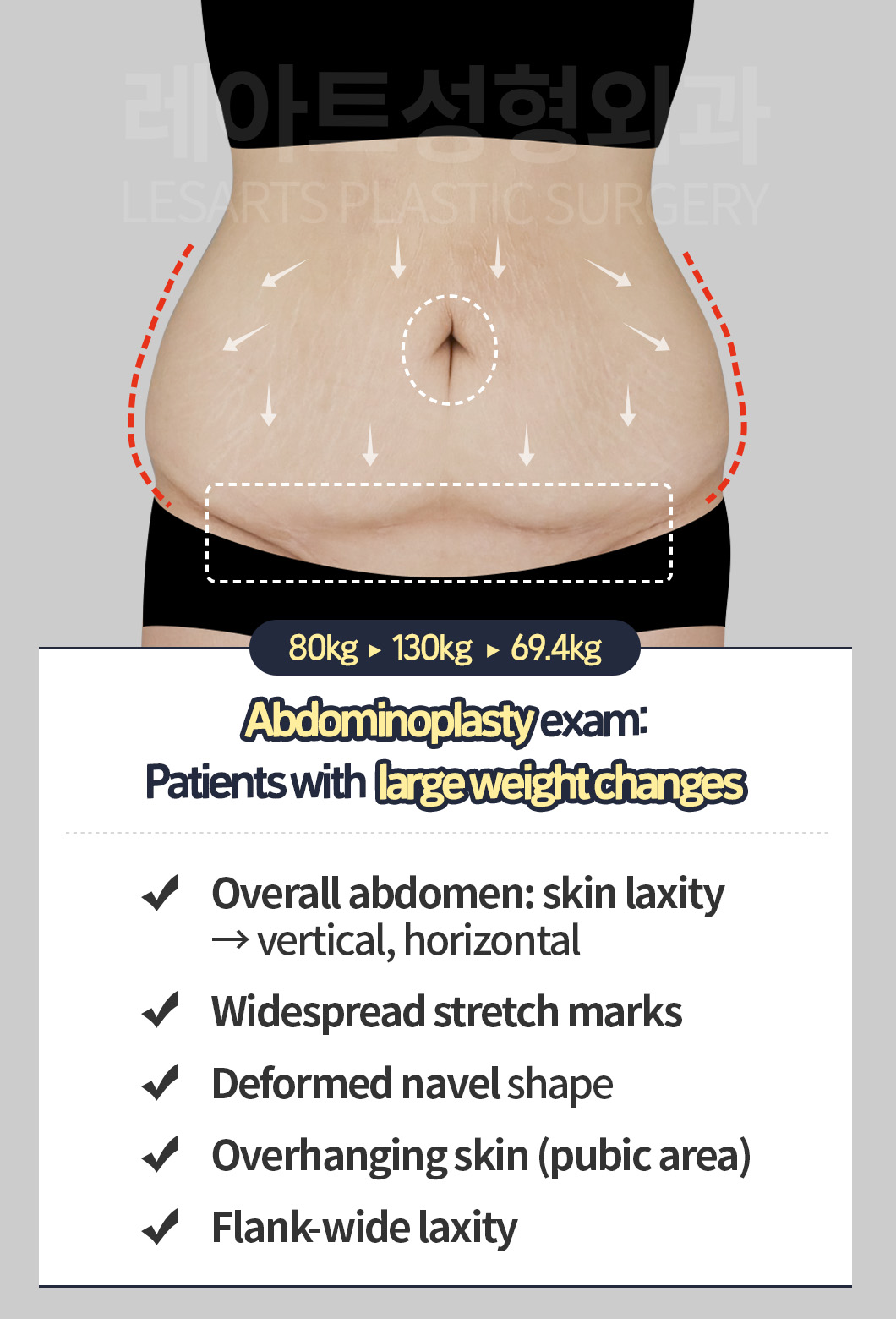
Physical examination confirmed generalized, severe skin laxity and ptosis across the entire abdomen,
with widespread stretch marks (striae distensae) distributed across large surface areas from past expansion.
The patient's paramount aesthetic goals were to correct
the protruding, folded pannus where lower abdominal skin draped over the mons pubis,
and to reconstruct her distorted, stretched umbilicus.
Furthermore, because skin redundancy extended beyond the anterior abdomen out toward the flanks,
we planned an L-type extended abdominoplasty that addresses the flanks simultaneously,
rather than a standard lower-incision tummy tuck.
To sculpt a sleeker abdominal silhouette, circumferential abdominal liposuction was performed concurrently,
and autologous fat grafting to the hip dips was integrated to balance lateral pelvic proportions.
During massive weight gain, abdominal skin expands
not only vertically, but also along the horizontal axis.
Completely correcting this dual-axis redundancy often requires
a fleur-de-lis abdominoplasty, which incorporates an inverted-T vertical midline incision.
However, because this technique leaves a prominent midline vertical scar down the abdomen,
after in-depth consultation, we proceeded with the extended transverse approach,
explaining preoperatively that mild horizontal laxity might partially persist.
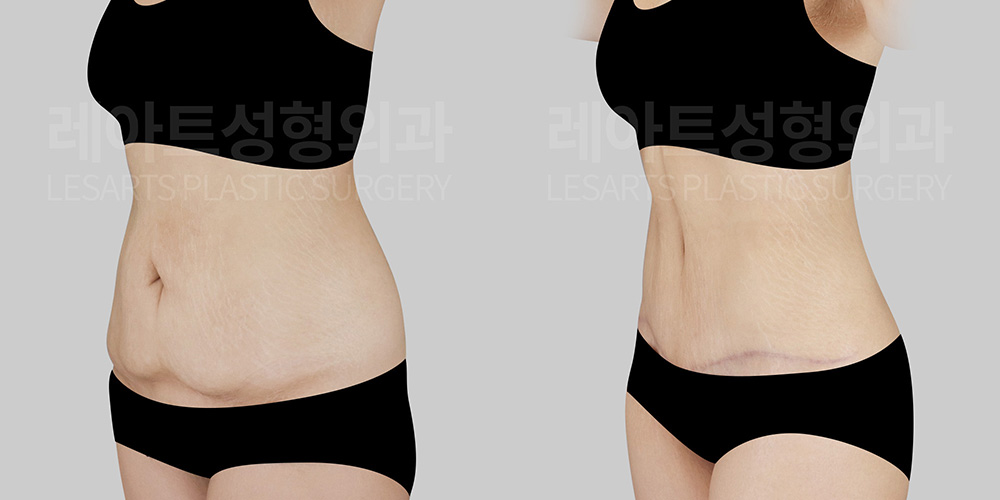
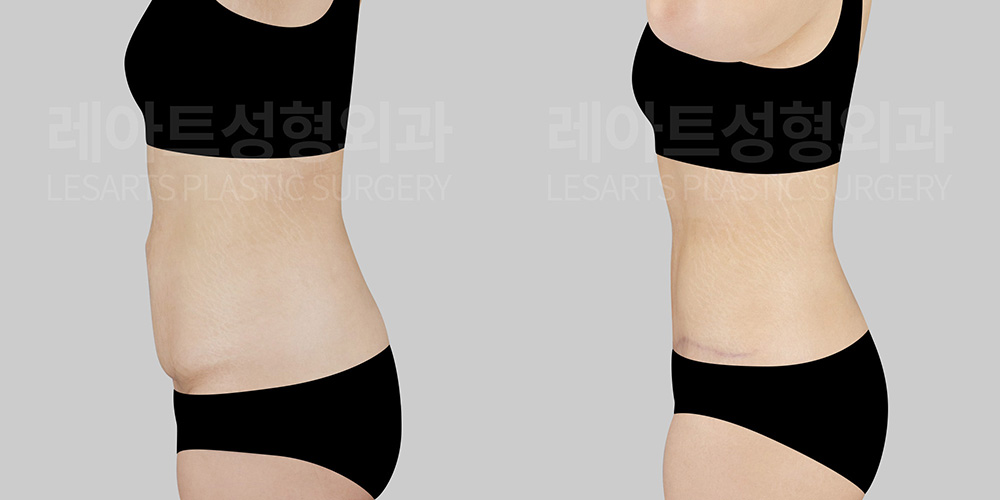
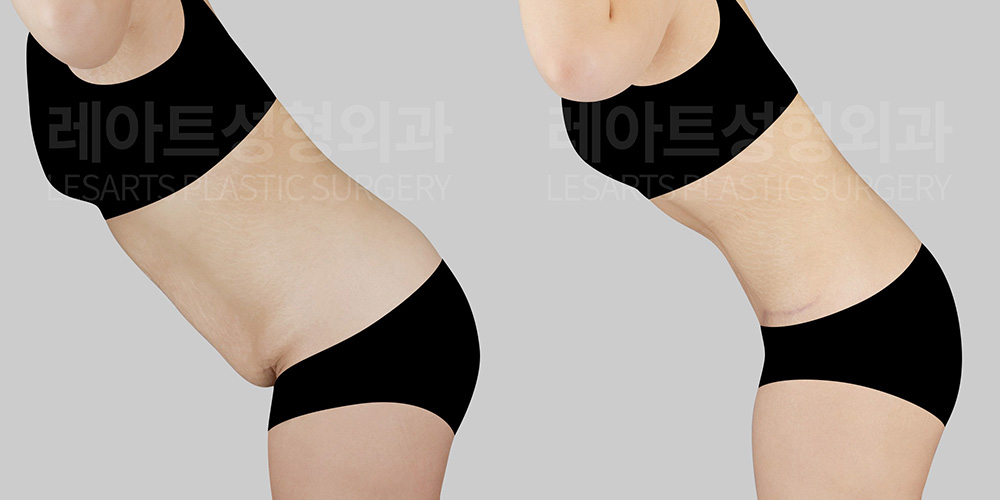
These photos demonstrate the results at 7 months post-extended abdominoplasty.
The irregular, hanging lower abdominal apron that caused the patient the greatest distress
has been smoothly advanced, resected, and securely tightened into a flat contour.
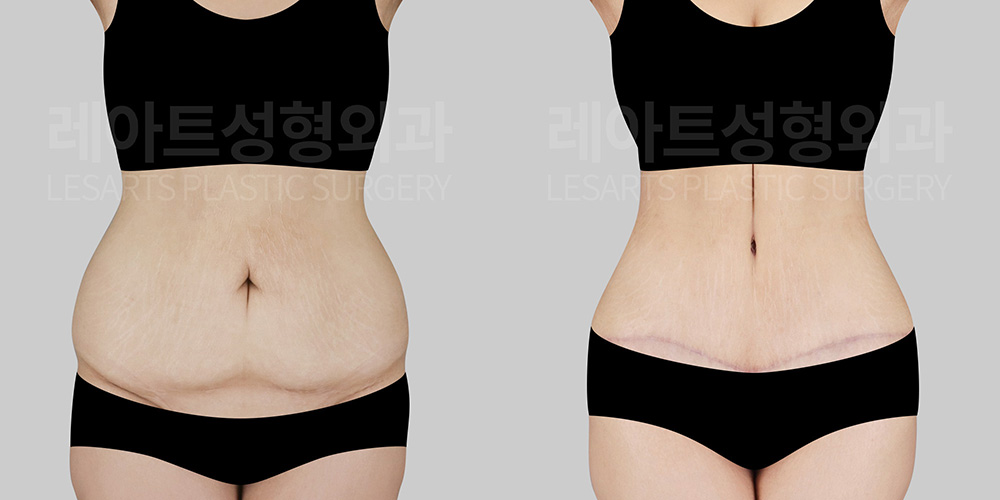
The low-positioned incision maintains excellent bilateral balance without distortion,
demonstrating remarkably stable healing for a 7-month postoperative timeline.
The scar is settling cleanly without hypertrophic widening or thick keloidal changes,
and the umbilicus was successfully reshaped into the naturally oriented vertical contour she desired.
Concurrently performing abdominal liposuction with hip dip fat grafting
re-established a feminine, flowing hourglass curve from the waistline down to the pelvis,
with virtually all functional clothing discomfort resolved.
However, as explained during preoperative planning,
a degree of horizontal skin redundancy along the upper abdomen remained
due to avoiding a midline vertical incision,
representing an intentional trade-off to spare the patient a prominent central scar.
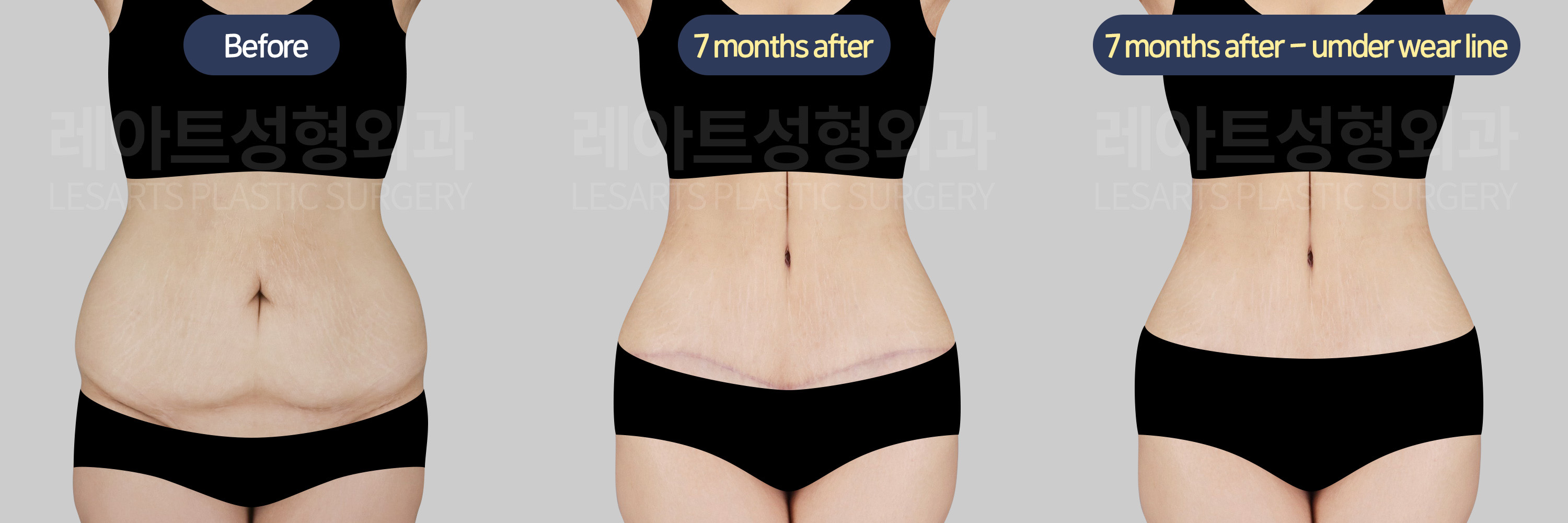
At 7 months post-op, the surgical area is still in the active remodeling phase,
meaning it is too early to judge this as the final definitive result.
As tissue continues to mature over the coming months, the scar line will gradually soften and fade,
and the abdominal wall contour will settle into an even more natural, harmonious line.
Abdominoplasty recovery does not end in the operating room.
Diligent postoperative scar management paired with consistent weight maintenance
is essential to preserving high-definition surgical outcomes.
Continuing regular scar care alongside balanced nutrition and core exercises
will ensure stable, long-lasting aesthetic and functional satisfaction.
[Explore Real Clinical Cases of Lesarts L-Type Tummy Tuck]
FAQ
Q1. Will loose, hanging abdominal skin retract naturally after massive weight loss?
Overstretched skin that has suffered severe dermal disruption rarely contracts
back to normal tension through weight loss or exercise alone.
Depending on the degree of ptosis, surgical abdominoplasty is often required.
Q2. When is an L-type extended abdominoplasty indicated?
When redundant skin and tissue laxity extend laterally beyond the lower abdomen
across the hips and flanks, an extended incision (L-type)
is indicated to achieve circumferential contour refinement.
Q3. Can liposuction be combined with an abdominoplasty?
Yes. When subcutaneous fat deposits coexist with skin laxity,
combining liposuction with tissue excision
allows for a significantly slimmer, flatter, and more sculpted abdominal contour.
Q4. Can horizontal skin looseness after weight loss be completely eradicated?
Severe horizontal skin laxity typically requires
a fleur-de-lis abdominoplasty with a vertical midline scar.
Patients must weigh the benefit of horizontal tightening against the presence of a vertical midline scar.
Q5. Is the outcome at 7 months post-tummy tuck considered final?
At 7 months, tissues are still undergoing internal remodeling and maturation.
The surgical scar will continue to lighten and soften,
and the overall abdominal contours will settle into an even more natural aesthetic over the following months.
Dr. Kukhan Lee


Cases finding
similar to my profile
Customer Diagnostics


Select the surgery and
area you are interestedto see real
before andafter changes.


we
make you,
the art
Clinic hours
MON - FRI
10 am – 7pm
SAT
10 am – 4pm
Holiday
SUN, HOLIDAY
Location
Lesarts Moon Clinic Tower 4-5F, 40, Nonhyeon-ro 168-gil,
Gangnam-gu, Seoul, Republic of Korea

Medical institution name Lesarts Plastic Surgery
Address Lesarts Moon Clinic Tower 4-5F, 40, Nonhyeon-ro 168-gil, Gangnam-gu, Seoul, Republic of Korea
Representative Moon sung jun
