Why do clinics give conflicting explanations about thigh liposuction, and what criteria should determine your surgical plan?
Thigh liposuction cannot be decided merely by whether to extract aggressively or conservatively.
After precisely measuring the depth and distribution of adipose layers via ultrasound,
it is crucial to design the surgical strategy by balancing the patient's aesthetic goals with safe extraction boundaries.
▶ Lesarts Liposuction Guide
Hello, I am Dr. Yongseung Seo, Plastic Surgeon at Lesarts Plastic Surgery.
Those considering liposuction often research extensively to ensure satisfying outcomes,
visiting multiple clinics to compare consultations firsthand.
However, visiting different clinics often leads to conflicting explanations and contradictory surgical directions, causing deeper confusion.
One clinic might state that meaningful changes are difficult given your frame,
while another assures you that your desired silhouette can be fully achieved.
Some advise conservative extraction strictly for safety,
whereas others warn that extracting too little will fail to deliver visible transformation.
When you make a major commitment to undergo liposuction yet every clinic offers different advice,
it becomes challenging to determine which approach is truly right for your body.
In such cases, the key is not to impose a single dogmatic surgical method as the only correct answer,
but to first understand the exact aesthetic transformation the patient desires,
explain the necessary conditions and techniques to achieve that goal, and then formulate the surgical plan.
In other words, it is essential to communicate both what must be limited for safety and what must be addressed to fulfill expectations,
tailoring the surgical strategy to the patient's unique needs.
The patient featured today had previously consulted with other clinics,
yet visited Lesarts Plastic Surgery to evaluate her anatomical condition and actual surgical possibilities
with greater precision after feeling dissatisfied with previous advice.
[Patient Profile]
Age: Late 20s
Height: 160 cm
Weight: 55 kg
BMI: 21 kg/m²
Body Fat: 31.1%
*Even with similar body measurements, liposuction outcomes may vary depending on individual anatomy.
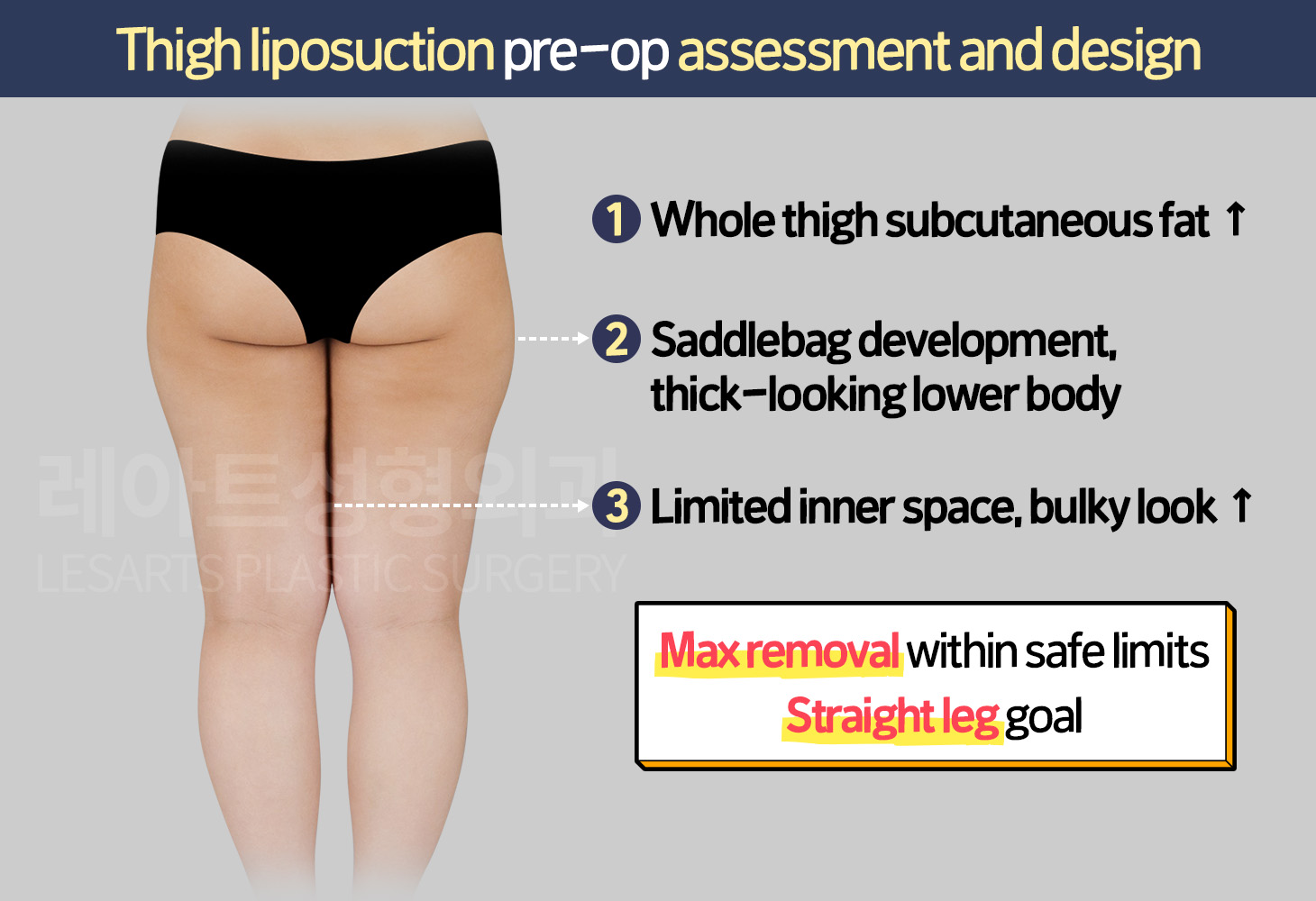
[Pre-Op Body Contour Assessment for Thigh & Hip Line Liposuction]
[Pre-Op Body Contour Assessment for Thigh & Hip Line Liposuction]
As noted earlier, the patient had already undergone
thigh liposuction consultations at other clinics.
One clinic recommended conservative extraction,
while another explained that surgery would unlikely produce dramatic results.
Left frustrated by those assessments,
the patient wanted to confirm whether substantial fat could be removed safely
to produce noticeable, transformative changes.
High-resolution ultrasound measured fat thickness across key zones:
Saddlebags (Outer Thighs): 50 / 41 mm
Inner Thighs: 23 / 20 mm
Posterior Thighs: 12 / 10 mm
Anterior Thighs: 21 / 20 mm
Knee Area: 12 / 12 mm
These measurements confirmed that subcutaneous fat was well-developed throughout.
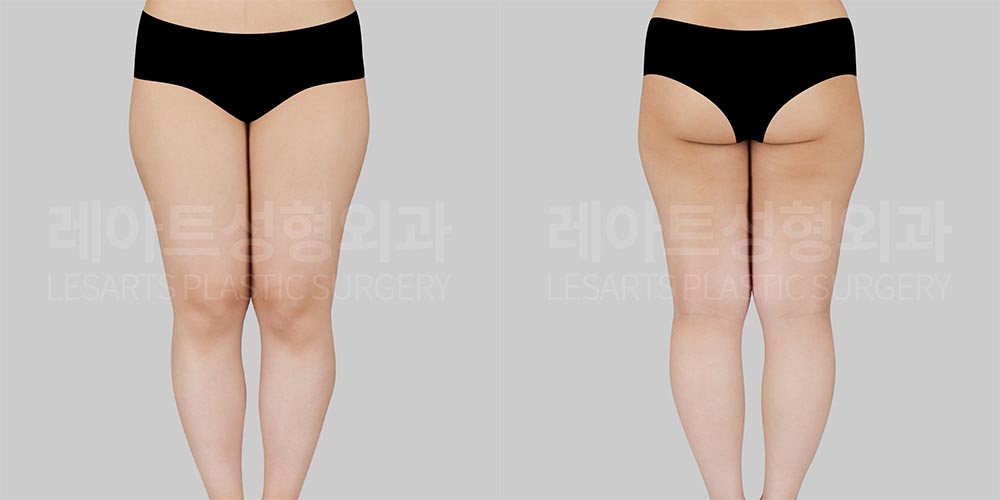
Visually, the inner thighs rubbed together tightly without a gap,
giving the lower body a heavy, congested impression,
while prominent outer saddlebags widened horizontal thigh width,
making the legs appear thicker and shorter overall.
[Pre-Op Diagnosis & Marking Design for Thigh Liposuction]
[Thigh & Hip Line Liposuction Surgical Design]
Having been told by previous clinics that noticeable changes were unlikely or that only conservative suctioning was possible,
the patient arrived deeply concerned about whether she could attain meaningful results.
However, because ultrasound confirmed substantially thick subcutaneous fat layers overall,
we assured her that significant transformation was well within realistic expectations through targeted liposuction.
Determining how much fat to resect versus how much protective subdermal tissue to preserve
cannot be judged purely by aspirated volume alone.
Extracting a safe, appropriate volume does not imply a lackluster aesthetic result,
and conversely, removing a high volume does not automatically trigger complications or skin irregularities.
Thus, it is crucial to evaluate individual anatomical frame and tissue elasticity,
calibrating the optimal surgical zone
to balance desired transformation with absolute safety.
After comprehensive consultation confirming her strong desire for visible circumferential reduction,
we designed the procedure to harvest maximum safe fat volume within physiological limits.
Without preference for a complex shape,
the design focused on sculpting a slim, seamless straight leg silhouette.
We also thoroughly explained preoperatively that substantially reducing outer saddlebags
could create an optical impression of mild buttock ptosis.
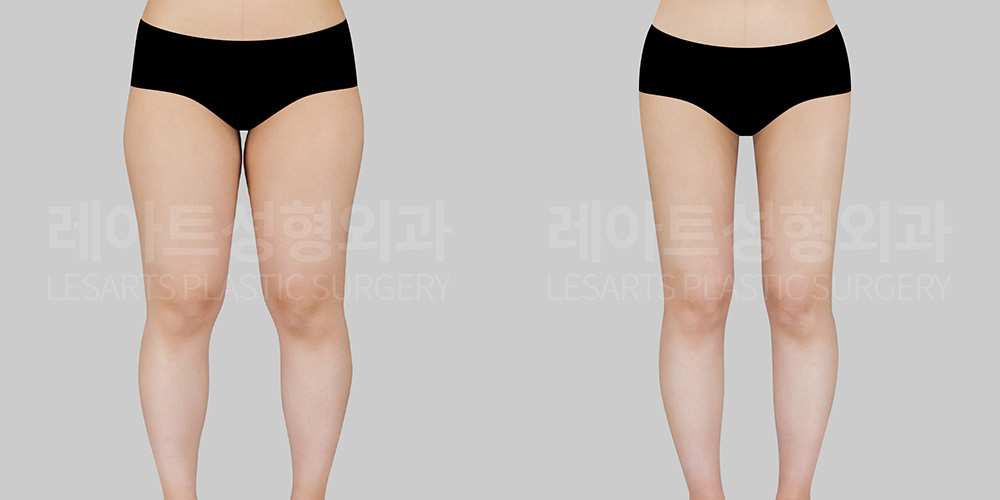
[High-Volume Liposuction Before & After - Dr. Yongseung Seo, Lesarts Plastic Surgery]
[Thigh Liposuction Before & After Comparison - Dr. Yongseung Seo]
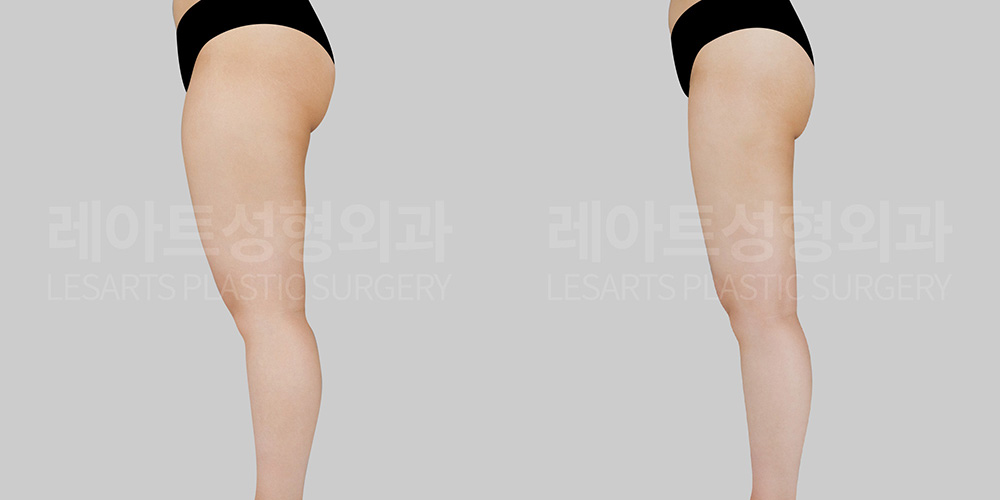
[Lateral Profile Changes Post-Thigh Liposuction - Dr. Yongseung Seo]
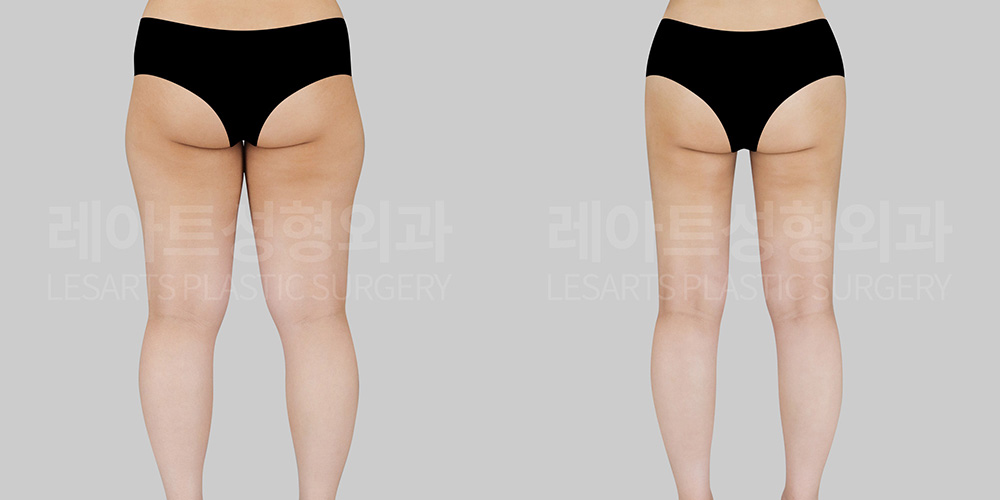
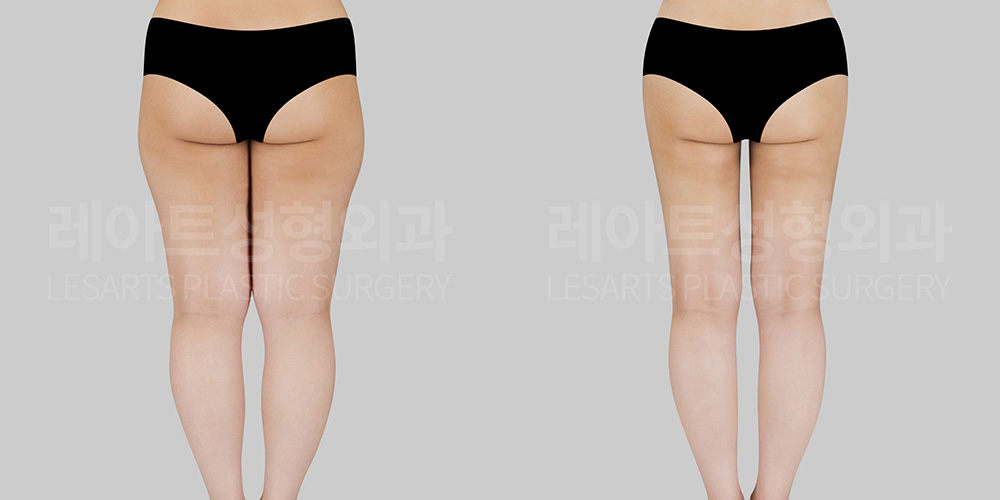
[Before & After Thigh & Hip Line Liposuction]
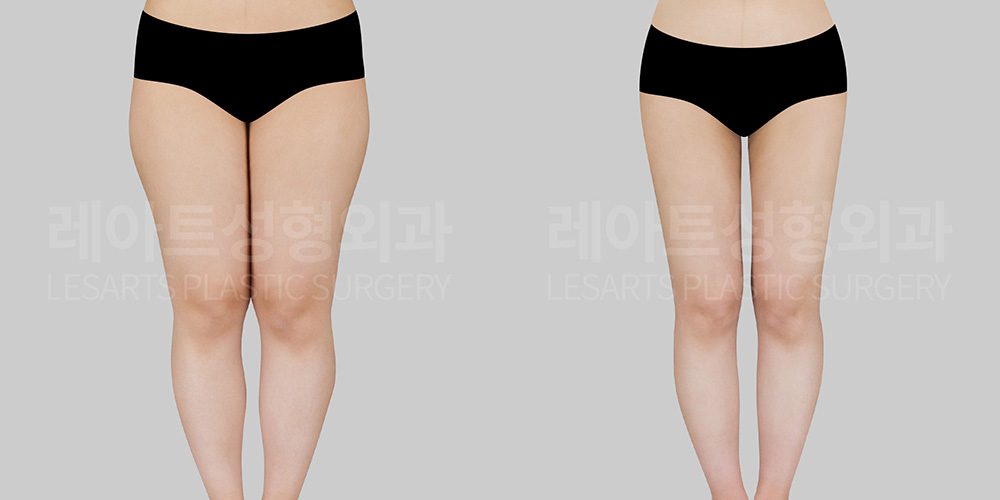
(Captured 2 months post-op under identical studio lighting and conditions)
In line with the patient's goals,
the surgery maximized fat harvesting to create a definitive before-and-after contrast.
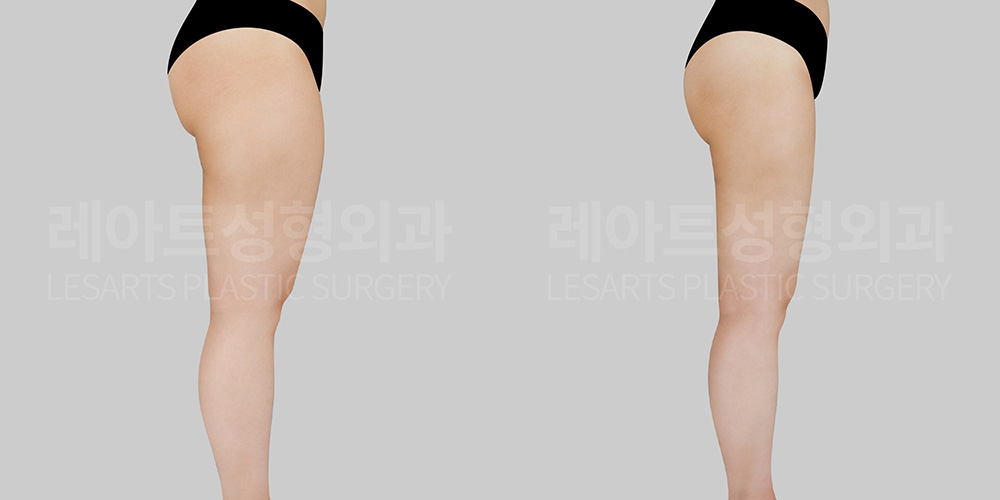
Post-operatively, a distinct thigh gap emerged without contour irregularities,
with substantial overall volume reduction verified throughout.
The contours settled into a smooth, straight leg line
free of dimpling or stepped indentations.
As expected with high-volume liposuction, transient mild hyperpigmentation/skin mottling
and a visual impression of a slightly lowered gluteal crease
were observed, though true structural sagging had not occurred.
We reassured the patient that skin tone will steadily improve as tissue matures,
and recommended targeted skin-tightening treatments and gluteal exercises for hip line support.
[Full Thigh Liposuction (Saddlebags & Thigh Gap) - Dr. Yongseung Seo]
[Thigh Liposuction Efficacy & Proportion Changes - Lesarts Plastic Surgery]
[Circumference Changes Post-Thigh Liposuction - Dr. Yongseung Seo]
This patient presented with such abundant subcutaneous fat that previous assessments were surprising,
and the clinical before-and-after contrast proved dramatic post-surgery.
Naturally, surgical experience is paramount in liposuction.
While diagnostic protocols remain secondary,
patient safety must always take absolute priority.
Yet true surgical excellence lies in producing the greatest possible transformation
that the patient desires within that uncompromising framework of safety.
Clinics prioritizing conservative suctioning or volume targets have valid rationales
that may be ideal for certain individuals.
However, if you are unsure which direction suits your physique or are searching for alternate solutions, visit Lesarts.
By identifying your specific aesthetic vision through thorough consultation
and diagnosing your tissues based on extensive clinical experience across diverse cases,
we will help realize your goals within safe, anatomically feasible boundaries.
【 View More Lesarts Plastic Surgery Thigh Liposuction Clinical Cases 】
FAQ
Q1. Why do consultations for thigh liposuction vary between clinics?
Each clinic operates under distinct safety thresholds, residual fat margins,
extraction targets, and surgical philosophies.
What matters most is aligning the plan with the patient's individual anatomy and desired changes.
Q2. Does having abundant subcutaneous fat guarantee greater liposuction results?
Sufficient subcutaneous fat layers allow noticeable reductions
in thigh circumference and overall bulk through liposuction.
However, actual degrees of change depend on underlying framework and tissue elasticity.
Q3. Does extracting high volumes of thigh fat inevitably cause complications?
High-volume extraction does not automatically result in complications.
The key is establishing an optimal extraction volume
after thoroughly verifying the patient's tissue condition and safe physiological margins.
Q4. Can the buttocks appear lower or drooping after high-volume thigh liposuction?
When outer saddlebag volume decreases substantially, the gluteal fold can visually appear lower
due to relative contrast, even if actual skin ptosis has not occurred.
In such cases, skin-tightening procedures and gluteal exercises can be helpful.
Q5. What is the most critical consideration in thigh liposuction?
Rather than simply debating high-volume versus conservative extraction,
it is crucial to establish an optimal surgical strategy within a safe framework,
accounting for the patient's unique body frame and aesthetic goals.