




Online Consultation
Please accurately enter the information below.
Quick Cost Consultation
Quick Consultation & Reservation
Cases finding
similar to my profile






Doctor's Note
Medical columns by our surgeons
Axillary Hyperhidrosis Surgery: How Much Can Sweating Truly Be Reduced?— A Combined Approach with Minimal Incision, Energy-Based Sweat Gland Destruction, and Liposuction
2026-08-10
Axillary Hyperhidrosis Surgery: How Much Can Sweating Truly Be Reduced?— A Combined Approach with Minimal Incision, Energy-Based Sweat Gland Destruction, and Liposuction
Can underarm hyperhidrosis surgery stop sweating 100% completely?
While eliminating 100% of sweat glands is anatomically unfeasible, precisely and uniformly treating the exact layer where sweat glands reside
aims to reduce underarm sweating to a degree where daily discomfort is virtually eliminated.
[Lesarts Plastic Surgery Official Website]
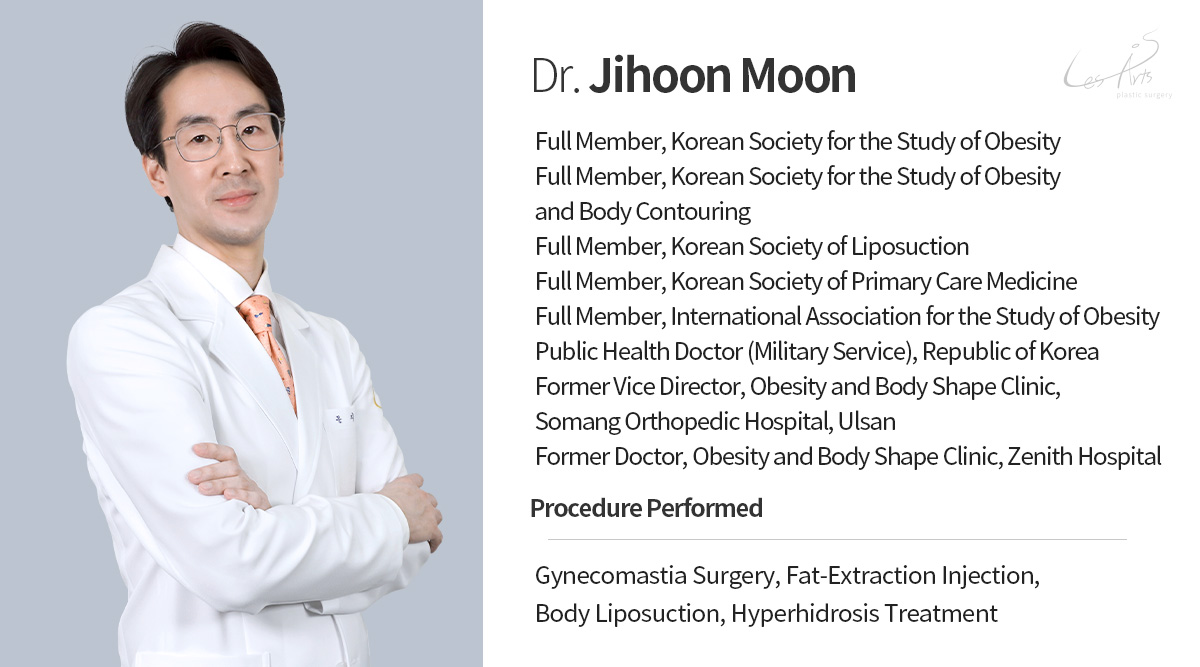
Hello, I am Dr. Jihoon Moon, Board-Certified Plastic Surgeon at Lesarts Plastic Surgery.
When patients visit our clinic seeking treatment for hyperhidrosis (excessive sweating),
there is a common question they ask most frequently.

[Hyperhidrosis Surgery - Dr. Jihoon Moon, Lesarts Plastic Surgery]
“If I undergo surgery, can sweat production be stopped entirely?”
“Can my underarms remain completely dry even in the middle of summer?”
The definitive clinical answer to this question is clear:
“Completely eradicating 100% of all sweat glands is anatomically unfeasible.”
However, there is an equally critical clinical fact that you should know.
[Hyperhidrosis Surgical Techniques - Lesarts Plastic Surgery]
Contemporary surgical treatments do not aim for unnatural total sweat cessation, but rather
aim to suppress perspiration to a level where it no longer causes discomfort in daily activities.
In clinical practice, surgical intervention successfully decreases sweat volume remarkably close to this ideal goal.
The Starting Point of Surgery: Where Are Sweat Glands Located?

[Axillary Sweat Treatment - Lesarts Plastic Surgery]
The first necessity in axillary hyperhidrosis surgery is understanding the micro-anatomical architecture.
Sweat glands (both eccrine and apocrine glands) concentrate along the junctional boundary plane where the deep reticular dermis meets the superficial subcutaneous fat layer.
This micro-thin junction is precisely the target layer intensively addressed during hyperhidrosis surgery.
[Underarm Sweating Surgical Methods - Lesarts Plastic Surgery]
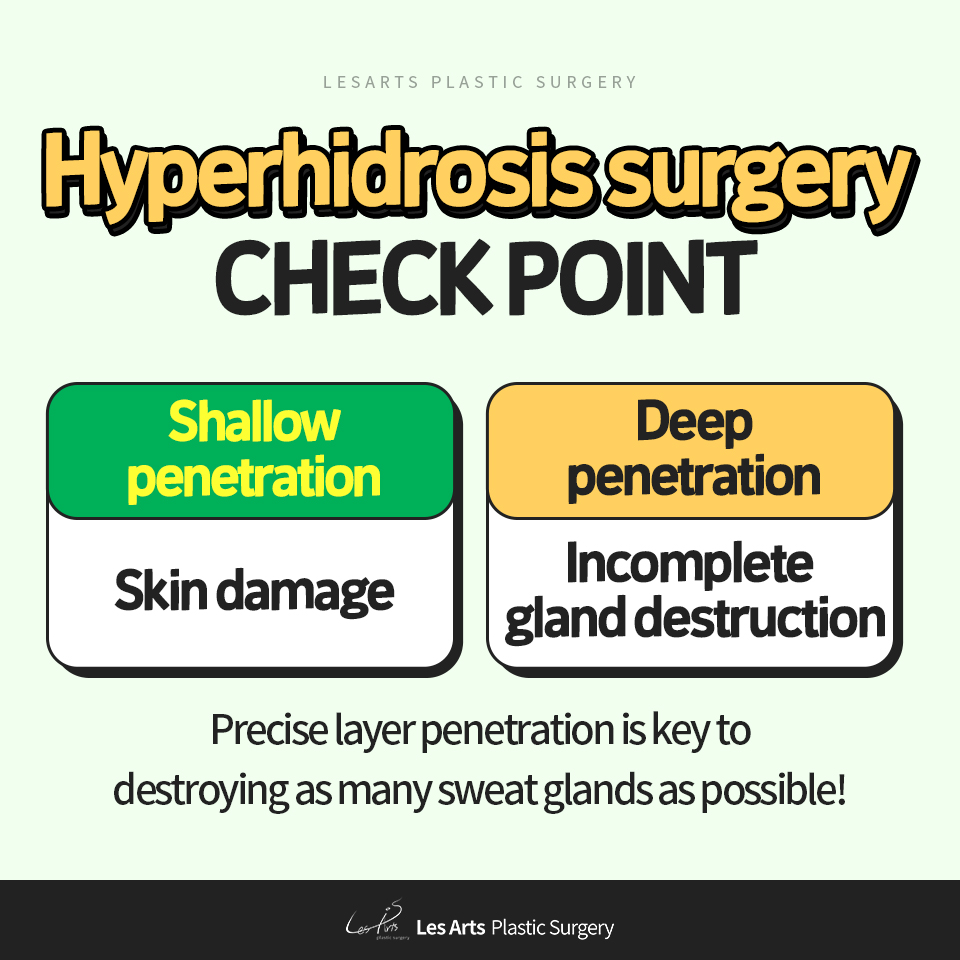
Operating too superficially risks dermal thermal injury or skin necrosis,
whereas dissecting too deeply fails to adequately eliminate the targeted glands.
Therefore, the surgical objective is unambiguous:
“Precisely navigating the narrow anatomical plane where sweat glands cluster to destroy as many glands as safely possible!”
[Clinical Efficacy of Hyperhidrosis Surgery - Dr. Jihoon Moon, Lesarts Plastic Surgery]
1. Minimal Incision Approach - Accurate Access Through Tiny Openings
Current hyperhidrosis procedures are executed through tiny incisions measuring just a few millimeters.
Through these micro-incisions, subcutaneous undermining, targeted energy delivery, and liposuction aspiration are sequentially performed.
While appearing relatively straightforward from the outside,
it is a delicate surgical technique requiring uniform treatment across the target layer while protecting cutaneous integrity.
A minimal incision does not merely signify reduced scar visibility.
For the operating surgeon, it demands maintaining uncompromising tactile precision within a restricted working space and limited direct visualization.
[Underarm Sweating Surgical Outcomes - Lesarts Plastic Surgery]
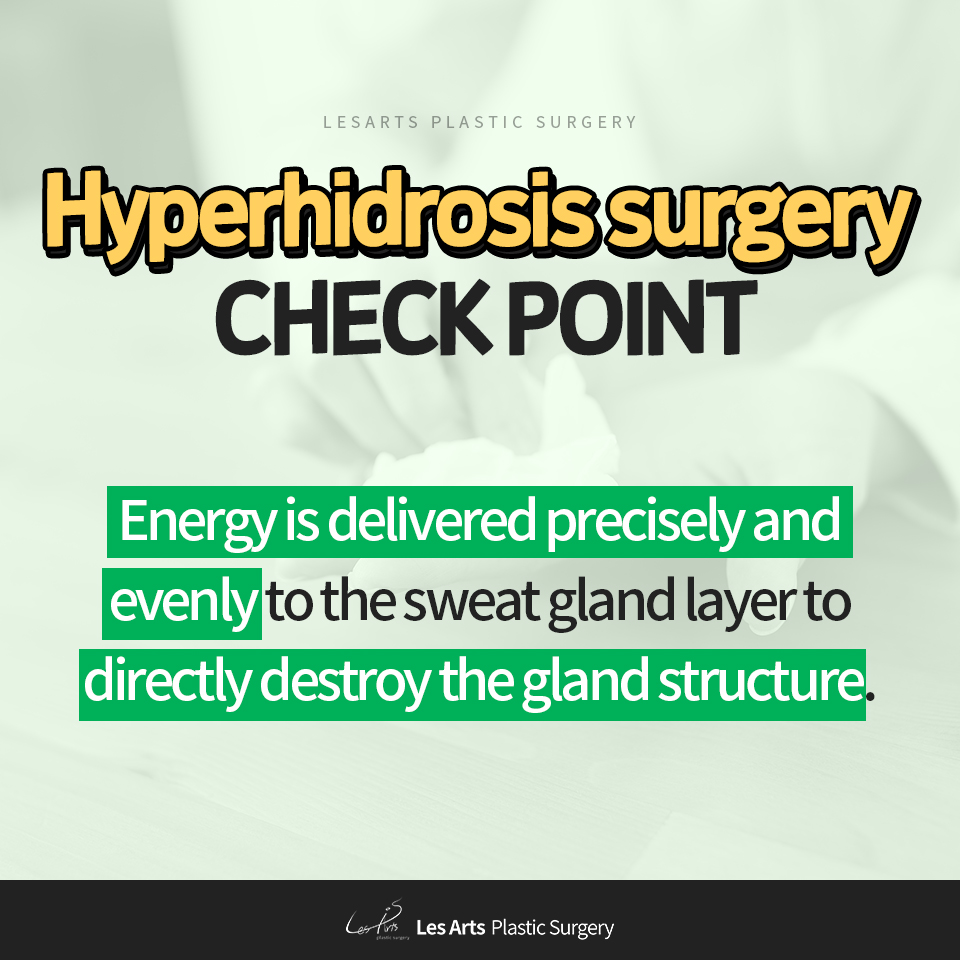
2. Energy-Based Sweat Gland Destruction - Delivering Energy Accurately to the Target Plane
Using specialized energy-assisted devices,
ultrasound, thermal, or laser energy is transmitted directly into the glandular plane to disrupt and ablate sweat gland architecture.
The vital technical factor here is not simply increasing energy output,
but dispersing the energy uniformly across the exact anatomical depth.
Deviating from the target depth diminishes therapeutic efficacy,
while excessive focal energy accumulation risks thermal injury to the overlying skin.
[Axillary Hyperhidrosis Treatment Protocol - Dr. Jihoon Moon, Lesarts Plastic Surgery]
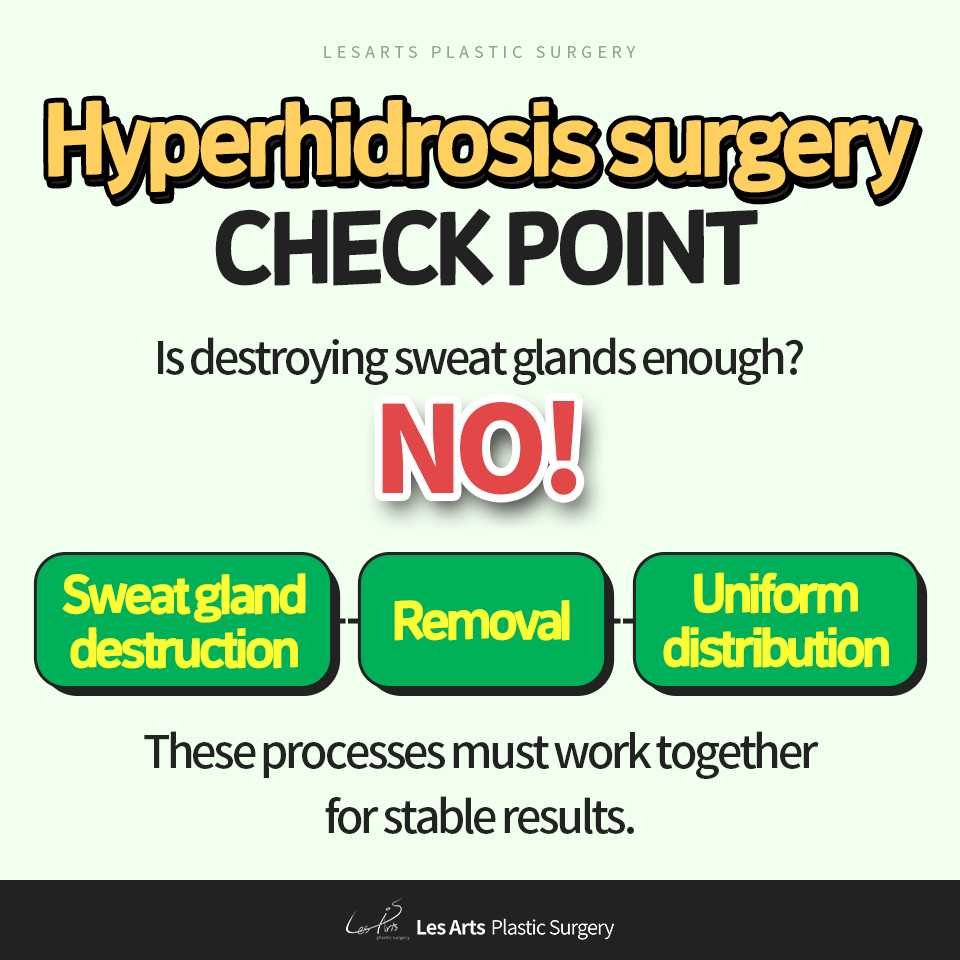
3. Liposuction - The Essential Finishing Stage Following Gland Destruction
Concurrently performing surgical aspiration following thermal ablation is essential;
concluding the procedure immediately after energy application is insufficient.
Liposuction here does not merely serve to debulk fatty tissue.
It physically suctions out ablated sweat gland debris and morcellated tissue,
leveling the subdermal plane to prevent irregular subcutaneous scarring.
In other words, the synchronized sequence of Destruction → Extraction → Homogenization
must be executed harmoniously to maximize surgical safety, efficacy, and clinical reproducibility.
A Quick Note!!
“Why do some individuals experience recurrent sweating after surgery?”
In most instances, this is related to incomplete sweat gland resection during the primary surgery.
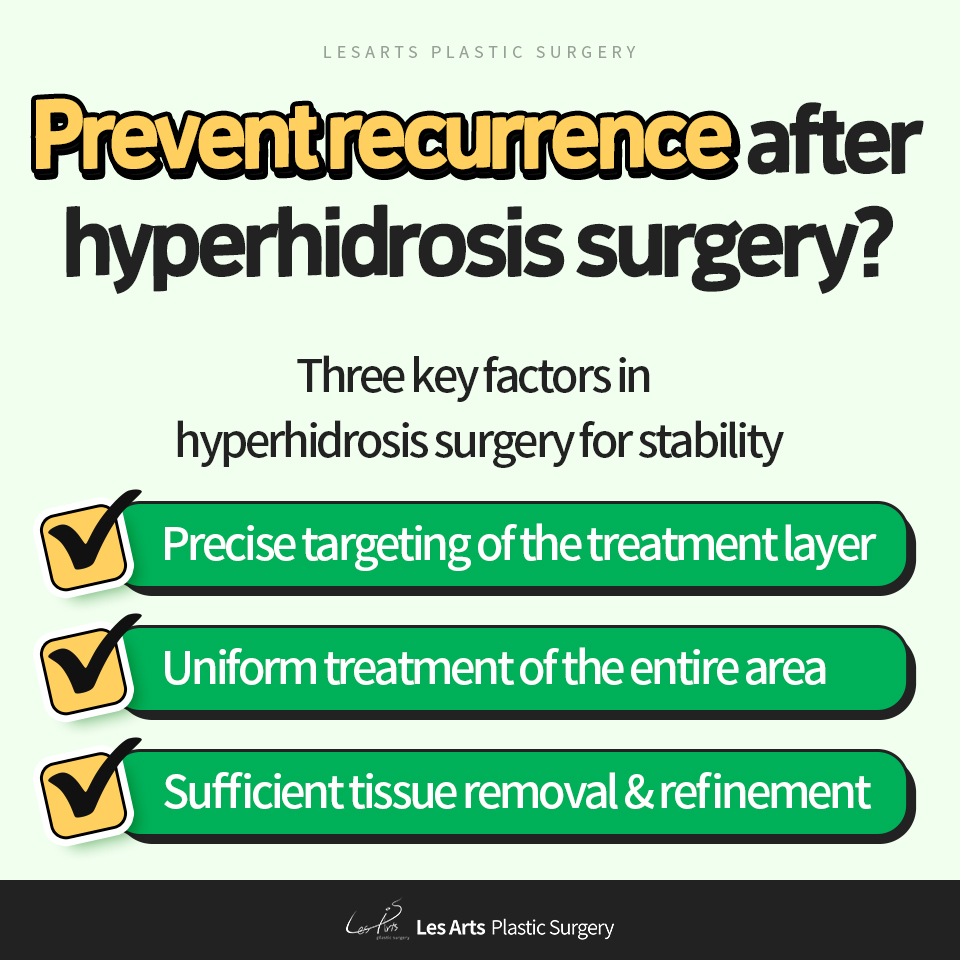
The core parameters dictating long-term hyperhidrosis surgery outcomes can be categorized into three pillars:
[Axillary Hyperhidrosis Recurrence Factors - Lesarts Plastic Surgery]
First: Navigating precisely into the correct anatomical target plane
Second: Treating the entire axillary footprint evenly without skipped margins
Third: Thoroughly aspirating destroyed glands and surrounding compromised tissue
If any of these three stages is inadequately performed,
residual sweat glands may cause the perception of post-operative recurrence.
Therefore, in hyperhidrosis surgery, it is vital to choose a board-certified surgical team with extensive experience
capable of executing every step of this delicate protocol with mastery.
FAQ
Q1. Does underarm hyperhidrosis surgery stop sweating 100% permanently?
Completely eradicating 100% of all sweat glands is anatomically unfeasible.
The surgical goal is to suppress perspiration to a level
where it no longer causes functional or social discomfort in daily life.
Q2. What is the working mechanism of axillary hyperhidrosis surgery?
The surgeon precisely accesses the junctional plane between the lower reticular dermis and upper subcutaneous fat,
delivers specialized energy to ablate the clustered sweat glands,
and utilizes cannula aspiration to physically evacuate the morcellated tissue.
Q3. Why is liposuction necessary in hyperhidrosis surgery?
It is not performed merely for localized fat reduction.
It physically evacuates destroyed sweat glands and ablated tissue,
smoothing the subdermal plane to ensure even tissue adherence and healing.
Q4. Can excessive underarm sweating recur after surgery?
If sweat glands are insufficiently ablated during the initial procedure
or if peripheral margins of the axillary vault are left untreated,
residual active glands can cause the sensation of persistent or recurrent sweating.
Q5. What are the key factors determining successful hyperhidrosis surgical outcomes?
Accurate target plane dissection, uniform treatment across the entire axillary perimeter,
and thorough evacuation of destroyed glandular tissue are paramount.
Executing these three stages with delicate surgical precision defines the definitive outcome.
Dr. Jihoon Moon


Cases finding
similar to my profile
Customer Diagnostics


Select the surgery and
area you are interestedto see real
before andafter changes.


we
make you,
the art
Clinic hours
MON - FRI
10 am – 7pm
SAT
10 am – 4pm
Holiday
SUN, HOLIDAY
Location
Lesarts Moon Clinic Tower 4-5F, 40, Nonhyeon-ro 168-gil,
Gangnam-gu, Seoul, Republic of Korea

Medical institution name Lesarts Plastic Surgery
Address Lesarts Moon Clinic Tower 4-5F, 40, Nonhyeon-ro 168-gil, Gangnam-gu, Seoul, Republic of Korea
Representative Moon sung jun
