




Online Consultation
Please accurately enter the information below.
Quick Cost Consultation
Quick Consultation & Reservation
Cases finding
similar to my profile






Doctor's Note
Medical columns by our surgeons
Thigh Liposuction | Sculpting 'Straight Leg Lines' for Tall Frames: Preventing Buttock Sagging and Seamless Contour Transitions
2026-08-11
Thigh Liposuction | Sculpting 'Straight Leg Lines' for Tall Frames: Preventing Buttock Sagging and Seamless Contour Transitions
Q. I am tall with a normal body weight, yet I am concerned about my thigh contours. Can liposuction create a smooth, 'straight leg line'?
A. Yes, through meticulous liposuction based on anatomical structures, you can achieve both a sleek straight leg line and an optical relative hip-up effect.
Rather than simply extracting high volumes of fat, the key lies in seamless design transitions connecting the outer saddlebags, inner thighs, and knee contours.
In particular, strategically preserving a minimal fat layer beneath the buttock (banana roll) prevents gluteal sagging and double-fold deformities,
while smoothly blending the saddlebags into the outer hip line makes the legs look visibly longer and creates a lifted buttock contour.
[Learn More About Lesarts Thigh Liposuction]
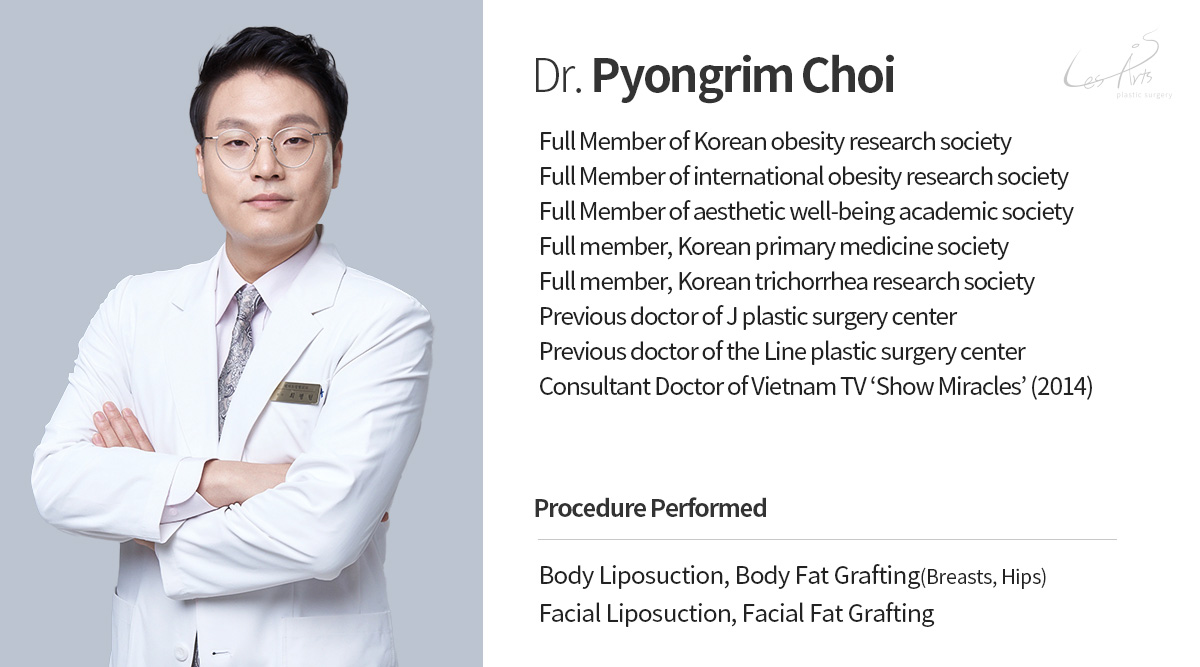
Hello, I am Dr. Pyongrim Choi, Board-Certified Plastic Surgeon at Lesarts Plastic Surgery.
Compared to the past, the proportion of tall women has steadily increased.
Accordingly, an increasing number of patients with normal body mass relative to their height
visit our clinic specifically due to thigh contouring and lower-body proportion concerns.
Among them, many share that protruding outer saddlebag fat and inner thigh bulges
prevent their legs from appearing straight, making their frame look disproportionately shorter than their actual height.
Today, we will review the case of a tall female patient in her late 20s who reshaped her thigh contours
into slender, straight leg lines via thigh liposuction, and examine how attention to anatomical details leads to superior aesthetic outcomes.

1. Anatomical Custom Sculpting for 'Straight Thigh Lines'
Simply extracting 'large' volumes of subcutaneous fat does not create an aesthetically pleasing straight leg line.
The surgeon must thoroughly understand the underlying muscle architecture and skeletal framework,
refining the overlying adipose layers into a uniform, seamless transition.
1) Key Design for the Lateral Saddlebag Line
Deep subcutaneous fat in the outer saddlebags must be targeted and suctioned to eliminate rounded bulkiness.
However, aggressive over-suctioning can unmask harsh bone boundaries, resulting in an unnatural, emaciated appearance;
thus, a soft transition from the pelvic curve down to the knee must be preserved.
2) Delicate Refinement of the Medial Line
Suctioning must be performed uniformly from the prominent upper inner thigh down to the suprapatellar knee region.
Because the medial thigh carries higher risks of skin laxity, sagging, and surface dimpling if over-resected,
tactile finesse backed by precise anatomical understanding is indispensable.
3) Balancing Overall Body Proportions
In frames where the upper thigh circumference is broad while tapering sharply toward the bottom, upper fat must be sufficiently reduced,
while the lower portion is contoured using gradation techniques to maintain smooth continuity.
This ensures visual movement flows vertically, producing a sleek, elongated straight leg silhouette.
2. 'Refining Details' Is What Perfects Thigh Liposuction
Even when circumferential measurements decrease and a 'straight line' is achieved,
perfecting micro-details is what elevates surgical results to true excellence.
1) The Medical Rationale for Preserving Minimal Infragluteal Fat (Banana Roll)
“Serving as a Supportive Anchor to Prevent Gluteal Sagging and Double-Crease Deformities”
Gluteal soft tissue is strongly influenced by gravity.
Aggressively suctioning fat directly beneath the infragluteal crease removes
the supportive 'scaffolding' that holds the buttock, predisposing it to post-op ptosis (sagging).
When this foundational support is compromised, a secondary folding crease can form beneath the original fold,
resulting in an unappealing 'double crease' deformity.
Therefore, preserving an optimal layer of fat to firmly support the gluteal fold is a critical surgical detail.
2) Why Saddlebags and the Lateral Hip Line Must Connect Seamlessly
“Visual Relative Hip-Up Effect Created by Continuous Contours”
Rather than merely isolating and suctioning outer saddlebag fat,
the surgeon must softly feather the transition into the lateral gluteal line.
This eliminates stepped indentations between the buttocks and thighs,
visually shifting the starting point of the buttocks upward
to make legs look longer and the buttocks appear lifted—producing a 'relative hip-up' effect.
3) Maximizing Continuity via Peripatellar (Chanel Line) Contouring
If the medial thigh is suctioned without extending into the peripatellar knee zone,
a localized bulge remains over the knee, causing a 'disconnected line deformity'.
To achieve a seamless straight line, forming a gentle, smooth slope from the mid-thigh down to the knee line
is essential.
Let us examine these principles through a clinical case study.
[Patient Profile & Body Specifications]
Profile: Female in her late 20s / 172 cm / 63.8 kg / BMI 21.6 kg/m² (Normal Range)
Goals: Desired sleek, straight, and slender thigh contours with an elongated aesthetic
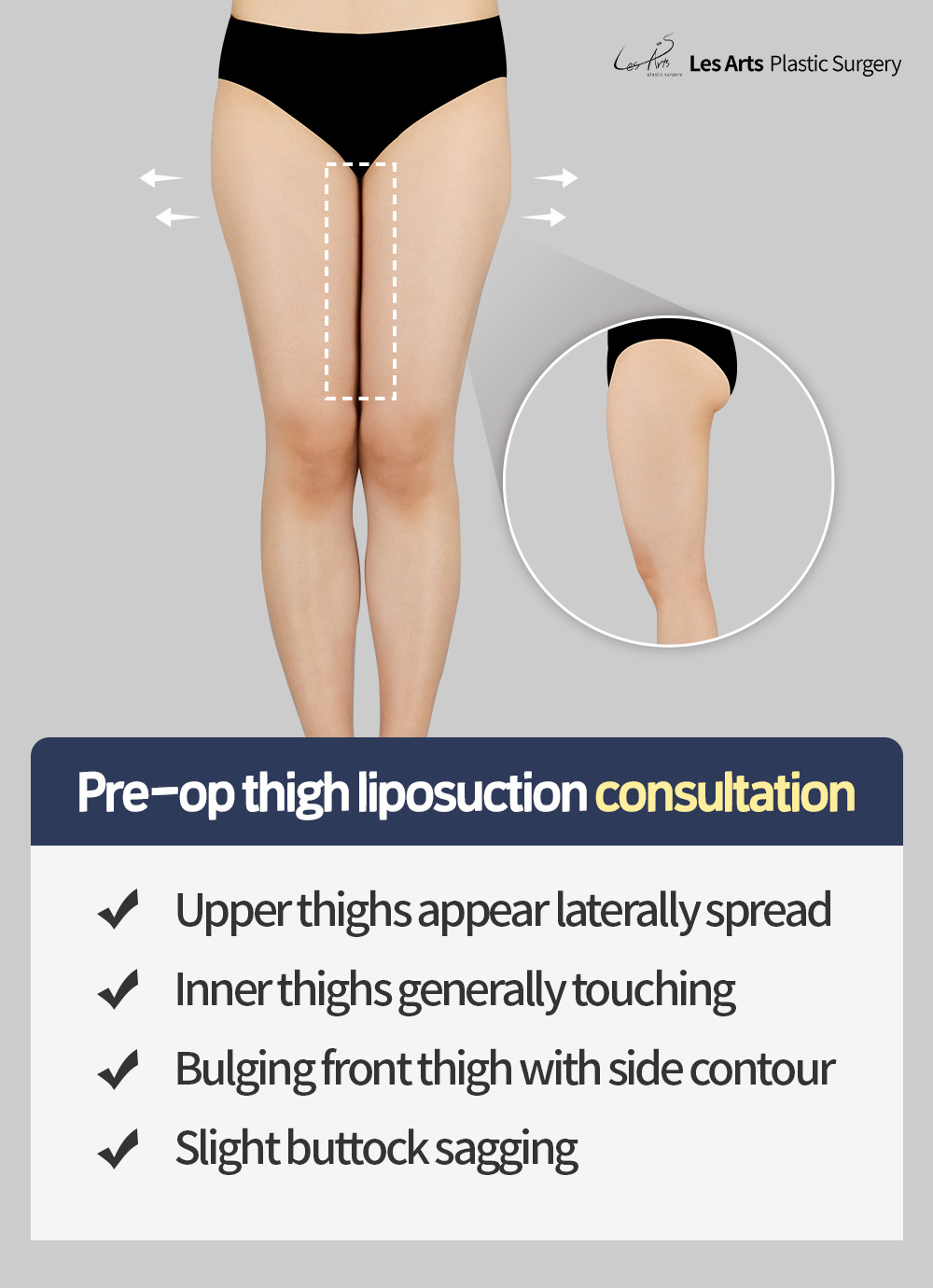
[Pre-Operative Body Contour Diagnosis]
Upper thighs appeared wide and flared outward relative to the lower thighs
Medial thighs rubbed closely together with localized fat concentrated superiorly
In lateral view, quadriceps muscle volume and overlying fat combined to create an anterior bulge
The gluteal fold showed mild downward descent with poor continuity toward the saddlebags
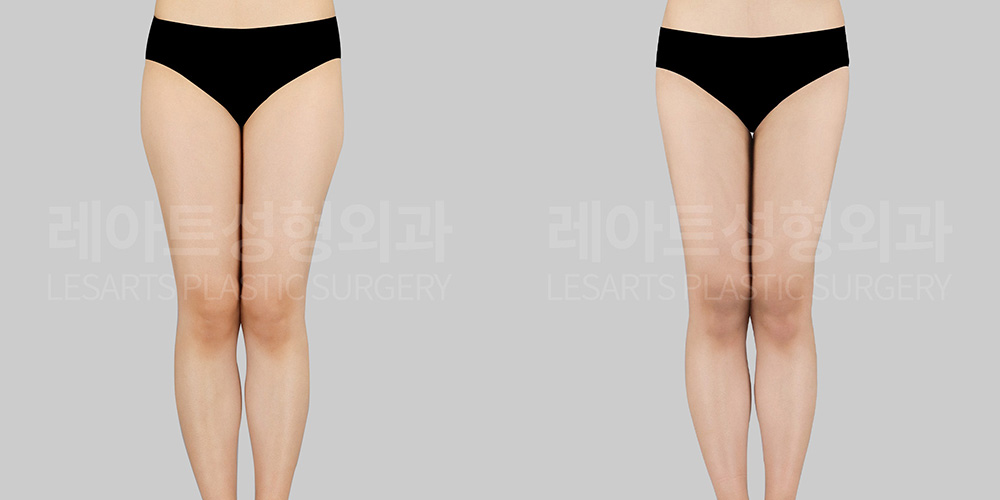
[Post-Operative Progress & Contour Transformation]
Frontal View: Refined into a slender, straight leg silhouette
The medial line was trimmed primarily along the upper third,
establishing a smooth, natural vertical drop toward the knees
Medial peripatellar fat was contoured to emphasize harmonious continuity into the calves
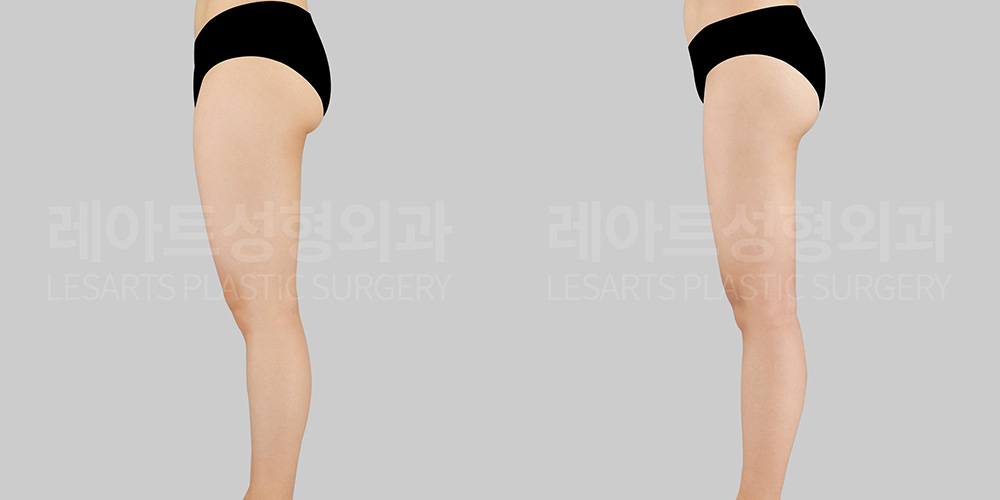
Lateral View: Precision debulking of fat over the rectus femoris reduced anterior projection,
yielding a soft, gentle curve without harsh muscular exposure

Posterolateral View: Infragluteal fat and lateral saddlebags blend smoothly
The visual origin of the buttocks shifted upward,
achieving a definitive 'relative hip-up' effect without requiring fat grafting
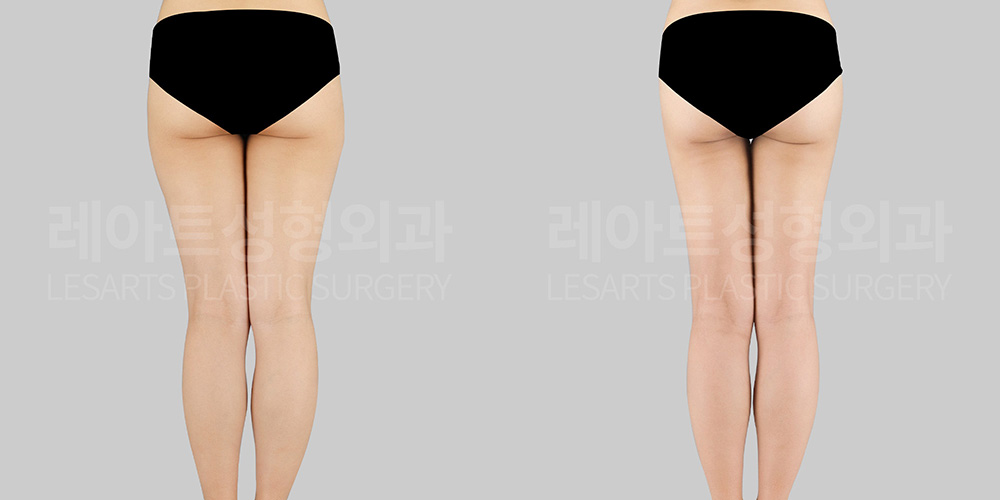
Posterior View: Eliminating saddlebags elevated the lateral inflection point,
making the legs appear visibly longer and more proportionate
Medial and lateral boundaries transition seamlessly into the knee and calf without step-offs
Without deepening or elongating the infragluteal fold,
adequate preservation of central infragluteal fat minimized sagging, completing a refined outcome
There is a well-known proverb: "See the forest, not just the trees."
In aesthetic body contouring, however, individual trees are just as critical as the overarching forest.
While many patients desire dramatic changes into a 'straight leg line' through thigh liposuction,
forcing a uniform, rigid shape without regard for individual anatomy is never the right approach.
The true goal is discovering the most natural, elongated, and sleek leg contour by comprehensively evaluating
muscular framework, skeletal alignment, and skin elasticity.
When a board-certified plastic surgeon meticulously accounts for subtle anatomical nuances,
post-operative patient satisfaction is exceptionally high.
If you are concerned about uneven thigh lines or lower-body proportions,
we recommend consulting with a specialist for a 1:1 body analysis to discover your optimal straight leg contour.
Thigh Liposuction FAQ
Q1. What must be considered when suctioning the outer saddlebags and inner thighs?
A. Avoiding aggressive over-suctioning and feathering the fat evenly according to anatomical structures is critical.
For the outer saddlebags, preserving a gentle curve from the pelvis to the knee prevents skeletonized bone exposure.
For the inner thighs, over-extraction risks skin sagging or contour irregularities; thus, creating a smooth slope down to the suprapatellar knee region is essential.
Q2. How can buttock sagging and double-crease deformities be prevented post-surgery?
A. By preserving a minimal layer of infragluteal fat (banana roll) to maintain supportive scaffolding.
Over-resecting fat directly beneath the buttock removes structural support, predisposing to ptosis
or a secondary fold below the gluteal crease. Preserving appropriate fat volume here is the key detail to preventing sagging.
Q3. Is a 'relative hip-up' effect achievable without fat grafting?
A. Yes, by seamlessly blending the outer saddlebags into the lateral hip line.
Eliminating stepped indentations between the thigh and gluteal margin
visually elevates the starting point of the buttocks, making the legs look longer and the buttocks lifted.
Q4. Why should peripatellar fat (around the knee) be suctioned alongside the thighs?
A. To prevent contour step-offs and ensure natural continuity between the thigh and calf.
Suctioning the thighs while neglecting the knees leaves a localized bulge, disrupting the line.
Forming a gentle gradient from the mid-thigh across the knee produces a cohesive, elongated straight leg silhouette.
Q5. For tall or specific body types, is aggressive fat extraction always the right answer?
A. No, balancing overall proportions tailored to individual muscle frame, bone structure, and skin elasticity comes first.
Rather than forcing a rigid straight line, suctioning must incorporate natural gradation between upper and lower thigh segments.
A comprehensive analysis of unique anatomical variables is what yields enduring, highly satisfying results.
Dr. Pyongrim Choi


Cases finding
similar to my profile
Customer Diagnostics


Select the surgery and
area you are interestedto see real
before andafter changes.


we
make you,
the art
Clinic hours
MON - FRI
10 am – 7pm
SAT
10 am – 4pm
Holiday
SUN, HOLIDAY
Location
Lesarts Moon Clinic Tower 4-5F, 40, Nonhyeon-ro 168-gil,
Gangnam-gu, Seoul, Republic of Korea

Medical institution name Lesarts Plastic Surgery
Address Lesarts Moon Clinic Tower 4-5F, 40, Nonhyeon-ro 168-gil, Gangnam-gu, Seoul, Republic of Korea
Representative Moon sung jun
