




Online Consultation
Please accurately enter the information below.
Quick Cost Consultation
Quick Consultation & Reservation
Cases finding
similar to my profile






Doctor's Note
Medical columns by our surgeons
“My chest? It started back in school…” The Roots of Gynecomastia in Men in Their 20s and 30s: The Link Between Pubertal Changes and Gynecomastia
2026-08-27
“My chest? It started back in school…” The Roots of Gynecomastia in Men in Their 20s and 30s: The Link Between Pubertal Changes and Gynecomastia [Doctor's Note by Dr. Jihoon Moon]
Why can gynecomastia that develops during puberty persist into adulthood without resolving naturally?
When glandular tissue proliferating from pubertal hormonal shifts undergoes fibrosis,
it can remain even after hormone levels normalize in adulthood.
In particular, adolescent overweight can influence the proliferation and persistence of glandular tissue.
[Lesarts Gynecomastia Surgery Guide]
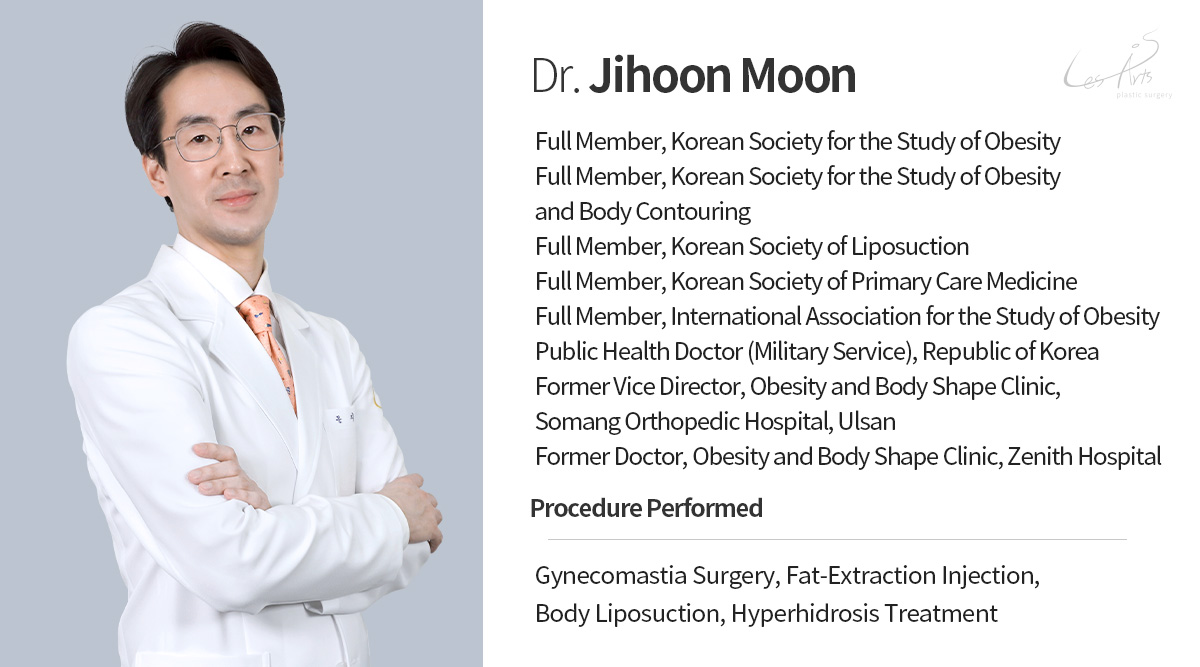
Hello, I am Dr. Jihoon Moon of Lesarts Plastic Surgery.
Whenever I consult with young men in their 20s or early 30s regarding gynecomastia, there is one question I always ask first:
“When did you first notice changes in your chest?”
Most patients reflect back on their memories and share a very similar story:
“I think it started back in middle or high school (sometimes even late elementary school). When I was younger, I thought it was just weight gain,
but even after losing a significant amount of weight in the military, weight came off everywhere else while my chest shape remained unchanged.”
In fact, among patients who visit the clinic for gynecomastia in adulthood, it is common for the condition to have originated during puberty.
At the time, many assumed it was simply due to weight gain or considered it a minor, temporary aesthetic concern during school years.
Why, then, do these pubertal chest changes fail to resolve naturally and persist into adulthood?
In this article, we will examine in detail the hormonal changes during puberty,
as well as how adolescent overweight can influence the development and persistence of gynecomastia.

[Causes of Pubertal Gynecomastia - Dr. Jihoon Moon, Lesarts Plastic Surgery]
1. Pubertal Physiological Gynecomastia: Hormonal Changes and Glandular Development
Puberty is a period when the onset of secondary sexual characteristics significantly shifts the male hormonal environment.
During this stage, masculine physical characteristics develop alongside a rapid increase in testosterone secretion.
However, androgens are not the only hormones that rise during puberty.
The female hormone estradiol can also temporarily elevate in the male body.
In most individuals, a natural balance between both hormones is established throughout growth;
however, during early to mid-puberty (ages 12–15) when testicular and adrenal maturation is underway, variations in secretion rates can occur.
When the relative influence of estrogen becomes temporarily pronounced, glandular tissue within the male breast can be stimulated and proliferate.
Such developmental chest changes are referred to as ‘physiological gynecomastia.’
With approximately 50% to 70% of adolescent boys experiencing physiological gynecomastia at least once—such as palpable breast buds or tenderness to friction—
it represents a relatively common physiological event during puberty.

[Causes of Persistent Pubertal Gynecomastia - Dr. Jihoon Moon, Lesarts]
2. Why Temporary Gynecomastia Persists into Adulthood: Glandular Fibrosis
Under typical growth patterns, testosterone dominance progressively establishes itself as one reaches late puberty (around ages 17–18).
Consequently, glandular tissue that temporarily developed under estrogen stimulation often undergoes spontaneous regression.
In some individuals, however, the proliferated glandular tissue does not sufficiently regress and remains into adulthood even after endocrine stabilization.
A primary pathophysiological factor behind this is ‘glandular fibrosis.’
When glandular tissue is stimulated over an extended period during puberty or exhibits heightened tissue sensitivity to hormones,
connective tissue elements such as collagen can progressively accumulate around the gland.
As long-standing glandular tissue undergoes fibrosis and becomes firmer, the likelihood of spontaneous regression diminishes.
Therefore, even after adult hormone profiles stabilize within standard ranges, the chronologically established glandular structure can remain permanently.
[Adolescent Overweight and Gynecomastia - Dr. Jihoon Moon, Lesarts]
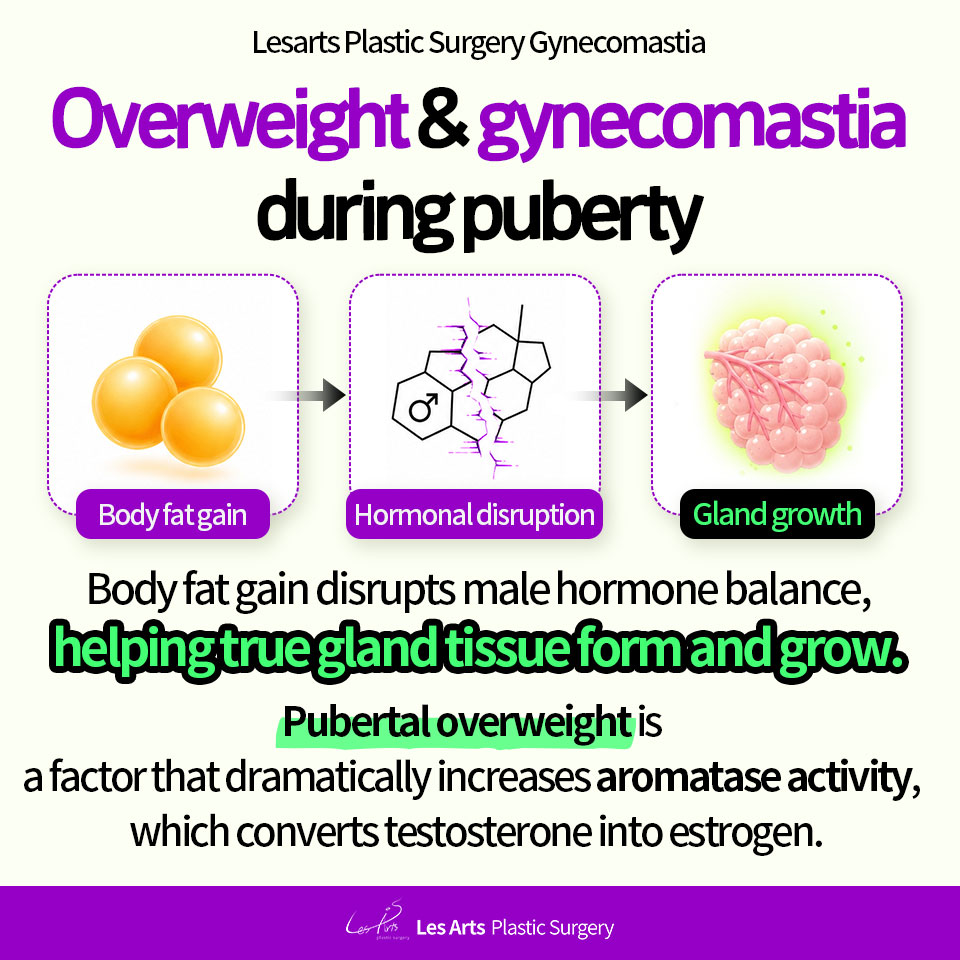
3. The Cycle of Adolescent Overweight and Gynecomastia: The Role of Aromatase
With recent increases in pediatric and adolescent obesity, instances where pubertal overweight contributes to adult gynecomastia are also rising.
This cannot be explained merely as an aesthetic issue of excess adipose accumulation in the chest from generalized weight gain.
Increased adiposity directly affects the male endocrine profile,
serving as a factor that promotes the true development and proliferation of glandular tissue.
A central catalyst in this pathway is the enzyme aromatase.
Aromatase converts androgens into estrogens.
When an adolescent is overweight or obese, total body fat mass increases,
which can upregulate aromatase activity within adipose tissue.
Consequently, a greater fraction of circulating androgens is converted into estrogens, altering systemic hormone balance.
In turn, the breast glandular tissue receives a compound stimulus: physiological pubertal hormonal fluctuations compounded by estrogen derived from adipose aromatase activity.
In essence, the gland is exposed to a dual stimulus: ‘Pubertal hormonal changes + Estrogen converted from body fat.’
Under these conditions, glandular tissue may proliferate more rapidly or involve a broader area compared to adolescents of standard weight.
Furthermore, dense adipocyte accumulation in the pectoral region also exerts a local effect.
Sustained adipose tissue around the chest creates a distinct microenvironment,
which can impede the natural post-pubertal regression of glandular tissue.
As a result, adolescent obesity can stimulate glandular growth while simultaneously
inhibiting its natural spontaneous involution, perpetuating a persistent cycle of gynecomastia.

[Gynecomastia and Diet - Dr. Jihoon Moon, Lesarts Plastic Surgery]
4. Why Chest Contour Remains Despite Significant Weight Loss
When men seek to address gynecomastia in adulthood, the first modalities attempted are typically weight loss and chest workouts.
Many implement rigorous dietary discipline, perform extended aerobic exercise,
or undergo significant weight reduction during military service due to structured physical routines.
Indeed, overall weight reduction decreases systemic adiposity, which can reduce chest adipose deposits and diminish overall volume to some extent.
Yet, many find that despite achieving a lean physique, localized projection persists directly behind the nipple-areolar complex,
leaving a feminine, rounded, or drooping silhouette that remains unresolved.
This distinction represents a primary clinical feature differentiating ‘pseudogynecomastia’ (caused primarily by fat) from ‘true gynecomastia’ (driven by glandular hyperplasia).
Dietary caloric restriction can reduce the size of surrounding adipocytes.
However, dense, fibrotic glandular tissue formed under the influence of adolescent endocrine shifts and excess weight differs biologically from standard adipose stores;
it does not simply metabolize or burn off through diet and exercise.
In fact, for men who exercise regularly, hypertrophy of the pectoralis major can push the overlying glandular tissue outward.
As a consequence, while the overall frame becomes more athletic and leaner, the focal projection around the nipple and areola can paradoxically appear more conspicuous.
[Lesarts Plastic Surgery Gynecomastia Surgery - Dr. Jihoon Moon]
5. Conclusion: Addressing Long-Standing Pubertal Gynecomastia Concerns
Gynecomastia that originates during puberty can impose a considerable psychological burden on adolescent boys during a critical phase of physical development and identity formation.
Although many expected the condition to resolve with time,
its persistence into adulthood can lead to ongoing self-consciousness in social settings and an instinctive habit of rounding the shoulders forward.
Particularly when gynecomastia in men in their 20s and 30s originated from pubertal endocrine shifts or adolescent overweight,
it cannot be attributed simply to a lack of willpower or inadequate physical discipline.
If this concern has persisted over the long term, rather than repeating self-directed weight loss in isolation,
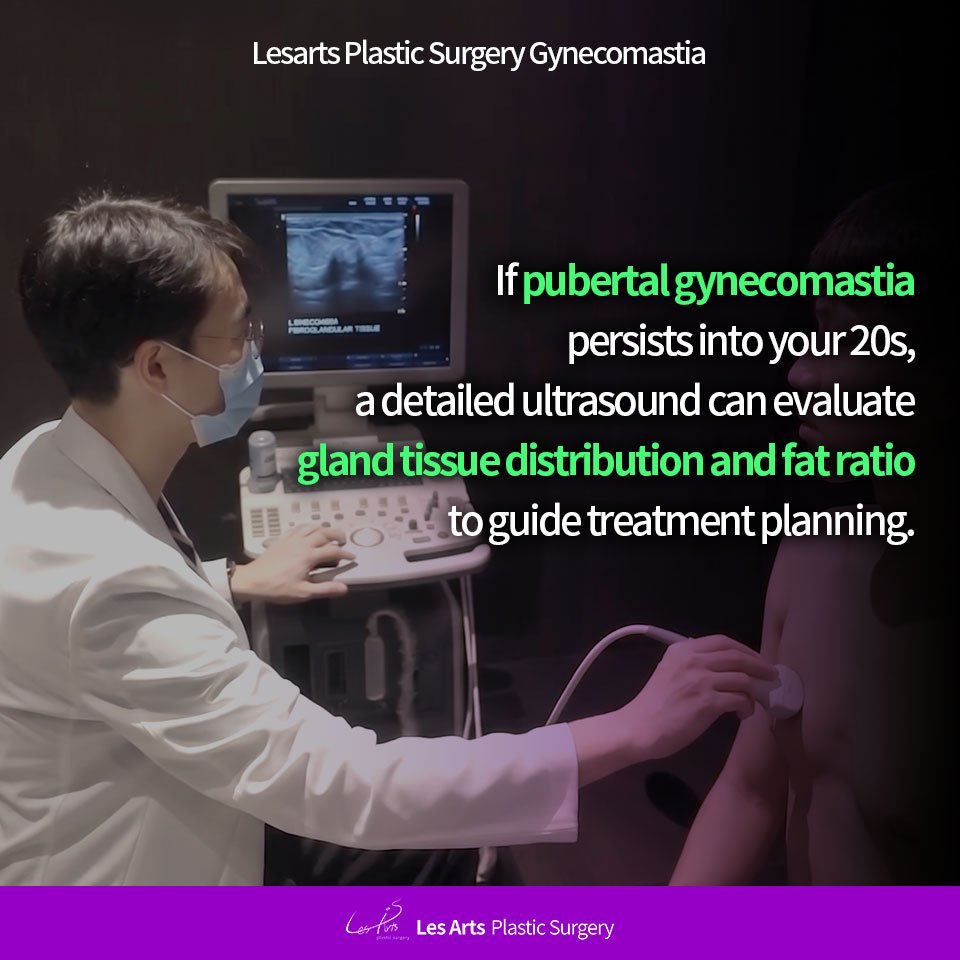
it is advisable to undergo high-resolution ultrasonography to objectively assess the extent of glandular proliferation
alongside the proportion and structural distribution of surrounding adipose tissue.
Accurately establishing the anatomical state of the chest is an essential first step
in differentiating the underlying cause and determining an appropriate clinical approach.
[Explore More Clinical Cases of Lesarts Gynecomastia Surgery]
FAQ
Q1. What causes gynecomastia to develop during puberty?
During puberty, temporary shifts in the balance between androgens and estrogens can occur,
leading to glandular tissue proliferation under estrogen stimulation
and resulting in physiological gynecomastia.
Q2. Does pubertal gynecomastia resolve spontaneously in adulthood?
In many cases, glandular tissue regresses naturally as maturity progresses.
However, when the glandular component undergoes fibrous consolidation,
gynecomastia can persist permanently into adulthood.
Q3. Can adolescent overweight or obesity influence gynecomastia?
Elevated body fat increases the activity of aromatase,
an enzyme that converts androgens to estrogens,
which can stimulate and prolong glandular tissue proliferation.
Q4. Can diet or pectoral exercise eliminate gynecomastia?
While weight reduction can diminish surrounding adipose volume,
proliferated and fibrotic glandular tissue
does not resolve through exercise or caloric deficit alone.
Q5. How can persistent adult gynecomastia be evaluated?
High-resolution ultrasound imaging allows objective assessment of
glandular distribution and adipose tissue proportions,
enabling an accurate diagnosis of the underlying anatomical presentation.
Dr. Jihoon Moon


Cases finding
similar to my profile
Customer Diagnostics


Select the surgery and
area you are interestedto see real
before andafter changes.


we
make you,
the art
Clinic hours
MON - FRI
10 am – 7pm
SAT
10 am – 4pm
Holiday
SUN, HOLIDAY
Location
Lesarts Moon Clinic Tower 4-5F, 40, Nonhyeon-ro 168-gil,
Gangnam-gu, Seoul, Republic of Korea

Medical institution name Lesarts Plastic Surgery
Address Lesarts Moon Clinic Tower 4-5F, 40, Nonhyeon-ro 168-gil, Gangnam-gu, Seoul, Republic of Korea
Representative Moon sung jun
