




Online Consultation
Please accurately enter the information below.
Quick Cost Consultation
Quick Consultation & Reservation
Cases finding
similar to my profile






Doctor's Note
Medical columns by our surgeons
Abdominoplasty | Sagging Lower Abdomen After C-Section: Why It Is Combined with Liposuction
2026-08-31
Abdominoplasty | Sagging Lower Abdomen After C-Section: Why It Is Combined with Liposuction [Doctor's Note by Dr. Pyongrim Choi]
If you have both sagging abdominal skin and excess thickness, is abdominoplasty alone sufficient?
Abdominoplasty serves to tighten and excise redundant, sagging skin,
while abdominal liposuction reduces remaining fat deposits across the upper abdomen and flanks
to refine overall thickness and body contours.
Particularly when skin laxity and localized fat coexist following childbirth,
it is essential to delineate the role of each procedure in a coordinated surgical plan.
▶ View Lesarts Abdominoplasty Clinical Cases
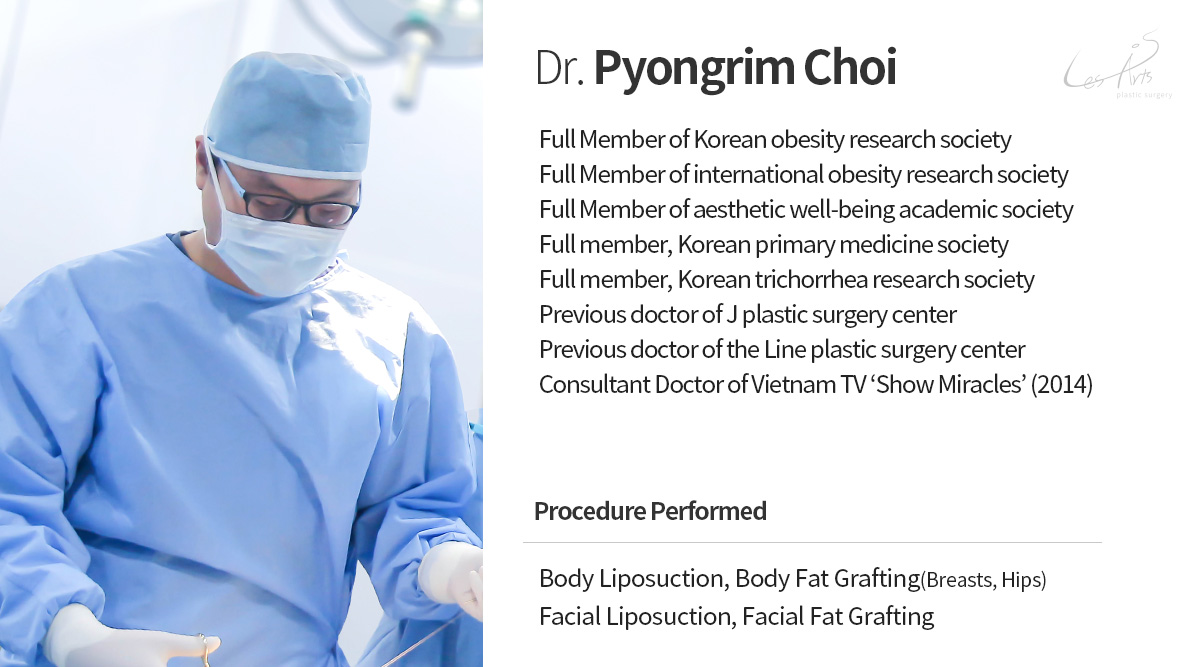
Hello, I am Dr. Pyongrim Choi of Lesarts Plastic Surgery.
Even after body weight returns close to pre-pregnancy levels post-childbirth,
many women notice that their lower abdomen protrudes forward,
or that redundant skin alters the way clothes fit
compared to before pregnancy.

[Contour Changes After Abdominoplasty and Abdominal Liposuction - Dr. Pyongrim Choi, Lesarts]
Particularly among those who have delivered via Cesarean section,
the issue often involves more than just residual adipose tissue;
cutaneous laxity, overall abdominal wall thickness, and adhesions around existing surgical scars
frequently interact to affect the contour.
In these circumstances, patients frequently ask whether liposuction alone will suffice,
or whether abdominoplasty alone is enough
to resolve their concerns.
Because both procedures address distinctly different anatomical factors,
rather than choosing one arbitrarily,
it is vital to clinically evaluate the specific degree to which redundant skin and localized fat
are contributing to the current abdominal contour.
Below, we review an actual case of a patient presenting with both lower abdominal skin laxity
and generalized abdominal thickness following C-section deliveries,
examining the clinical rationale for combining abdominoplasty
with abdominal liposuction.
[Patient Information]
Age: Late 40s
Height: 161 cm
Weight: 68 kg
BMI: 26
C-Section History: Two deliveries, 15 years prior
Peak Weight During Pregnancy: 93 kg
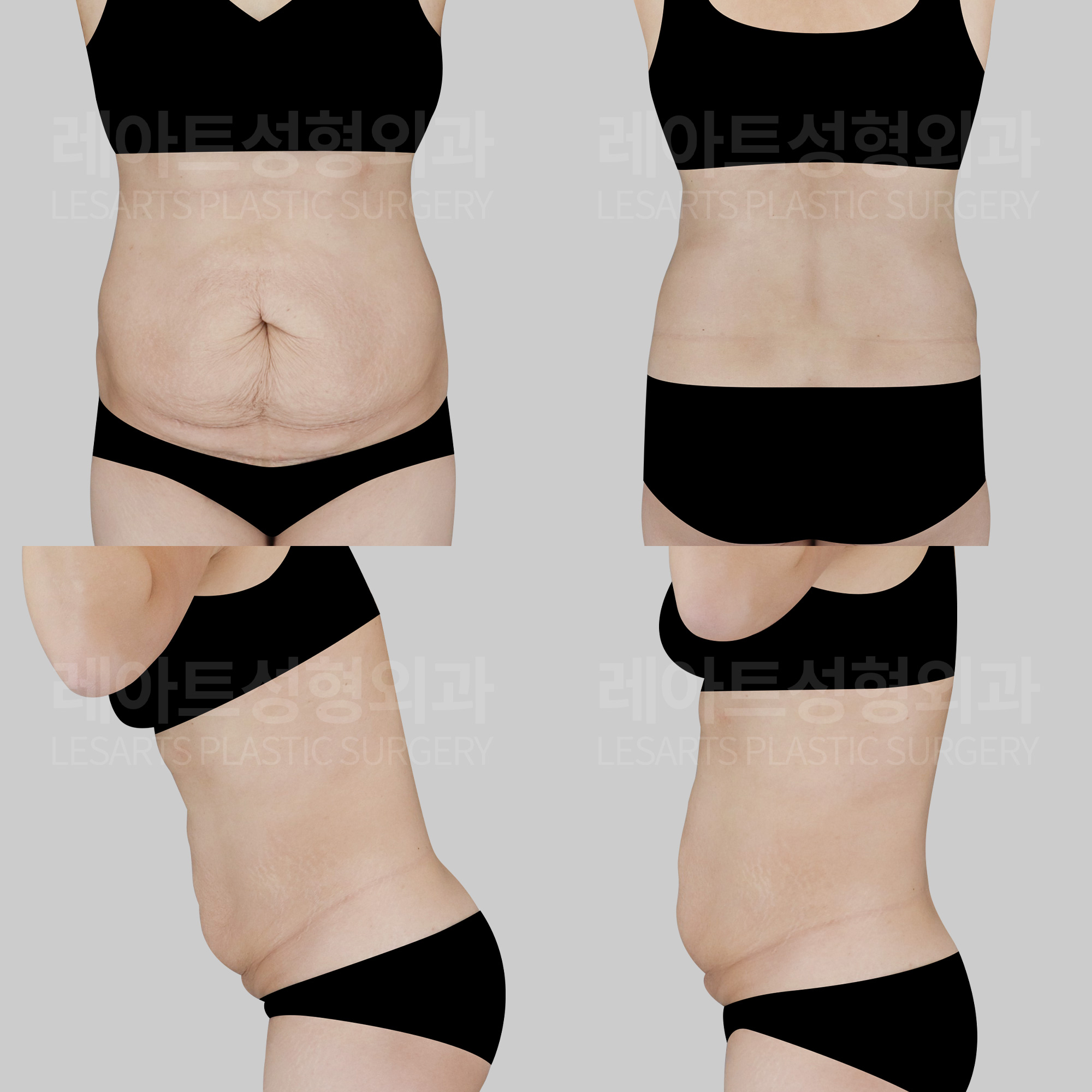
[Preoperative Evaluation for Abdominoplasty + Abdominal Liposuction]
Preoperative Status
1. Residual Lower Abdominal Skin Laxity
Prior to surgery, redundant skin hung downward across the lower abdomen,
forming visible horizontal skin folds.
When such significant cutaneous excess exists,
reducing abdominal depth via liposuction alone
does not eliminate the redundant skin envelope.
Consequently, had only adipose tissue been removed,
the loose cutaneous folds and wrinkling in the infraumbilical region
would have remained largely unchanged.
2. Abdominal Fullness Extending to the Upper Abdomen and Flanks
Alongside skin laxity, prominent subcutaneous fat deposits
remained across the upper abdomen, flanks, and central abdominal wall.
If only the lower abdominal skin were excised and tightened,
persistent thickness across the upper abdomen and lateral flanks
would still leave the torso appearing bulky and disproportionate overall.
Therefore, achieving a harmonious, balanced abdominal profile required not just tightening the lower abdomen,
but simultaneously debulking and contouring subcutaneous thickness
from the epigastrium through the flanks.
3. Adhesions Surrounding Prior C-Section Scars
Due to two prior Cesarean deliveries,
dense cicatricial adhesions were identified around the lower abdominal scar.
These tethering bands pulled the skin and underlying tissues downward,
disrupting smooth surface contours and causing
the tissue directly above the scar to protrude in a stepped, shelf-like appearance.
In summary, this patient presented not simply with excess adipose tissue,
but with a combined clinical presentation where redundant skin, localized fat,
and post-C-section scar adhesions simultaneously compromised the abdominal contour.
Distinct Clinical Roles: Abdominoplasty vs. Liposuction
1. Abdominoplasty — Excising Redundant, Stretched Skin
Abdominoplasty excises redundant cutaneous tissue from the lower abdomen
and advances the lax abdominal flap downward, restructuring the overall
contour into a taut, unified plane.
In this case, because the previous Cesarean section scar
fell within the designated excision template,
the fibrous scar was resected alongside the redundant tissue,
providing fundamental structural correction
to flatten the infraumbilical wall.
However, advancing cutaneous tissue alone
does not reduce the actual thickness of adipose layers
remaining in the upper abdomen and flanks.
Thus, relying solely on abdominoplasty would have been insufficient
to refine the generalized torso volume and waistline definition
desired by the patient.
2. Abdominal Liposuction — Sculpting Torso Thickness and Waistline Proportions
Abdominal liposuction was directed at thinning the upper abdomen
and lateral flanks to connect anatomical lines
in a natural, seamless transition.
Because the supraumbilical abdomen interfaces directly with the advanced lower flap,
the upper adipose layer was sculpted evenly
to ensure both zones matched in depth
without unnatural demarcation.
Similarly, the flanks and love handles were contoured
to transition smoothly from waist to iliac crest,
preventing abrupt steps or lateral dog-ear puckering
at the terminal edges of the transverse incision.
Furthermore, anticipating the final redraping vector of the skin flap,
three-dimensional lipocontouring was applied across the anterior abdominal wall and flanks,
simultaneously releasing scar tethering during cannula dissection
to allow the abdominoplasty flap to settle smoothly and evenly.
In this clinical case, concurrently reducing upper abdominal and flank volume
served as a decisive technical component.
If only lower abdominal skin is excised while leaving epigastric and flank fullness intact,
the overall torso can remain visually heavy and wide.
▶ View More Abdominoplasty Before & After Cases
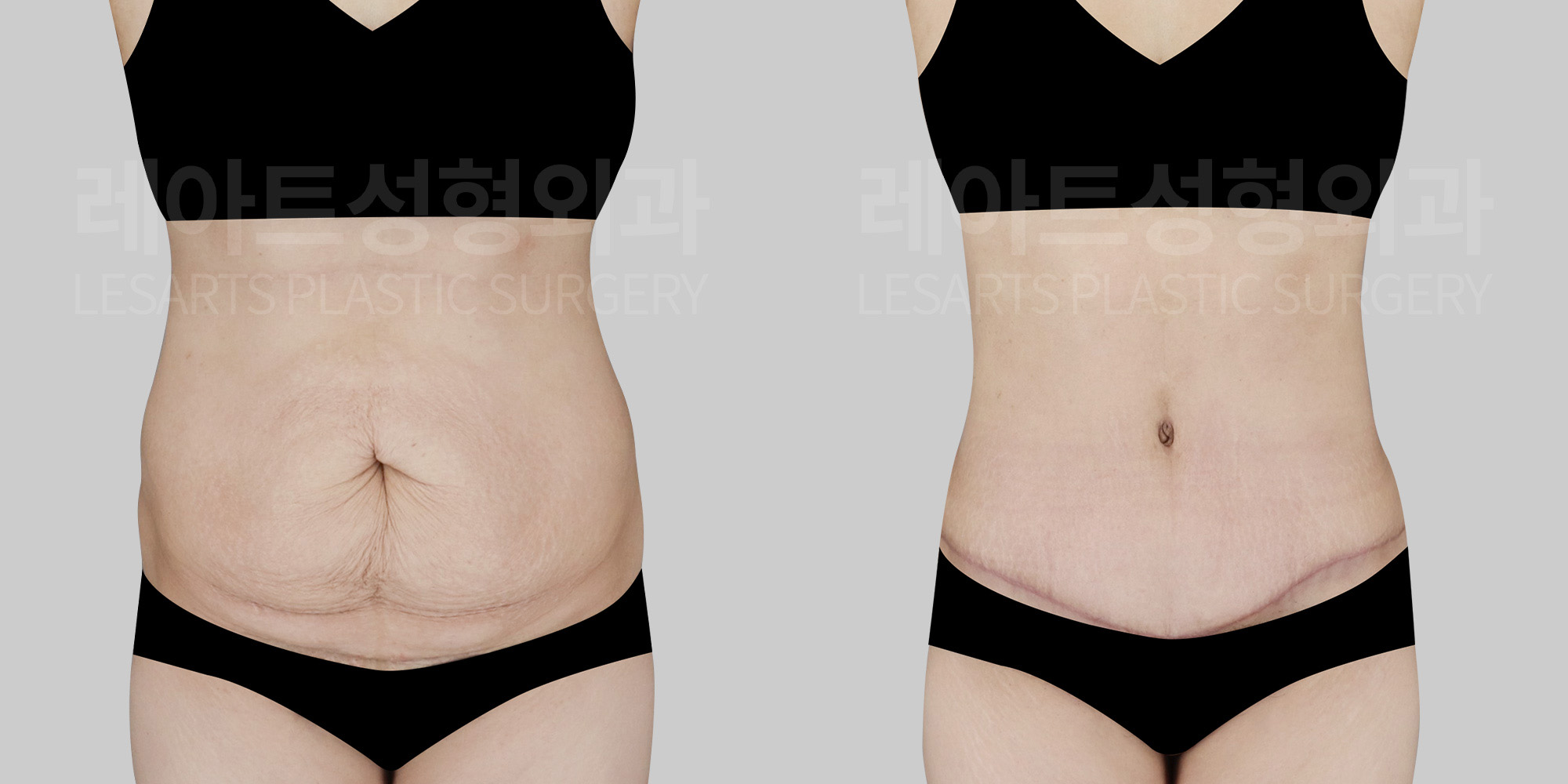
[Clinical Effects of Liposuction Combined with Abdominoplasty - Dr. Pyongrim Choi, Lesarts]
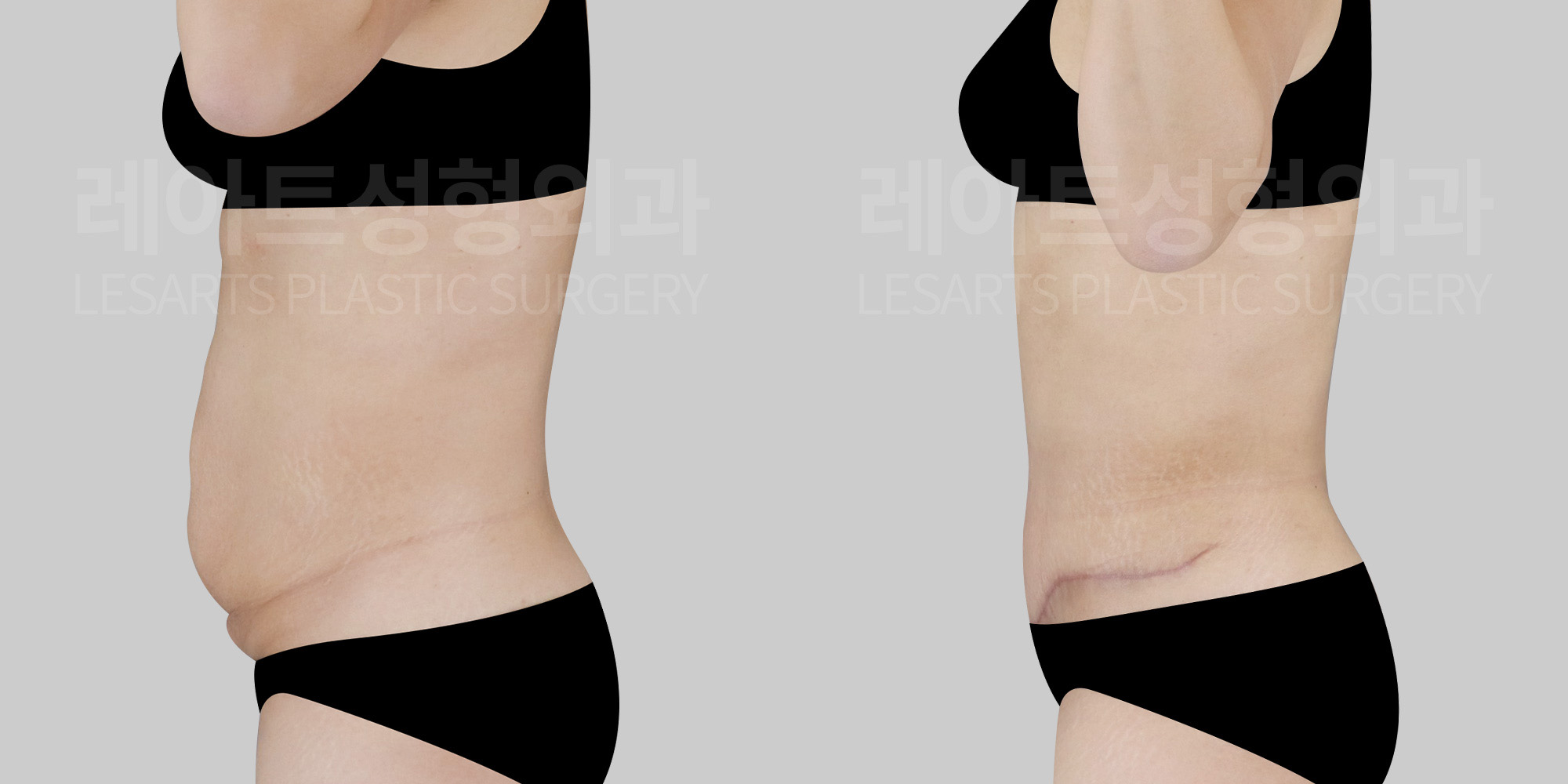
[Before & After Anterior Abdominal Liposuction & Abdominal Contouring - Lesarts Plastic Surgery]
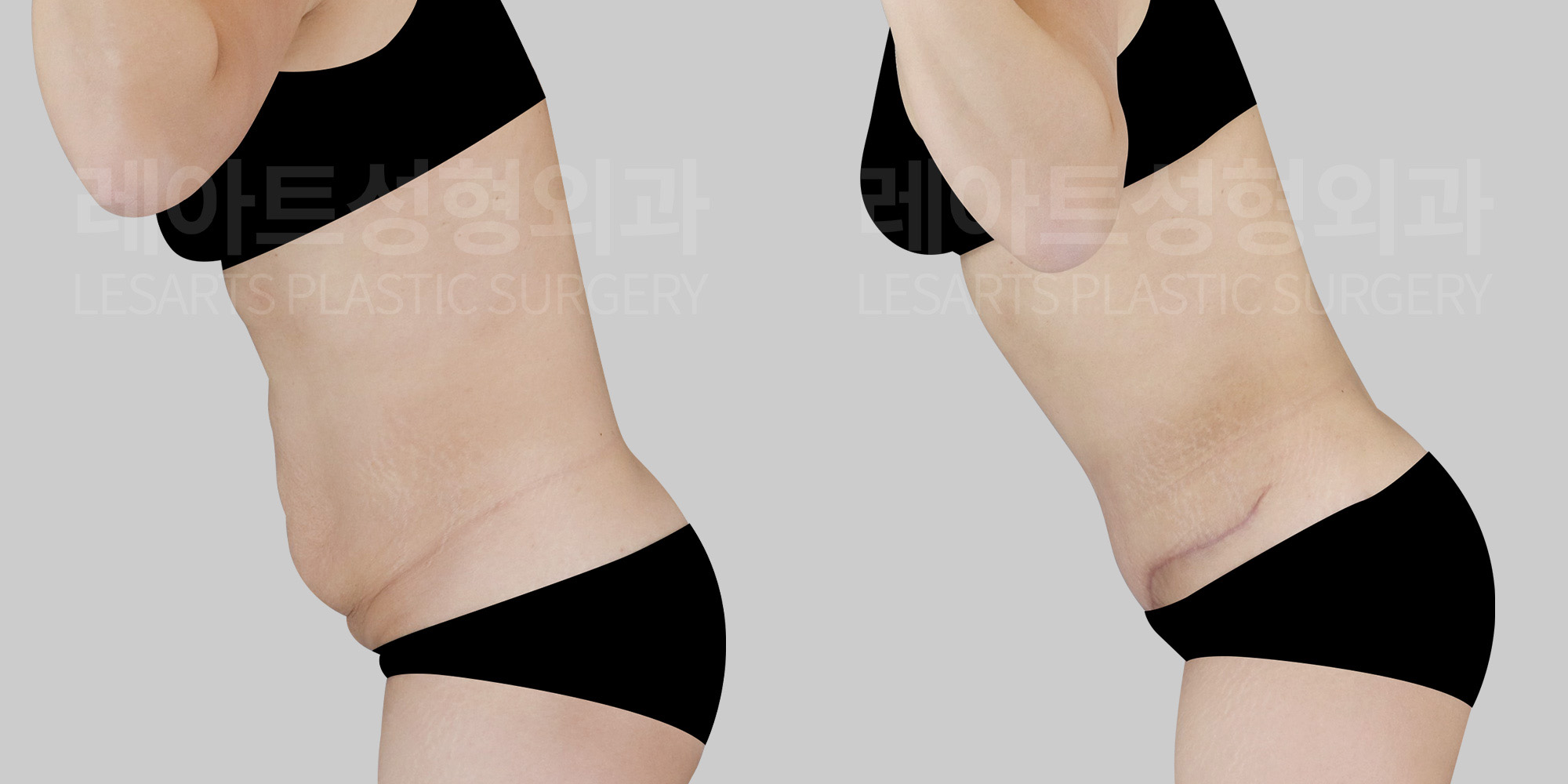
3-Month Postoperative Abdominal Contouring Comparison - Dr. Pyongrim Choi, Lesarts
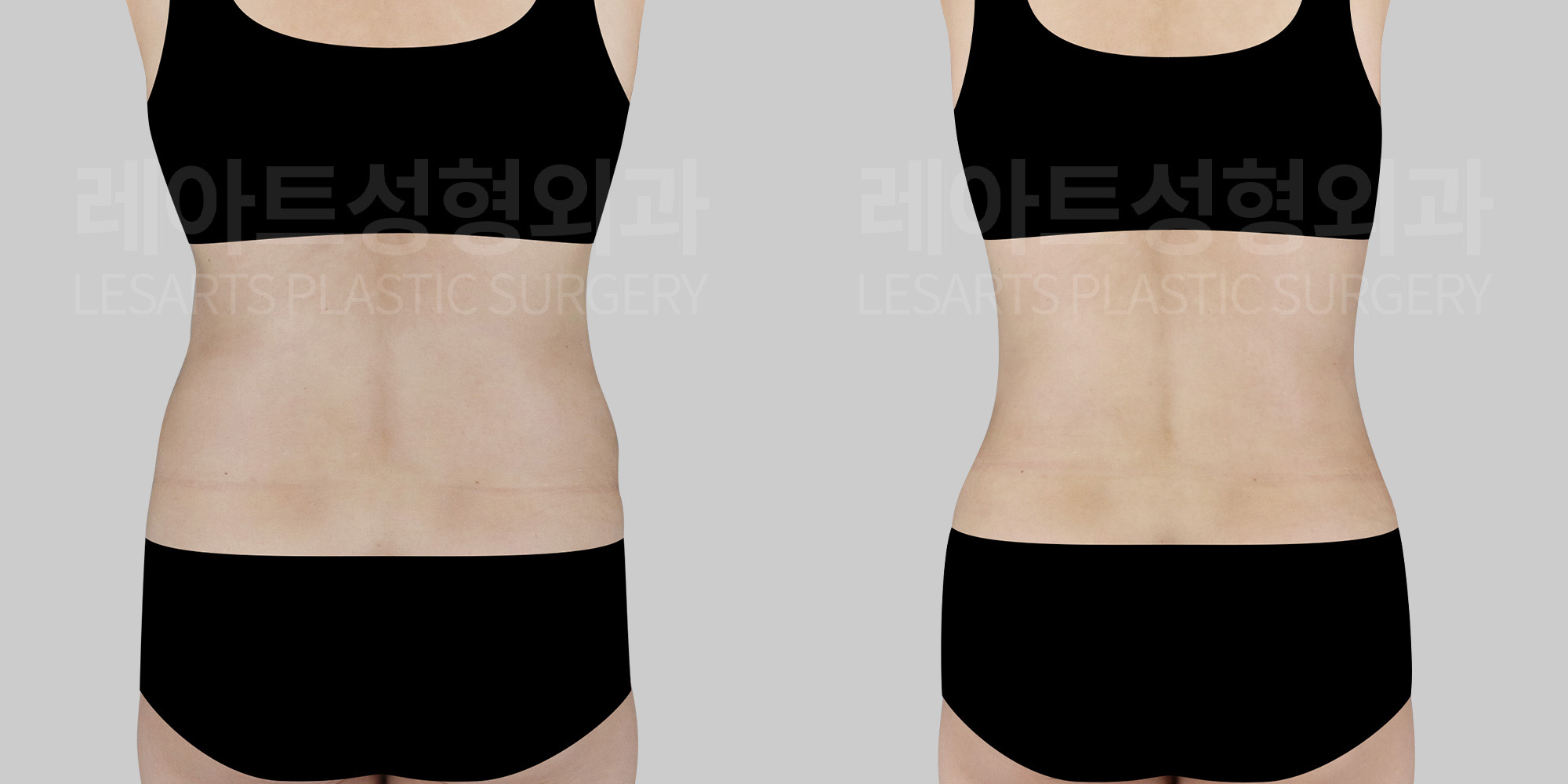
[Flank Contour Transition After Abdominal Liposuction - Lesarts Plastic Surgery]
The clinical transformation following combined abdominoplasty and abdominal liposuction
extended well beyond simply flattening the lower belly.
With redundant infraumbilical skin excised and overall abdominal wall thickness diminished,
the visual volume of the entire torso noticeably decreased.
The lateral flanks were contoured in unison, establishing a smoother transition
connecting the waistline and lower abdomen compared to baseline.
In summary, the postoperative outcomes demonstrated:
1. Marked reduction in lower abdominal cutaneous laxity
2. Reduction in generalized abdominal depth and thickness
3. Streamlined lateral flank contours
4. Refined transition connecting the waistline to the pelvis
Through these coordinated refinements, even without dramatic shifts on the scale,
the overall body silhouette presents a distinctly lighter, balanced line.
In abdominal body contouring surgery,
it is critical not only to select a procedure,
but to clearly divide and execute the anatomical responsibilities
demanded by each clinical component.
Abdominoplasty excises redundant cutaneous laxity,
while abdominal liposuction sculpts residual thickness
and refines structural transitions.
Accordingly, when presenting with both lower abdominal skin redundancy and generalized adipose fullness,
structuring a combined dual-action surgical approach is often essential to achieve a comprehensive, natural contour.
▶ View More Lesarts Abdominal Liposuction Cases
Abdominoplasty & Abdominal Liposuction FAQ
1. If my lower abdomen sags after childbirth, can I undergo liposuction alone?
If substantial redundant skin is present, removing only adipose tissue
can leave cutaneous folds and laxity unchanged.
It is essential to distinguish whether lower abdominal fullness is primarily driven by adipose deposits,
or whether structural skin laxity also plays a major role.
2. Does abdominoplasty alone make the abdomen significantly thinner?
The primary function of abdominoplasty is the excision and redraping of redundant skin.
If thick adipose deposits remain across the upper abdomen and flanks,
torso thickness may still be noticeable even after cutaneous tightening.
3. Why are abdominoplasty and liposuction frequently performed together?
When redundant skin and localized adipose deposits coexist,
combining both techniques allows each issue to be corrected simultaneously.
Abdominoplasty removes excess cutaneous tissue, while liposuction
calibrates the thickness of the anterior abdomen and lateral flanks.
4. Can a prior Cesarean section scar be excised during abdominoplasty?
If the previous C-section scar is located within the designated lower abdominal excision area,
it can be excised together with the redundant skin flap.
Feasibility depends on the precise anatomical position of the scar relative to the planned surgical margins.
5. Can combined abdominoplasty and liposuction improve waistline contours?
When treatable adipose deposits are present along the flanks and love handles,
concurrent liposuction refines the transition from the waist down to the pelvis,
establishing a more seamless and harmonious waistline silhouette.
Dr. Pyongrim Choi


Cases finding
similar to my profile
Customer Diagnostics


Select the surgery and
area you are interestedto see real
before andafter changes.


we
make you,
the art
Clinic hours
MON - FRI
10 am – 7pm
SAT
10 am – 4pm
Holiday
SUN, HOLIDAY
Location
Lesarts Moon Clinic Tower 4-5F, 40, Nonhyeon-ro 168-gil,
Gangnam-gu, Seoul, Republic of Korea

Medical institution name Lesarts Plastic Surgery
Address Lesarts Moon Clinic Tower 4-5F, 40, Nonhyeon-ro 168-gil, Gangnam-gu, Seoul, Republic of Korea
Representative Moon sung jun
