




Online Consultation
Please accurately enter the information below.
Quick Cost Consultation
Quick Consultation & Reservation
Cases finding
similar to my profile






Doctor's Note
Medical columns by our surgeons
Thigh Liposuction | Slender Upper Body but Heavy Thighs? Lower Body Contour Changes After a 7kg Weight Gain
2026-09-04
Thigh Liposuction | Slender Upper Body but Heavy Thighs? Lower Body Contour Changes After a 7kg Weight Gain [Doctor's Note by Dr. Pyongrim Choi]
Why do thighs appear disproportionately heavy when the upper body is relatively slender?
When weight increases, adipose tissue does not
accumulate evenly across every body area.
If fat concentrates in specific lower body regions, such as the inner thighs or saddlebags,
the lower body can appear noticeably broader compared to the upper frame.
In such cases, rather than focusing solely on reducing scale weight, it is essential
to evaluate where fat is concentrated and assess the transitional line between the pelvis and thighs.
▶ View Lesarts Thigh Liposuction Cases
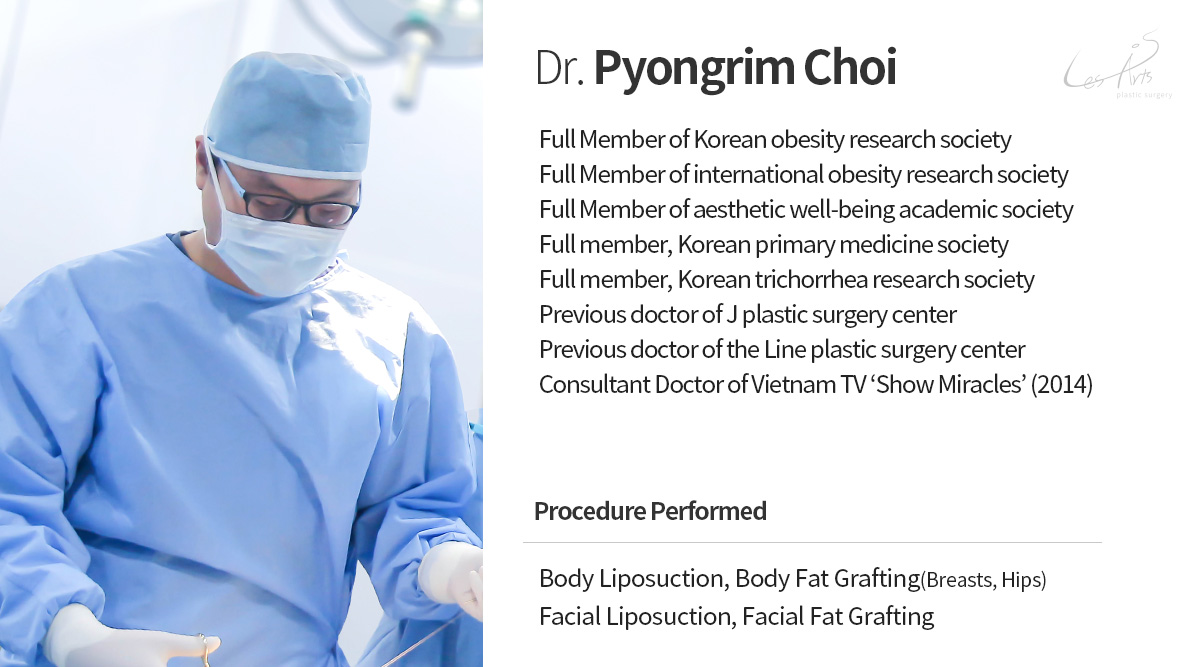
Hello, I am Dr. Pyongrim Choi of Lesarts Plastic Surgery.
“I gained weight, but why does it feel like it all went exclusively to my thighs?”
This is a question I hear quite frequently during clinical consultations.
Particularly when the upper body remains comparatively slim,
adipose tissue concentrating predominantly in the thighs
makes the lower extremities feel noticeably heavier than before,
leading many patients to feel distressed
over an altered overall body balance.
These physical shifts following weight gain
cannot be explained simply by the numbers on a scale.
Where adipose tissue is localized,
and how smoothly the anatomical contour connecting
the waist, pelvis, and thighs flows
fundamentally dictates how the entire silhouette appears.
The patient presented today experienced approximately 7kg of weight gain,
with contour changes centered on prominent saddlebags
becoming her primary aesthetic concern.
Below, we review how comprehensive circumferential thigh liposuction paired with pelvic fat grafting
was designed to contour, balance, and refine her lower body lines.
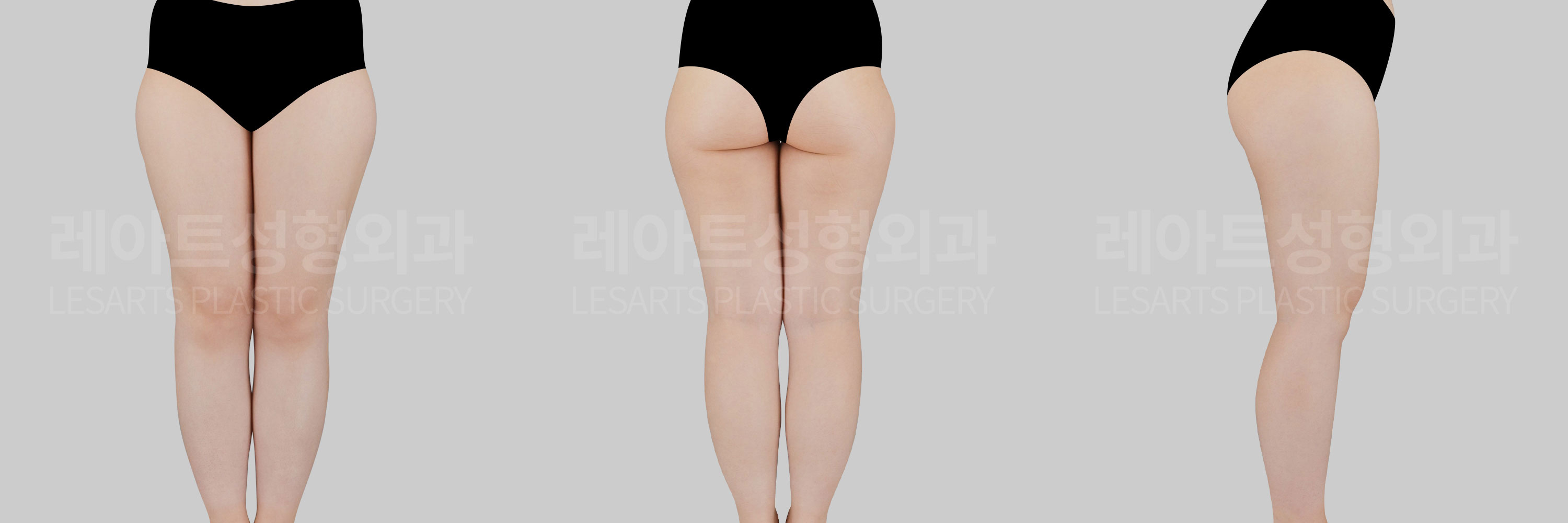
[Preoperative Assessment: Thigh Liposuction & Pelvic Fat Grafting]
[Patient Profile]
Age: Late 20s
Height: 157 cm
Weight: 58 kg
Patient Goals: Streamlining prominent saddlebags into a sleek, straight-line thigh contour
On preoperative physical examination, three primary anatomical features were identified:
First, laterally protruding trochanteric saddlebag deposits
Second, touching medial thigh fat pads
Third, anteriorly projected thigh curvature
In particular, while the superolateral pelvic margin (hip dip area) was relatively depressed,
the saddlebag area directly below bulged outward.
Consequently, the transition cascading from the pelvis down to the thighs
lacked a continuous line, exaggerating an abrupt, interrupted lateral silhouette.
Considering these anatomical proportions, simply debulking
the saddlebags in isolation was insufficient to produce the seamless
lower body contour she envisioned.
Therefore, the surgical strategy was planned to debulk lower body fullness via circumferential thigh liposuction,
concurrently performing autologous fat grafting to the depressed pelvic hollows.
Below, we examine the multidirectional clinical outcomes
recorded at 4 months postoperatively.
▶ Learn More About Lesarts Liposuction
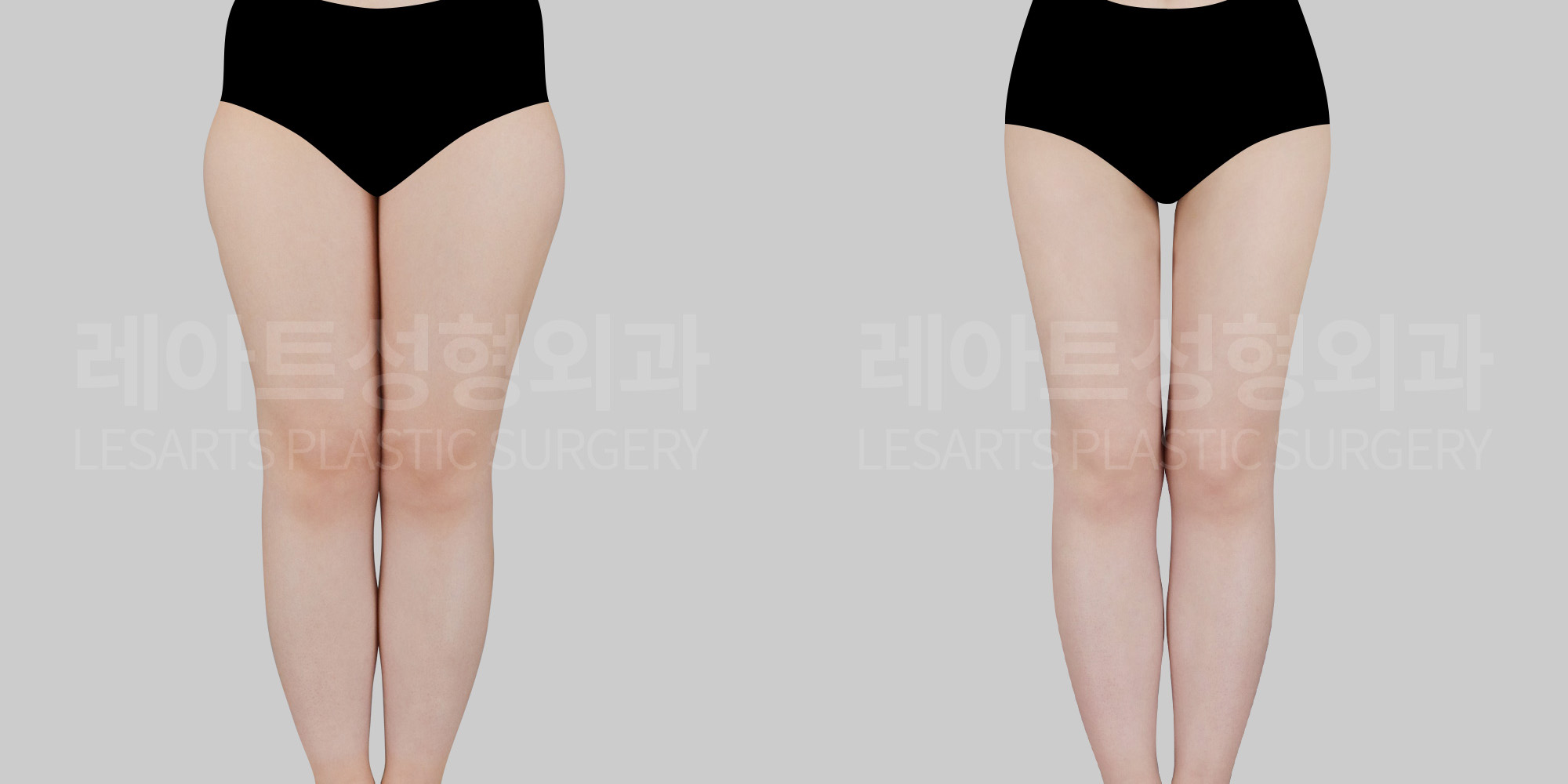
[Before & After Concurrent Thigh Liposuction and Pelvic Contouring]
Preoperatively, protruding lateral saddlebags caused
the thighs to appear broader than the pelvis.
The inner thighs were touching closely,
leaving virtually no medial separation between the legs.
Postoperatively, with trochanteric bulk reduced,
the transitional line from pelvis to thighs
flows far more naturally than baseline.
Additionally, medial fat reduction created a natural separation
between the inner thighs,
transitioning into a generally slender, elongated lower body silhouette.
The structural refinement is also clearly discernible
when observing undergarment fit pre- and post-surgery.
Preoperatively, saddlebag fullness bulged beneath the panty line
while the supra-pelvic contour above appeared relatively hollowed.
Postoperatively, debulking saddlebag deposits alongside
pelvic fat grafting to restore superolateral volume
has smoothed the peripelvic margins cleanly.
Consequently, the continuous curve transitioning from the waist
through the pelvis down to the thighs now connects harmoniously.
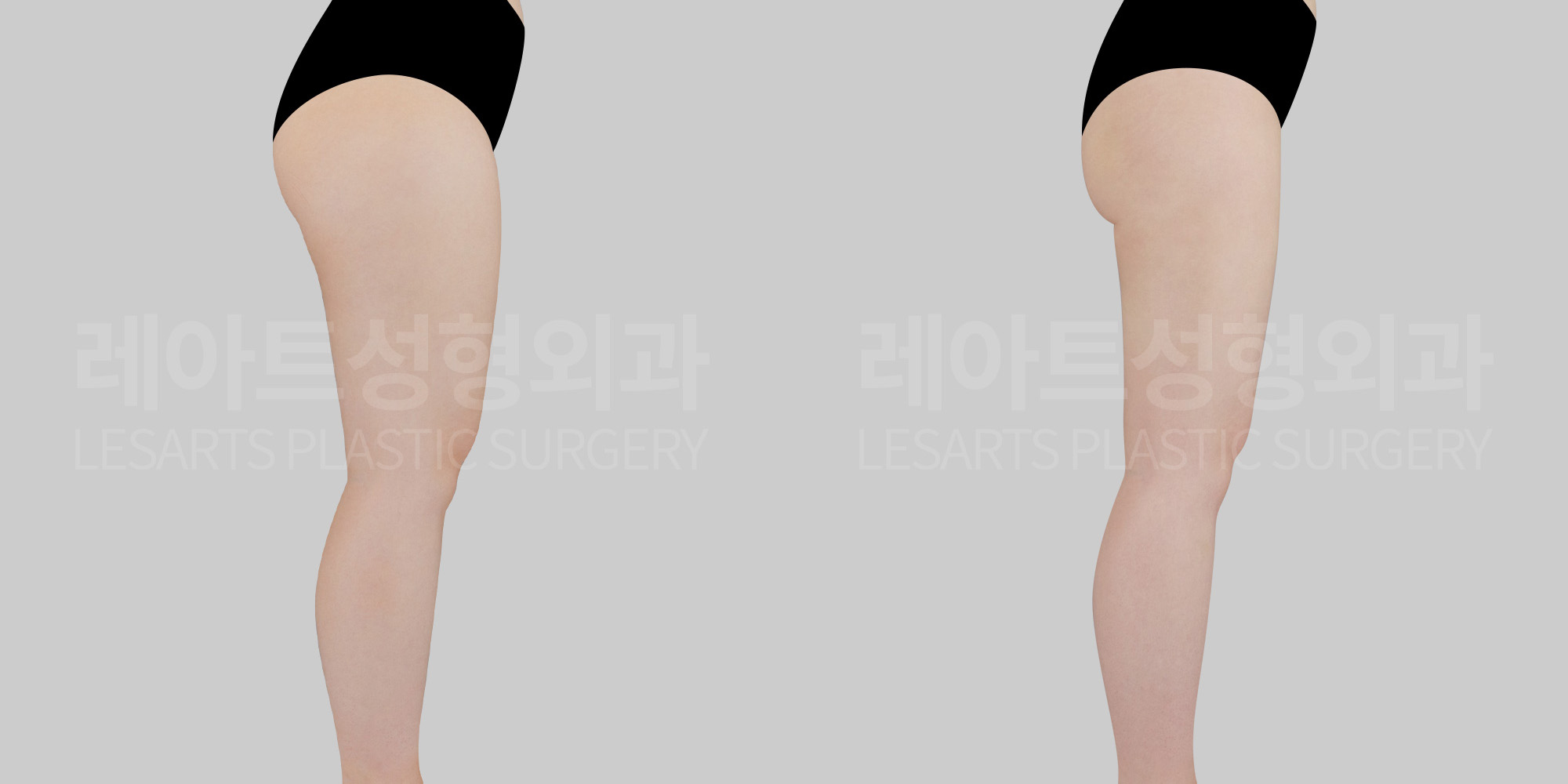
[Thigh Liposuction Before & After - Dr. Pyongrim Choi, Lesarts Plastic Surgery]
On lateral examination preoperatively, the anterior thigh bulged prominently forward,
projecting further anteriorly than the pelvic plane.
This localized fullness lent the lower body
a visually heavy and bulky profile.
Postoperatively, anterior thigh volume was streamlined to smooth the outer line,
allowing the suprapatellar knee contours to emerge more distinctly than before.
Alongside these changes, the legs exhibit a visually lengthened proportion.

[Circumferential Changes Before & After Thigh Liposuction - Dr. Pyongrim Choi, Lesarts Plastic Surgery]
Prior to surgery, the depressed lateral pelvis
paired with the protruding saddlebags below it
visually segmented the upper and lower body.
Postoperatively, autologous fat grafting replenished
volume in the depressed pelvic hollows,
allowing lateral hip curvature to flow smoothly into the thigh line.
Consequently, the feminine S-curve transitioning from the waist
through the pelvis into the thighs is noticeably enhanced.
Before surgery, disproportionate lower body fullness relative to the upper body
caused the overall visual center of gravity
to appear weighed downward.
Following thigh liposuction, debulking localized fullness
established a more balanced integration between the upper and lower body,
creating an overall lighter, well-proportioned impression.
Furthermore, augmenting volume deficiencies in the pelvic zone via fat grafting
achieved a comprehensive silhouette transformation
that extends far beyond simple circumferential thinning.
Thigh liposuction is not a procedure focused merely on reducing numeric circumference.
Even at an identical scale weight, where adipose tissue is concentrated
fundamentally alters the balance between the torso and extremities,
as well as the aesthetic transition connecting the hips to the thighs.
In this case, weight gain disproportionately increased fullness in the saddlebags, inner thighs,
and anterior thighs, while the juxtaposition of hollowed hips and bulging saddlebags
disrupted smooth bodily transitions.
By debulking redundant lower body volume through circumferential thigh liposuction
and simultaneously grafting fat into the depressed pelvic hollows,
surgical execution restored overall structural harmony.
Postoperatively, volume reductions along the saddlebags, medial thighs,
and anterior plane, combined with pelvic volumetric restoration,
refined the contour running from the waist through the pelvis down to the thighs.
If the lower body feels disproportionately heavy, rather than focusing solely
on weight metrics, it is vital to evaluate specific adipose distribution
and carefully assess how the pelvic-thigh structural transition is configured.
▶ View More Lesarts Thigh Liposuction Cases
Thigh Liposuction & Pelvic Fat Grafting FAQ
Q1. Can weight gain concentrate primarily in the thighs while the upper body remains slender?
Adipose tissue does not distribute uniformly across the body when weight increases.
When fat accumulates selectively in targeted lower body areas like the inner thighs or saddlebags,
the lower body can appear noticeably broader and heavier relative to the upper frame.
Q2. Can lower body lines be sufficiently refined through saddlebag liposuction alone?
If excess fat is distributed across the inner or anterior thighs in addition to saddlebags,
the surgical plan must be established around the entire lower extremity silhouette.
Which specific zones require reduction to achieve a continuous line depends on individual adipose distribution.
Q3. Can fat grafting be performed concurrently if the pelvic contour is hollowed?
When deficient pelvic volume creates an abrupt, stepped transition between the waist and thighs,
autologous fat grafting can be utilized to augment the lateral hollows and restore a continuous curve.
Q4. Does inner thigh liposuction create space between the legs?
If sufficient medial subcutaneous fat is present and inner leg contact is driven by adipose thickness,
liposuction can create a clean medial separation.
However, achievable clearance varies based on underlying skeletal alignment, muscle curvature, and baseline fat volume.
Q5. Is thigh liposuction intended primarily as a weight reduction procedure?
The objective of liposuction is body contouring—refining localized fat deposits to reshape circumferences and silhouettes—rather than massive systemic weight reduction.
Therefore, evaluating regional adipose distribution and overall bodily balance is far more critical than tracking scale weight alone.
Dr. Pyongrim Choi


Cases finding
similar to my profile
Customer Diagnostics


Select the surgery and
area you are interestedto see real
before andafter changes.


we
make you,
the art
Clinic hours
MON - FRI
10 am – 7pm
SAT
10 am – 4pm
Holiday
SUN, HOLIDAY
Location
Lesarts Moon Clinic Tower 4-5F, 40, Nonhyeon-ro 168-gil,
Gangnam-gu, Seoul, Republic of Korea

Medical institution name Lesarts Plastic Surgery
Address Lesarts Moon Clinic Tower 4-5F, 40, Nonhyeon-ro 168-gil, Gangnam-gu, Seoul, Republic of Korea
Representative Moon sung jun
