




Online Consultation
Please accurately enter the information below.
Quick Cost Consultation
Quick Consultation & Reservation
Cases finding
similar to my profile






Doctor's Note
Medical columns by our surgeons
Abdominal Liposuction | “I Lost 5kg, So Why Hasn't My Lower Belly Changed? Why Lower Abdominal Volume Persists”
2026-09-07
Abdominal Liposuction | “I Lost 5kg, So Why Hasn't My Lower Belly Changed? Why Lower Abdominal Volume Persists”
Why does the lower abdomen remain unchanged even after losing 5 to 6 kg of body weight?
The lower abdomen is influenced not only by adipose distribution, but also by abdominal wall integrity, dermal elasticity, and regional anatomical characteristics.
Consequently, lower abdominal fullness can persist despite overall weight reduction; if subcutaneous fat is the primary factor, liposuction may be considered for contour refinement.
[Lesarts Abdominal Liposuction Guide]
“I lost weight, so why does my lower belly remain unchanged?”
Hello, I am Dr. Pyongrim Choi of Lesarts Plastic Surgery.
Among women in their 20s and 30s who have lost approximately 5 to 6 kg over about three months,
it is quite common to find that lower abdominal volume stubbornly persists even though the overall physique has become noticeably slimmer.
When this occurs, many patients wonder:
“Should I increase my workout volume?”
“Do I need to lose more weight on the scale?”
However, the reason the lower abdomen does not diminish easily cannot be explained by body fat volume alone.
This occurs because regional anatomical structure, adipose distribution patterns,
and abdominal wall tone interact simultaneously.
In this column, we will examine why lower abdominal fullness persists after weight loss,
what can be improved through liposuction, and the anatomical limits of surgical contouring.
1. Why the Lower Abdomen Bulges Despite Weight Loss
The lower abdomen cannot simply be viewed as an area where fat accumulates heavily.
It features distinct structural characteristics that differentiate it from other body regions.
1) Structural Differences in Abdominal Adipose Layers
Abdominal subcutaneous fat is broadly divided into two anatomical planes:
Superficial layer ▶ Treatable via liposuction
Deep layer ▶ Adjacent to the abdominal wall, influencing baseline contour architecture
Because the lower abdomen has a relatively high proportion of deep subcutaneous fat,
localized volume frequently remains rather than flattening completely, even after systemic weight reduction.
2) Influence of Gravity and Retinacular Ligament Structures
Fibrous fascial septa support and anchor the skin envelope across the lower abdomen.
While these structures anchor the skin relatively firmly in the upper abdomen,
they become comparatively lax and distensible as they extend inferiorly.
Coupled with the continuous vector of gravity,
adipose tissue tends to settle inferiorly, forming a prominent 'pocket-like' bulge.
3) Abdominal Wall Integrity, Rectus Musculature, and Intra-Abdominal Pressure
Repeated cycles of weight gain and loss, previous pregnancy and childbirth,
as well as sedentary habits or postural imbalances can alter abdominal shape.
In particular, when rectus abdominis tone attenuates and core support decreases,
the abdominal wall may project forward even when subcutaneous fat volume is not excessive.
Ultimately, lower abdominal protrusion is not solely an adipose issue,
but a multifaceted presentation involving fat, structural ligaments, and muscular integrity.
4) Physiological Adipose Distribution Patterns in Women
Due to physiological characteristics, women
have a natural predisposition to accumulate adipose tissue in the lower abdomen and pelvic regions.
Adipose tissue in this region exhibits lower lipolytic responsiveness
and acts as 'resistant fat' that remains until the final stages of dietary weight loss.
Consequently, even when overall scale weight decreases,
lower abdominal volume often fails to diminish proportionately.
2. What Degree of Refinement Can Liposuction Achieve?
1) Debulking Focal 'Pocket Fat' in the Lower Abdomen
When lower abdominal fat concentrates focally,
it often protrudes as an isolated, prominent mass.
Precisely debulking this localized subcutaneous layer
reduces anterior lower abdominal protrusion,
allowing the lateral profile to settle flatter and smoother than before.
Concurrently, the transition connecting the abdomen down to the pelvis can be contoured far more naturally.
2) Ensuring Anatomical Transitions with Contiguous Areas
When treating the lower abdomen, it is vital to maintain harmonious continuity
to prevent unnatural demarcations along adjacent regions.
By concurrently contouring the upper abdomen, the epigastric and infraumbilical planes transition smoothly,
while refining flank and love handle volume
establishes a continuous, balanced silhouette from the waist to the pelvis.
3. Anatomical Factors Liposuction Cannot Resolve
1) Visceral Fat Cannot Be Removed via Liposuction
Liposuction selectively targets subcutaneous adipose tissue.
Therefore, if the abdominal wall projects forward due to firm visceral fat accumulation
or elevated intra-abdominal pressure, the contour changes achievable via liposuction alone remain bounded.
2) Severe Abdominal Wall Musculofascial Laxity
When significant rectus diastasis or severe fascial attenuation is present,
the abdomen may not flatten completely even after thorough adipose extraction.
Such presentations fall within the clinical scope of abdominoplasty or musculoaponeurotic plication.
3) Variations in Dermal Elasticity and Skin Recoil
Even in younger patients in their 20s,
a history of rapid weight fluctuations or repetitive weight cycling
can compromise dermal elastic recoil.
In such cases, post-aspiration redraping may be less taut
than originally anticipated.
Clinical Case: Abdominal Liposuction
Female in her mid-20s, 171 cm / 64 kg
Aesthetic Goals: Resolve prominent lower abdominal fullness and achieve a slender contour free of surface irregularities
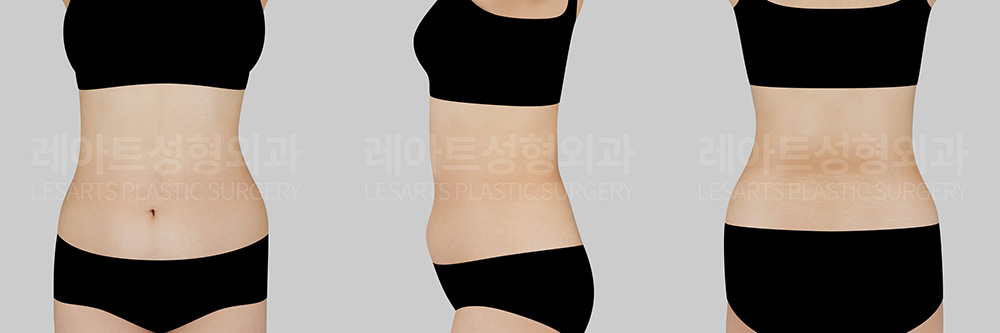
[Preoperative Condition for Abdominal Liposuction - Dr. Pyongrim Choi, Lesarts]
This patient presented with persistent fullness localized in the lower abdomen despite having lost approximately 6 kg over a 3-month period.
In particular, adipose tissue clustered heavily across the central and inferior infraumbilical wall,
manifesting as a typical ‘pocket-type protrusion.’
Because residual fat was also distributed across the upper abdomen and lateral flanks,
comprehensive circumferential abdominal liposuction was performed rather than isolated lower abdominal debulking.
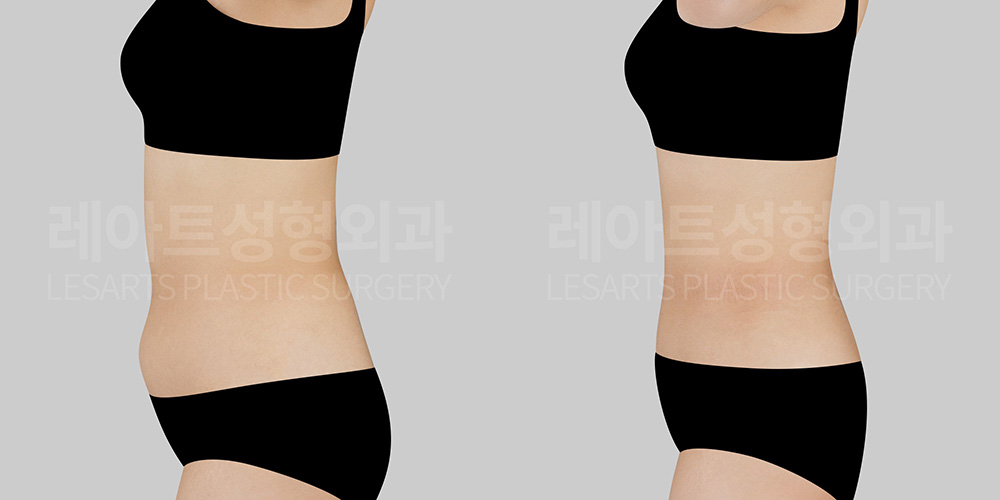
[Lower Abdominal Liposuction Before & After - Dr. Pyongrim Choi, Lesarts Plastic Surgery]
[Waistline Comparison Before & After Abdominal Liposuction - Lesarts Plastic Surgery]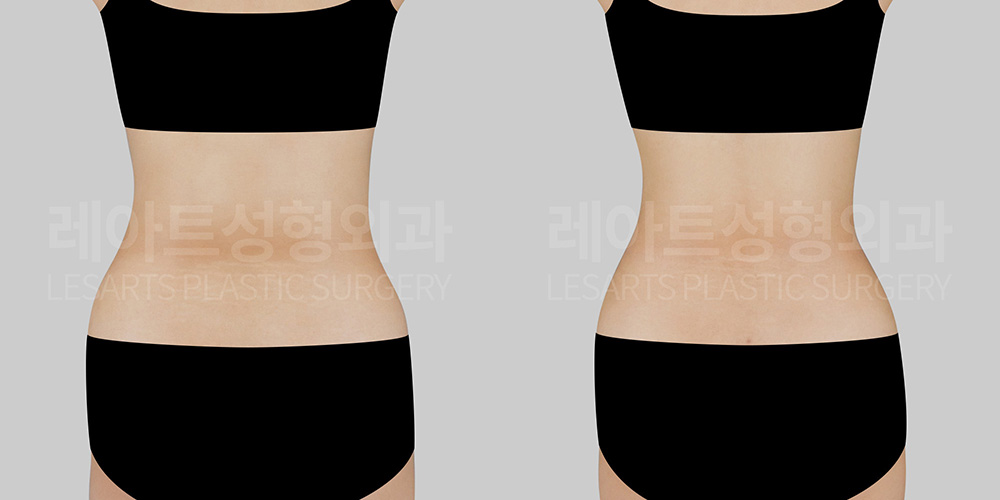
[Circumferential Waist Reduction via Abdominal Liposuction - Dr. Pyongrim Choi, Lesarts]
Following abdominal liposuction, accounting for physiological baseline abdominal wall projection,
the overall lower abdominal bulge diminished significantly, settling into a flatter and smoother contour.
Excess flank fullness was contoured simultaneously,
establishing a seamless, natural transition from the waist down to the pelvis.
The lower abdomen is not merely an area of fat accumulation;
due to unique structural and physiological factors, it is an anatomical zone where volume frequently persists through the final stages of weight reduction.
Therefore, when dietary management fails to produce desired contour changes,
it is crucial to evaluate the underlying anatomical causes of lower abdominal protrusion accurately.
Liposuction is designed to refine body shape and contours rather than serve as a method for generalized weight loss.
Accurately assessing whether your concern is driven by subcutaneous fat, abdominal wall laxity, or a combination of both
allows for a targeted, appropriate clinical plan that delivers predictable, rewarding outcomes.
[View More Real Cases of Lesarts Abdominal Liposuction]
FAQ
Q1. Why does the lower abdomen resist reduction even after significant weight loss?
The lower abdomen is influenced by compound factors including regional fat distribution, ligamentous support, and abdominal wall tone.
Consequently, lower abdominal fullness can persist even when overall scale weight decreases.
Q2. Can lower abdominal liposuction improve a prominent lower belly?
If the protrusion is primarily caused by subcutaneous fat, liposuction can reduce focal volume
and help refine the abdominal profile into a flatter contour.
Q3. Is it possible to treat only the lower abdomen?
When treating only the lower abdomen, continuity with adjacent zones must be considered.
Depending on individual anatomy, contouring the upper abdomen, flanks, and love handles concurrently
helps create a seamless, cohesive torso transition.
Q4. Can abdominal liposuction remove visceral fat?
Liposuction exclusively removes subcutaneous adipose tissue.
If protrusion is driven by visceral fat or elevated intra-abdominal pressure,
the degree of contour refinement achievable through liposuction alone remains limited.
Q5. Can the abdomen fail to flatten completely even after liposuction?
If rectus diastasis, abdominal wall fascial laxity, or compromised skin elasticity is present,
the abdomen may not become entirely flat following fat extraction alone.
Therefore, identifying the precise anatomical cause of protrusion prior to surgery is essential.
Dr. Pyongrim Choi


Cases finding
similar to my profile
Customer Diagnostics


Select the surgery and
area you are interestedto see real
before andafter changes.


we
make you,
the art
Clinic hours
MON - FRI
10 am – 7pm
SAT
10 am – 4pm
Holiday
SUN, HOLIDAY
Location
Lesarts Moon Clinic Tower 4-5F, 40, Nonhyeon-ro 168-gil,
Gangnam-gu, Seoul, Republic of Korea

Medical institution name Lesarts Plastic Surgery
Address Lesarts Moon Clinic Tower 4-5F, 40, Nonhyeon-ro 168-gil, Gangnam-gu, Seoul, Republic of Korea
Representative Moon sung jun
