




Online Consultation
Please accurately enter the information below.
Quick Cost Consultation
Quick Consultation & Reservation
Cases finding
similar to my profile






Doctor's Note
Medical columns by our surgeons
[Medical Column] “Is It Breast Tissue, Not Just Axillary Fat?” Everything About Accessory Breasts for Women Hesitant to Wear Sleeveless Tops
2026-09-15
[Medical Column] “Is It Breast Tissue, Not Just Axillary Fat?” Everything About Accessory Breasts for Women Hesitant to Wear Sleeveless Tops
Written by Dr. Jihoon Moon, Lesarts Plastic Surgery
This column was authored directly by our medical staff.
※ Unauthorized copying, editing, or redistribution is strictly prohibited. ※
If stubborn anterior axillary fullness persists despite dieting, could it be an accessory breast?
While it may represent localized adiposity, it can also indicate an accessory breast with residual glandular parenchyma.
Because surface inspection cannot definitively differentiate tissue composition,
high-resolution ultrasound is essential to confirm the presence of glandular elements within the adipose plane.
[View More Real Cases of Lesarts Accessory Breast Surgery]
1. The Summer Season and the Truth Behind Stubborn Axillary Fullness
As vacation season approaches and sleeveless tops or swimwear become wardrobe staples, many women share similar frustrations in the mirror:
‘I dedicated myself to dieting and lost weight, so why does this stubborn fullness in front of my armpits never go away?’
“Whenever I wear sleeveless tops, the protruding fullness in front of my underarms is so noticeable that I constantly try to cover it up.”
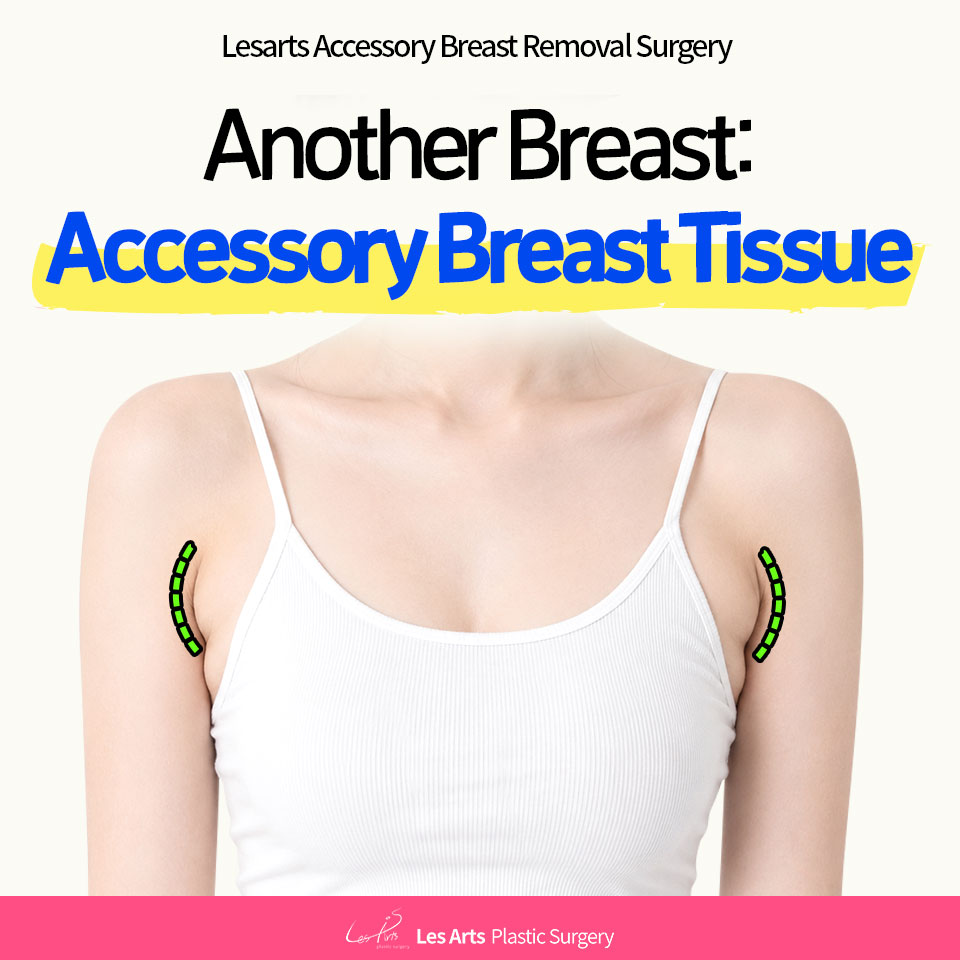
[Accessory Breast Excision - Dr. Jihoon Moon, Lesarts Plastic Surgery]
Many assume that anterior axillary bulges are simply stubborn fat or age-related changes,
attempting to resolve them through rigorous exercise and caloric restriction, or giving up entirely.
However, if the area remains unchanged despite consistent workouts and weight reduction,
it is frequently not simple adiposity, but an additional breast tissue structure existing beyond the normal anatomical breasts—
namely, an Accessory Breast (Polymastia / Ectopic Breast Tissue).
Today, we explore the developmental origins of accessory breasts, precise diagnostic protocols,
and effective clinical corrective options.
2. Does All Axillary Fullness Indicate an Accessory Breast? - Definition & Diagnosis
To state the clinical reality clearly: not all anterior axillary fullness constitutes an accessory breast.
To understand ectopic breast tissue situated outside standard anatomical landmarks,
we must examine embryonic development.
During weeks 4 to 6 of human embryonic development,
approximately nine pairs of mammary buds form along the mammary ridge (milk line)
extending bilaterally from the axillae to the groin.
Under typical physiological conditions, most of these embryonic buds spontaneously regress,
leaving only a single bilateral pair on the anterior chest wall to develop into normal breasts.
However, if these embryonic mammary buds fail to regress completely
and persist within the axilla or abdominal wall,
they form ectopic glandular parenchyma.
This residual ectopic glandular tissue forms the biological foundation of an accessory breast.
The anterior axilla represents the single most common anatomical site where accessory breasts occur.
Precise Diagnosis: The Diagnostic Importance of Ultrasound
How do we differentiate simple axillary adiposity from a true accessory breast?
Surface examination and inspection alone cannot reliably distinguish between them.
Therefore, verifying the true nature of axillary fullness
mandates high-resolution ultrasound imaging.
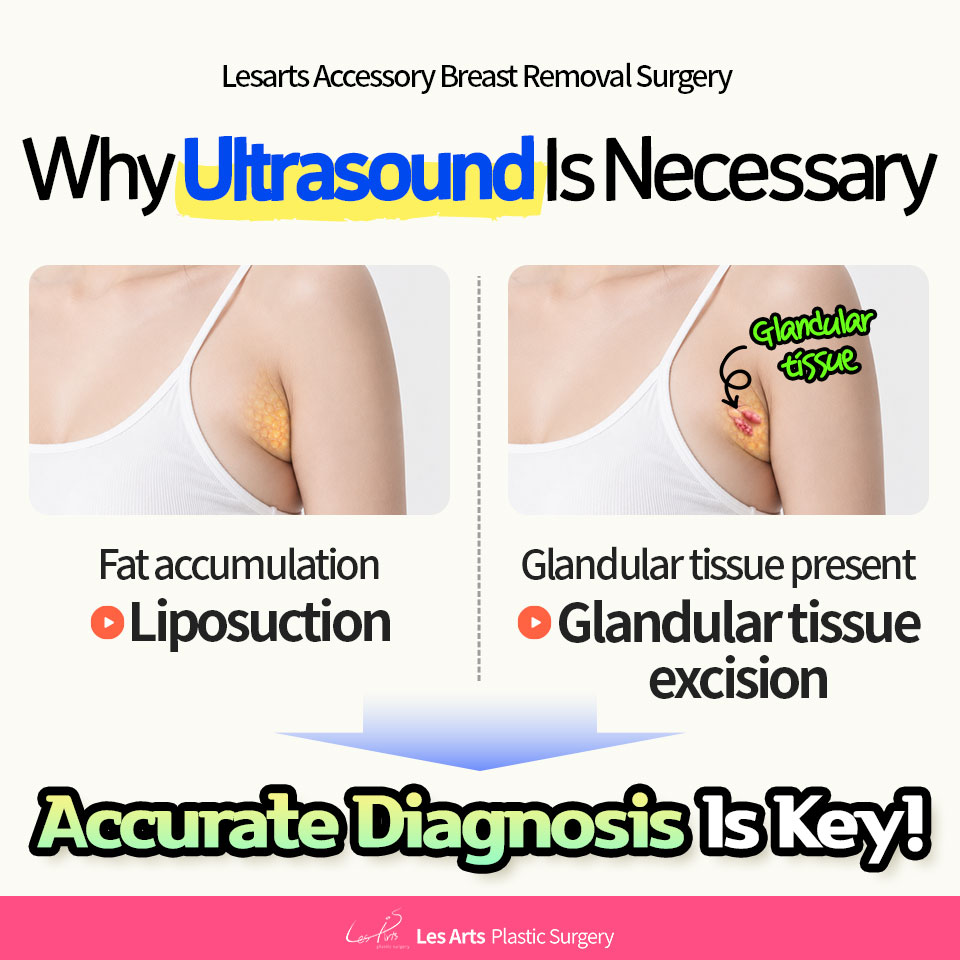
[Accessory Breast Ultrasound Assessment - Dr. Jihoon Moon, Lesarts Plastic Surgery]
Ultrasound evaluation must verify whether true glandular tissue resides beneath the subcutaneous plane
to clinically confirm a true accessory breast.
If ultrasound confirms no glandular elements and identifies only adipose tissue,
this represents pseudogynecomastia or simple localized axillary fat, which resolves through liposuction.
Conversely, if an active, proliferated glandular disc is confirmed,
it represents an accessory breast requiring direct surgical glandular excision alongside liposuction for definitive correction.
3. Clinical Signals: Cyclic Mastalgia and Postmenopausal Persistence
Accessory breasts present not only aesthetic concerns, but functional symptoms as well.
Because the ectopic glandular parenchyma within an accessory breast responds to female hormones
identically to standard breast tissue, a variety of physiological symptoms frequently develop.

[Premenstrual & Postpartum Axillary Pain and Nodules - Lesarts Plastic Surgery]
[Primary Symptoms of Accessory Breasts]
1. Cyclic axillary swelling and tingling or aching pain synchronized with the menstrual cycle (premenstrual phase)
2. Acute engorgement and severe mastalgia during pregnancy and immediately postpartum
3. A firm, palpable mass (lump) felt beneath the axillary skin on manual palpation
4. Continued presence of the axillary bulge and nodularity even after menopause
Cyclic Discomfort Linked to Menstrual Phases
The most frequent presentation is symptoms correlating with the menstrual cycle.
Just as primary breasts enlarge and feel tender due to premenstrual endocrine shifts,
accessory breast tissue in the axillae swells and exhibits dull, throbbing discomfort in tandem.
These symptoms typically ease once menses concludes, only to recur in subsequent cycles.
Severe Engorgement During Early Lactation
Many women experience significant distress from accessory breasts during pregnancy and delivery.
Immediately postpartum during lactation engorgement, regardless of whether one breastfeeds,
rapid surges in estrogen, progesterone, and prolactin cause accessory breast tissue to swell acutely.
During this phase, axillary tissue can swell to fist-sized proportions,
and milk secretion may occur through rudimentary micro-papillae (pseudonipples) or cutaneous pores.
This is often accompanied by local heat and severe pain.
While hormonal stabilization eventually subsides acute swelling,
overexpanded glandular parenchyma and stretched skin often fail to retract fully, leaving noticeable tissue laxity and ptosis.
Persistence of Accessory Breasts After Menopause
Some wonder: “Will an accessory breast disappear naturally after menopause?”
While cyclical pain and swelling diminish as endocrine stimulation wanes postmenopausally,
the pre-existing fibrotic glandular tissue and surrounding adipose layers remain permanently.
Thus, the physical bulge persists outwardly,
and firm nodular masses (lumps) continue to be felt upon palpation.

[Surgical Protocols for Accessory Breasts - Dr. Jihoon Moon, Lesarts Plastic Surgery]
4. Definitive Correction: Surgical Excision and Recovery
Glandular tissue within an accessory breast cannot be dissolved through medication, dietary regimens, or massage.
Definitive correction requires direct surgical removal of the parenchymal tissue.
Optimal accessory breast correction involves more than isolated glandular excision or simple liposuction alone;
sculpting a smooth, natural transition requires integrating both procedures concurrently.
Accessory breast surgery is a relatively straightforward procedure taking approximately one hour, performed on an outpatient basis with same-day discharge.
A discreet incision measuring approximately 8 mm or less is placed along the natural skin folds of the anterior axilla,
with sutures removed around postoperative days 10 to 14.
Following suture removal, showering as well as
light workouts, fitness routines, and everyday physical activities can be resumed comfortably.
An accessory breast is not an embarrassing condition, but a natural developmental variant and treatable medical condition resulting from residual embryonic tissue.
✔ Individuals troubled by axillary bulging when choosing clothing
✔ Those experiencing cyclic swelling and dull aching during menstrual cycles
✔ Mothers noticing firmer nodularity or sagging in the axillae following childbirth
If you experience these concerns, rather than relying indefinitely on dietary restriction alone,
we recommend an accurate clinical evaluation at a specialized clinic.
Confirming tissue composition via ultrasound and proceeding with tailored surgical correction
resolves functional discomfort and restores comfortable confidence in your daily wardrobe.
FAQ
Q1. Does all axillary bulging indicate an accessory breast?
No. It can represent simple localized adipose accumulation. True clinical diagnosis of an accessory breast requires ultrasound verification of glandular tissue within the subcutaneous plane.
Q2. Can an accessory breast cause premenstrual axillary discomfort?
Yes. Because the ectopic glandular parenchyma responds to circulating female hormones, cyclical swelling, tenderness, and dull aching frequently occur before menstruation.
Q3. Can accessory breasts enlarge or become painful postpartum?
During postpartum lactation engorgement, surging levels of estrogen and prolactin can cause accessory breast tissue to swell significantly, often accompanied by localized heat and severe pain.
Q4. Do accessory breasts disappear naturally after menopause?
While cyclical pain and swelling subside due to decreased hormonal stimulation postmenopausally, the pre-existing fibrotic glandular tissue and adipose layers persist permanently, maintaining the visible bulge.
Q5. Can accessory breasts be eliminated through diet or massage?
Ectopic glandular tissue within an accessory breast cannot be eliminated through weight loss, massage, or medications. If glandular tissue is confirmed, surgical excision is required.
Dr. Jihoon Moon


Cases finding
similar to my profile
Customer Diagnostics


Select the surgery and
area you are interestedto see real
before andafter changes.


we
make you,
the art
Clinic hours
MON - FRI
10 am – 7pm
SAT
10 am – 4pm
Holiday
SUN, HOLIDAY
Location
Lesarts Moon Clinic Tower 4-5F, 40, Nonhyeon-ro 168-gil,
Gangnam-gu, Seoul, Republic of Korea

Medical institution name Lesarts Plastic Surgery
Address Lesarts Moon Clinic Tower 4-5F, 40, Nonhyeon-ro 168-gil, Gangnam-gu, Seoul, Republic of Korea
Representative Moon sung jun
