




Online Consultation
Please accurately enter the information below.
Quick Cost Consultation
Quick Consultation & Reservation
Cases finding
similar to my profile






Doctor's Note
Medical columns by our surgeons
Thigh Liposuction | Why Women Aspire to Have a Thigh Gap: Is It Merely for Aesthetic Appeal?
2026-09-18
Thigh Liposuction | Why Women Aspire to Have a Thigh Gap: Is It Merely for Aesthetic Appeal?
Q. What visual and functional benefits can be achieved by creating a thigh gap through inner thigh liposuction, and what are the essential principles for safe surgery?
A. Alongside visual improvements such as visually elongating the legs and refining trouser fit, it simultaneously delivers functional relief by reducing friction, chafing, heat rash, and hyperpigmentation during ambulation. However, because the inner thigh has thin skin and abundant lymphatic vessels, reckless large-volume extraction must be avoided; instead, fat should be delicately contoured in harmony with skeletal alignment and muscular structure to prevent depressions and skin laxity.
Learn More About Lesarts Plastic Surgery Thigh Liposuction
Written by Dr. Pyongrim Choi, Lesarts Plastic Surgery
This column was authored directly by our medical staff.
※ Unauthorized copying, editing, or redistribution is strictly prohibited. ※
When looking at full-body outfit photos of models on social media or shopping platforms, there is a specific anatomical focal point that immediately catches the eye: the straight, clear ‘thigh gap’ sculpted between both inner thighs.
Women in their 20s and 30s visiting our clinic for thigh liposuction consultations frequently voice remarkably consistent goals:
“I want a natural space between my inner thighs.”
“I don't want my inner thighs to touch and bunch together tightly when wearing skinny jeans or slacks.”
“Even when I diet rigorously and lose weight, my inner thigh fat stubbornly remains until the very end.”
An intriguing clinical observation is that patient satisfaction following thigh liposuction stems not merely from numeric circumferential reduction measured with a tape, but from the dramatic transformation in lower body proportions and silhouette once a clear medial clearance is established.
However, an ideal thigh gap is never achieved by indiscriminately scraping away all subcutaneous fat down to the bone.
Meticulous three-dimensional operative design must comprehensively incorporate pelvic width, femoral alignment, muscular development, and stratified adipose distribution; furthermore, the inner thigh is an anatomically demanding zone requiring delicate and smooth surgical execution due to its exceptionally thin skin envelope.
Today, through a clinical case of a tall female patient in her late 20s standing over 170 cm, we examine why a thigh gap serves as a prime aesthetic goal for many women and outline the clinical principles necessary to achieve inner thigh contouring safely without complications.
1. Why Do Many Women Aspire to Have a Thigh Gap?
1) Legs Appear Visually Longer and Significantly More Slender
When medial inner thighs touch closely without clearance, the lower body appears horizontally broad and visually short compared to true physical proportions.
Conversely, when a natural and straight clearance is established between the inner thighs:
✔ The visual origin of the legs appears higher, making them look significantly longer
✔ The pelvic silhouette appears more structured and three-dimensionally contoured
✔ The waistline appears relatively more tapered and defined
✔ The entire body proportion achieves a slimming effect equivalent to dropping a clothing size
In essence, the visual line transformation experienced in the mirror is far more dramatic than numbers on a scale.
2) Complete Transformation in Wardrobe Fit and Silhouette
When wearing slacks, skinny jeans, fitted leggings, or skirts, inner thigh friction and bunching are eliminated, allowing clothing to drape in a straight, streamlined line.
3) Improvement of Irregular Medial Cellulite and Surface Unevenness
By smoothly contouring clustered subcutaneous fat along the medial thigh, skin texture and surface transitions settle evenly, enhancing the taut and elongated appearance of the legs in photographs.
2. Functional Benefits Beyond Aesthetic Refinement
Establishing a thigh gap provides significant everyday functional relief beyond cosmetic satisfaction.
1) Significant Reduction in Inner Thigh Chafing and Friction
The physical discomfort of inner thighs rubbing together and catching fabric during daily walking or stair climbing is substantially eliminated.
2) Prevention of Heat Rash and Friction-Induced Dermatological Issues
Particularly in hot, humid summer conditions, chafing pain, heat rash, skin irritation, and chronic post-inflammatory hyperpigmentation driven by repetitive skin-on-skin friction are markedly reduced.
3) Enhanced Comfort During Workouts and Outdoor Activities
During dynamic lower-body activities such as running, jogging, hiking, and fitness training, mechanical interference between the thighs is removed, making movement notably lighter and more comfortable.
3. Crucial Surgical Principles in Inner Thigh Liposuction
Along the medial thigh, aggressive over-aspiration must never become the goal or surgical approach.
Recklessly evacuating subcutaneous fat beyond safe limits can precipitate severe dermal tethering to deep fascia, localized contour step-offs, soft-tissue hollows, and permanent skin wrinkling or laxity. Because the inner thigh is characterized by thin dermis, rich superficial microvasculature, and delicate lymphatic networks, highly refined, uniform cannula manipulation is essential.
Exemplary clinical outcomes rely not on uncalibrated debulking, but on preserving bilateral symmetry, protecting continuous lines from pelvis to knee, and retaining a delicate safety buffer of subcutaneous fat to support natural dermal recoil.
4. Postoperative Care Guidelines for Thigh Liposuction
A refined result is achieved not only in the operating room, but through structured, disciplined post-care during recovery.
✔ Wear customized medical compression garments consistently for the full duration advised by the medical team
✔ Refrain from strenuous lower-body resistance workouts during initial recovery until swelling and bruising stabilize
✔ Maintain proper hydration and balanced protein intake to support tissue regeneration and circulation
✔ Undergo scheduled radiofrequency post-care and ultrasound follow-up evaluations to relieve induration (bio-bands) and assist lymphatic drainage
During tissue recovery, temporary firmness or uneven induration known as bio-bands naturally develops as part of internal wound healing; this progressively resolves over 3 to 6 months, returning to soft, smooth tissue pliability.
[Clinical Case Analysis: Thigh Liposuction]
Patient Profile: Female in her late 20s / 172 cm / 70 kg
Patient Goals: “Despite being tall, my lower body looks heavy. I want my thighs to appear as slim and streamlined as possible.”
[Preoperative Assessment: Thigh Contours]
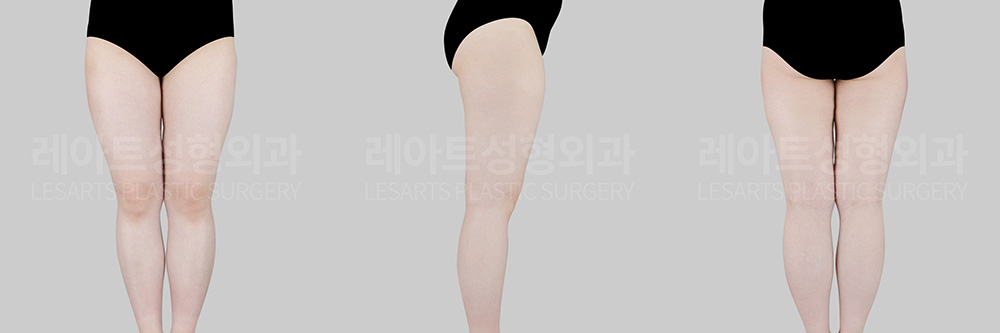
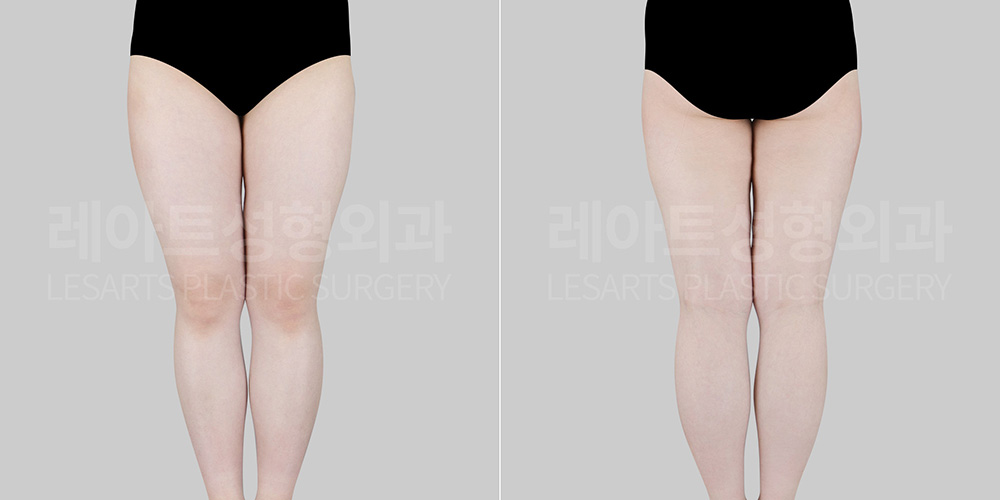
Preoperative Thigh Liposuction Assessment
The patient presented with localized lower-body adiposity concentrated below the pelvis relative to her upper frame; her inner thighs touched closely in a natural standing stance, causing her legs to appear visually short and heavy despite her tall stature.
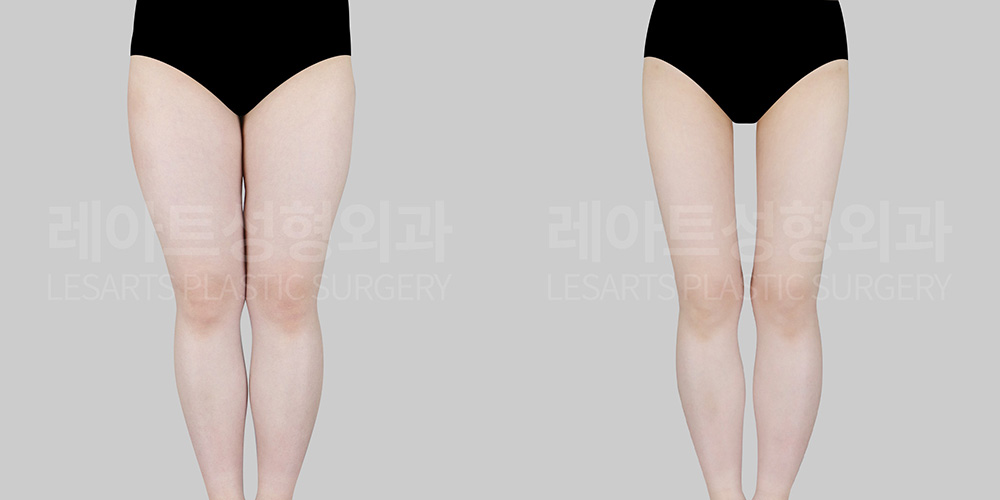
[Postoperative Progress at 4 Months]
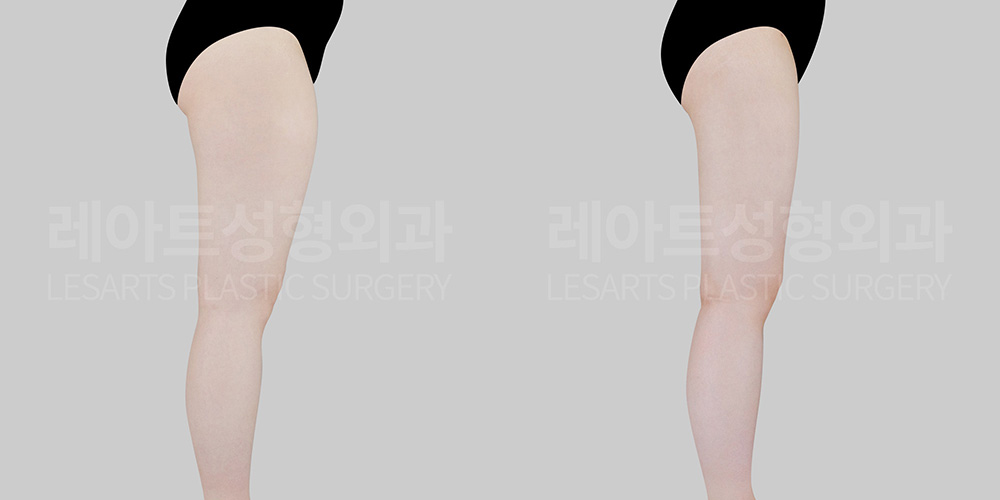
Thigh Circumference Reduction - Lesarts Plastic Surgery
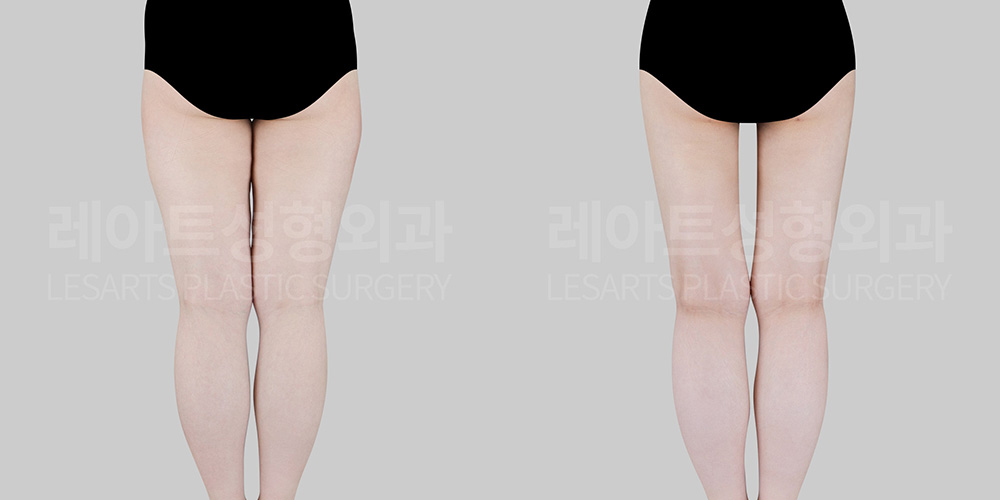
Creating a Thigh Gap with Thigh Liposuction - Dr. Pyongrim Choi
At 4 months postoperatively, the core transformation lies in a clean, continuous, natural straight thigh gap sculpted between both inner thighs, extending far beyond simple numeric reduction.
On frontal view, her legs appear visually elongated, while lateral and posterior profiles reveal trochanteric saddlebags and anterior quadriceps bulges smoothed into a seamless contour.
The patient expressed high satisfaction, noting: “Even without drastic changes on the scale, trousers and jeans fit entirely differently, and my leg silhouette looks completely transformed.”
[1-Year Long-Term Follow-Up Progress]
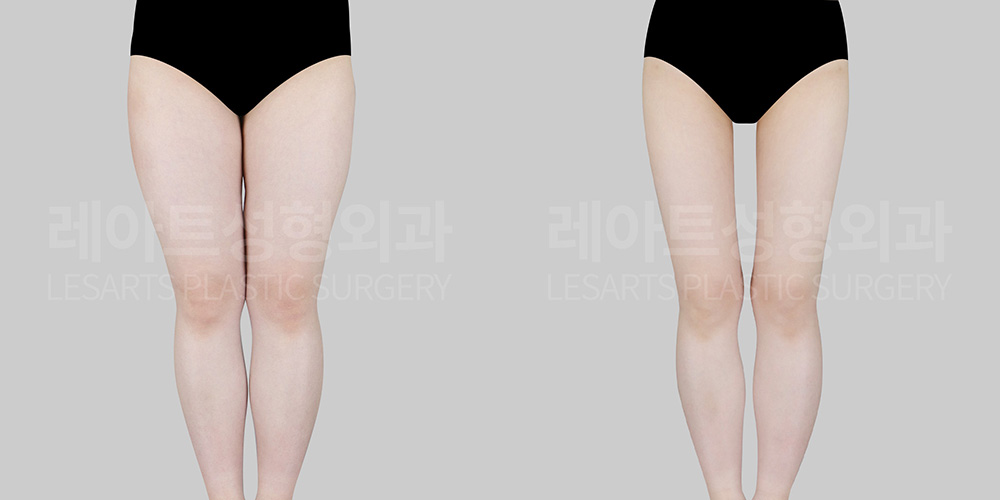
1-Year Follow-Up Post-Thigh Liposuction - Lesarts Plastic Surgery

Inner Thigh Liposuction - Dr. Pyongrim Choi, Lesarts

From the 4-month mark through to one year, the patient maintained healthy nutritional habits and light aerobic exercise, supporting continued physical vitality.
As a result, the surgically contoured thigh gap settled into an even firmer, more defined contour, establishing an elongated lower extremity proportion extending continuously from pelvis to ankle.
Liposuction is not a general obesity treatment aimed solely at scale weight; it is a body contouring procedure that sculpts balanced lines over individual skeletal frameworks. When combined with consistent post-care and weight maintenance, outcomes remain stable and rewarding for years.
A thigh gap is not merely a transient trend. Sculpting an inner thigh contour tailored to personal anatomy elevates visual limb length, pelvic curvature, and overall structural balance. However, imposing a standardized, uniform shape across all patients is clinically inappropriate. Disregarding pelvic alignment, quadriceps bulk, and subcutaneous fat distribution risks causing bow-legged deformities or surface indentations.
The most rewarding thigh liposuction is never the one that extracts the highest volume of fat indiscriminately, but one that executes a tailored design harmonizing with the patient's native frame.
At Lesarts Plastic Surgery, we analyze individual skeletal angles and bodily proportions rather than focusing solely on numeric measurements, aiming to sculpt leg contours that deliver both aesthetic elegance and functional comfort in daily life. If persistent inner thigh fullness causes your lower body to feel heavy, we encourage you to schedule an in-depth consultation with a board-certified plastic surgeon to explore a safe, customized surgical plan.
Thigh Liposuction FAQ
Q1. Why does having a space between the thighs (thigh gap) make one appear significantly more slender than their actual weight?
A. When inner thighs touch closely, the lower body easily appears wide and visually shortened. Establishing medial clearance creates an optical effect where legs appear longer and straighter, while relative waist and pelvic curves become more pronounced, refining overall bodily proportions.
Q2. What functional discomforts in daily life improve after reducing inner thigh fat?
A. Mechanical friction during ambulation is eliminated. In particular, chafing, heat rash, skin irritation, and friction-induced hyperpigmentation common during warmer months are substantially reduced, making physical activities like running or hiking far more comfortable.
Q3. What complications can arise from over-aspiration of the inner thigh?
A. Due to thin skin and rich lymphatic networks, excessive aspiration can lead to dense fibrous adhesions, localized step-offs or indentations, and dermal laxity with transverse creasing. Controlled extraction that preserves a smooth contour is mandatory.
Q4. Is post-surgical firmness or uneven induration normal during early recovery?
A. Yes, this is an expected physiological healing reaction known as bio-bands. As tissues heal and skin contracts, temporary firmness and edema develop; with consistent compression garment wear and adequate hydration, tissues progressively soften over several months.
Q5. What is the key to maintaining smooth leg contours from 4 months to 1 year post-op?
A. Following structural contouring via liposuction, maintaining stable body weight through balanced nutrition and light aerobic exercise is essential. Sustained post-care allows the refined thigh gap to settle naturally, supporting long-term aesthetic stability.
Dr. Pyongrim Choi


Cases finding
similar to my profile
Customer Diagnostics


Select the surgery and
area you are interestedto see real
before andafter changes.


we
make you,
the art
Clinic hours
MON - FRI
10 am – 7pm
SAT
10 am – 4pm
Holiday
SUN, HOLIDAY
Location
Lesarts Moon Clinic Tower 4-5F, 40, Nonhyeon-ro 168-gil,
Gangnam-gu, Seoul, Republic of Korea

Medical institution name Lesarts Plastic Surgery
Address Lesarts Moon Clinic Tower 4-5F, 40, Nonhyeon-ro 168-gil, Gangnam-gu, Seoul, Republic of Korea
Representative Moon sung jun
