




Online Consultation
Please accurately enter the information below.
Quick Cost Consultation
Quick Consultation & Reservation
Cases finding
similar to my profile






Doctor's Note
Medical columns by our surgeons
Gynecomastia | 2-Week Post-Gynecomastia Surgery Progress, Scar Condition & Contour Transformation
2026-09-18
Gynecomastia | 2-Week Post-Gynecomastia Surgery Progress, Scar Condition & Contour Transformation
Q. What visual contour changes and scar management protocols can be expected during the early 2-week recovery phase following gynecomastia surgery?
A. Even during the early recovery phase with residual swelling and minor bruising, the periareolar fullness flattens and the apex of projection shifts upward toward the upper pectoralis, establishing a defined, masculine chest wall contour immediately.
Following suture removal, wound closure strips such as Steri-Strips are applied to prevent scar stretching, with residual erythema gradually fading over approximately three months into an inconspicuous line.
Learn More About Lesarts Gynecomastia Surgery
Written by Dr. Kukhan Lee, Lesarts Plastic Surgery
This column was authored directly by our medical staff.
※ Unauthorized copying, editing, or redistribution is strictly prohibited. ※
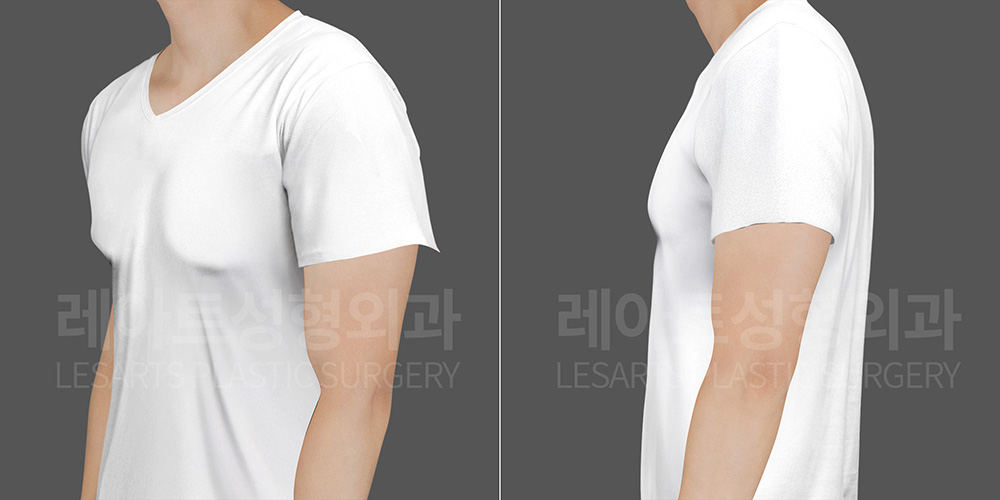
Preoperative Cotton T-Shirt Fit in Gynecomastia
As the peak summer vacation season sets in and temperatures rise, lightweight clothing becomes a daily necessity.
During this period, men seeking consultations at plastic surgery clinics due to concerns over forward chest projection and retroareolar lumps noticeably increase.
For those who struggle to wear a single thin white t-shirt comfortably, often layering thicker garments or hesitating to visit summer beaches, water parks, and pools, this represents a significant personal concern.
A prime anatomical cause behind this daily discomfort and clothing fit limitation is male gynecomastia.
Despite consistent resistance training and rigorous dietary weight control, rounded lower pole chest fullness frequently resists reduction,
and while compression undershirts or adhesive concealers provide temporary masking, they cannot serve as fundamental medical solutions.
Recently, an increasing number of proactive patients visit our clinic after reviewing clinical columns and surgical reviews to evaluate their chest structure accurately.
During initial consultations, a frequent question asked by male patients is:
“Will I be able to see visible contour changes immediately during early recovery after surgery?”
While tissue stabilization, resolution of swelling, and scar maturation require several months, the majority of patients perceive a dramatic improvement in chest contours and wardrobe fit from the early post-op phase.
In this clinical case, we review the contour changes and wound healing progression observed at 2 weeks post-gynecomastia surgery.
The patient was a male in his early 20s measuring 178 cm and 77 kg with an athletic build.
In-clinic body composition analysis revealed a lean body fat percentage of approximately 12%, reflecting dedicated fitness routines, weightlifting, and balanced nutrition.
Nevertheless, rounded, feminine lower chest projection persisted despite dieting, leading him to suspect true gynecomastia,
prompting his visit to Lesarts Plastic Surgery for definitive diagnostic ultrasound evaluation.

Preoperative Evaluation: Chest Projection & T-Shirt Silhouette
His foremost daily frustration was the visible chest silhouette protruding beneath thin summer t-shirts.
Beyond facing strict limitations when selecting wardrobe options, he experienced psychological self-consciousness in settings requiring him to remove his shirt, such as swimming pools or beach resorts.
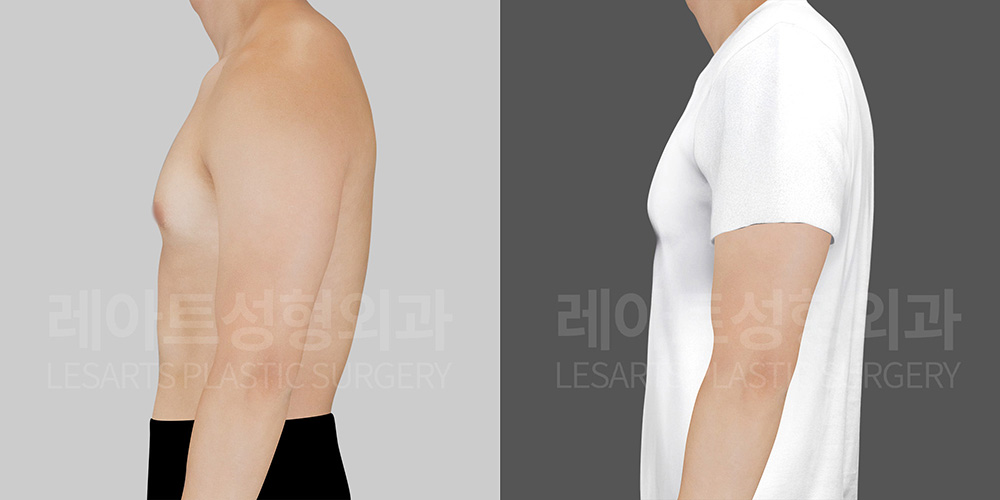
Preoperative View: Contrast Between Pectoralis Musculature and Rounded Lower Pole
Targeted physical examination revealed well-developed pectoralis major musculature, providing masculine muscular volume across the upper chest pole.
Conversely, the lower chest pole exhibited focal outward protrusion centered beneath the areola due to hypertrophic glandular tissue, forming an unbalanced, rounded contour.
This obscured the firm, straight lines typical of a masculine frame, leading to a definitive diagnosis of Simon Grade IIa gynecomastia.
Diagnostic ultrasound confirmed well-defined pectoralis musculature along with dense, firm true glandular discs measuring over 20 mm (2 cm) in diameter situated deep within both retroareolar regions.
Correlating clinical examination with imaging findings, true gynecomastia (Simon Grade IIa) requiring concurrent subcutaneous glandular excision and targeted liposuction was confirmed.
Before finalizing his decision, the patient asked:
“How much will my chest contour realistically transform after surgery?”
While eager to resolve a chest shape that had troubled him since his school years, he also experienced natural apprehension regarding surgery.
Through an in-depth consultation reviewing procedural mechanisms, recovery timelines, and similar clinical case comparisons, he proceeded with confidence.

Immediate Postoperative Contour Transformation - Lesarts Plastic Surgery
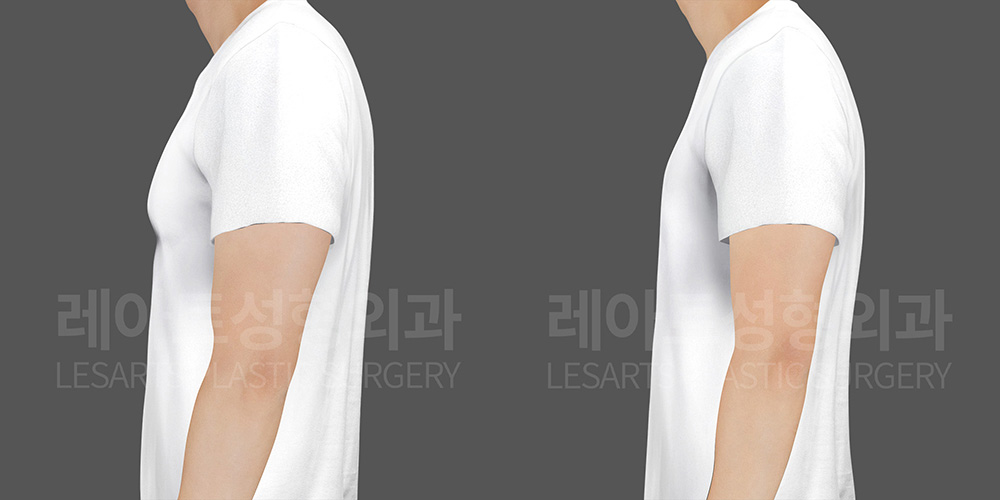
T-Shirt Fit at 2 Weeks Post-Gynecomastia Surgery - Dr. Kukhan Lee, Lesarts
2-Week Postoperative Progress and Recovery
The two-week postoperative milestone marks the removal of periareolar micro-sutures and the transition to structured taping and scar management.
At this early stage, minor residual swelling and bruising may remain, and subtle bilateral asymmetries or temporary tissue firmness can be felt as part of normal healing.
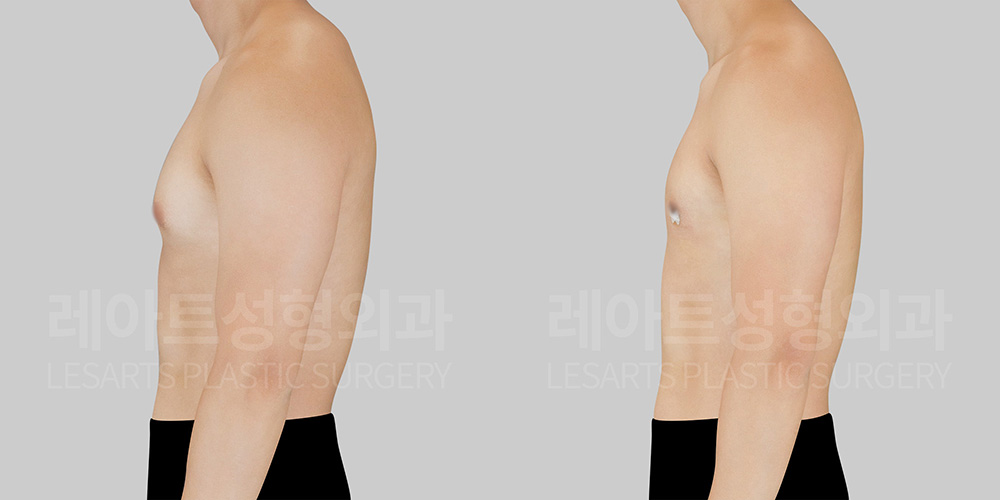
Male Gynecomastia Glandular Excision - Dr. Kukhan Lee, Lesarts Plastic Surgery
Nonetheless, comparing his baseline presentation reveals a dramatic, visible refinement across the lower chest pole.
The anterior projection height of the lower pole flattened into a smooth, even plane,
and the apex of chest projection on lateral profile shifted upward from the areola toward the upper pectoralis major.
Because the patient possessed well-developed pectoralis musculature, this three-dimensional contour improvement appeared distinctly defined and athletic.
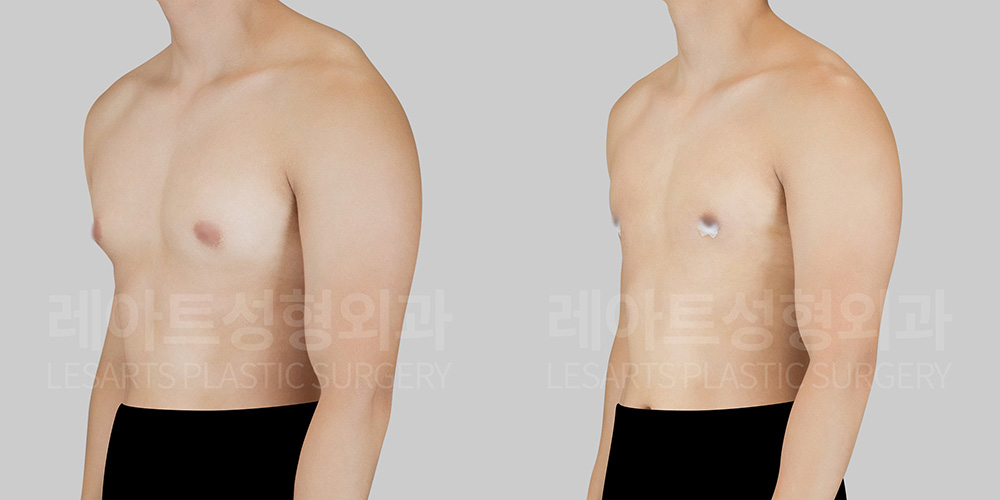
2-Week Postoperative Outcomes - Dr. Kukhan Lee, Lesarts Plastic Surgery
Furthermore, resolving the rounded lower areolar fullness established a masculine, straight chest wall contour integrating seamlessly with the upper pectorals.
Firming the lower pole reduced visual vertical chest length from the front, establishing a structured, masculine chest profile.
Following suture removal, medical wound closure strips (Steri-Strips) were applied along the periareolar margin to support tension-free scar stabilization.
Micro-incisions placed precisely along the pigmented areolar boundary typically exhibit fading erythema around 3 months post-op, blending into surrounding dermal tones as healing matures into an inconspicuous line.
As internal edema fully resolves and soft tissues soften over coming months, his chest wall silhouette will settle into an even more natural, sculpted masculine contour.
If forward chest projection impacts personal confidence, clothing choices, or social interactions,
rather than dismissing it as simple excess weight, consulting a plastic surgery clinic to check for glandular proliferation is recommended.
Particularly when localized retroareolar fullness persists despite high-intensity weight training and caloric control, high-resolution ultrasound by a board-certified plastic surgeon offers the most accurate initial step toward resolving this concern.
Male gynecomastia is a recognized medical condition that can lead to private distress and diminished social confidence.
Through accurate diagnostic evaluation and safe, customized surgical execution, you can regain comfortable confidence when wearing lightweight clothing this summer.
Gynecomastia FAQ
Q1. Why did the lower chest protrude in a rounded shape despite an athletic build with 12% body fat?
A. Although the pectoralis major was well-developed, true glandular tissue measuring over 20 mm resided beneath the areolas (Simon Grade IIa). Glandular parenchyma cannot be reduced through exercise or diet; lower body fat often highlights this feminine lower pole projection further.
Q2. What is the most significant profile transformation observed at 2 weeks post-gynecomastia surgery?
A. The anatomical apex of anterior projection shifts naturally from the areola upward toward the upper pectoralis major. Lower chest height flattens and vertical breast length appears shorter, creating a firm, masculine impression.
Q3. Are residual swelling, subtle asymmetry, or surface induration normal at 2 weeks post-op?
A. Yes, these represent expected early wound-healing responses. Two weeks marks the beginning of tissue reorganization and edema clearance; temporary minor swelling or firmness resolves progressively into smooth contours as tissues stabilize.
Q4. How is scar care managed immediately following suture removal at 2 weeks?
A. Medical skin closure tapes such as Steri-Strips are applied over the incision to reduce skin tension and prevent scar widening. Subsequent topical scar regimens and UV protection support optimal scar maturation.
Q5. How long does it take for the periareolar incision scar to stabilize and become inconspicuous?
A. Erythema along the incision typically begins to fade around 3 months postoperatively. Throughout ongoing tissue remodeling, the scar blends into the pigmented areolar boundary, maturing into an inconspicuous line.
Dr. Kukhan Lee


Cases finding
similar to my profile
Customer Diagnostics


Select the surgery and
area you are interestedto see real
before andafter changes.


we
make you,
the art
Clinic hours
MON - FRI
10 am – 7pm
SAT
10 am – 4pm
Holiday
SUN, HOLIDAY
Location
Lesarts Moon Clinic Tower 4-5F, 40, Nonhyeon-ro 168-gil,
Gangnam-gu, Seoul, Republic of Korea

Medical institution name Lesarts Plastic Surgery
Address Lesarts Moon Clinic Tower 4-5F, 40, Nonhyeon-ro 168-gil, Gangnam-gu, Seoul, Republic of Korea
Representative Moon sung jun
