




Online Consultation
Please accurately enter the information below.
Quick Cost Consultation
Quick Consultation & Reservation
Cases finding
similar to my profile






Doctor's Note
Medical columns by our surgeons
Gynecomastia | Continuing Hair Loss Medication After Gynecomastia Surgery: Is It Safe?
2026-09-18
Gynecomastia | Continuing Hair Loss Medication After Gynecomastia Surgery: Is It Safe?
Q. Can I continue taking hair loss medications (finasteride, dutasteride) as before after gynecomastia surgery?
What is the safe protocol for dosage adjustment?
A. Continuing daily high-dose intake carries the risk of endocrine imbalance that can re-stimulate residual glandular tissue and cause recurrence, making strategic reduction necessary.
However, abruptly discontinuing medication can trigger acute rebound hair loss; therefore, finasteride should be reduced to 3–4 times per week (alternate days) and dutasteride to 2–3 times per week to balance hair preservation and recurrence prevention.
Learn More About Lesarts Plastic Surgery Gynecomastia Surgery
Written by Dr. Jihoon Moon, Lesarts Plastic Surgery
This column was authored directly by our medical staff.
※ Unauthorized copying, editing, or redistribution is strictly prohibited. ※
During consultations with young male gynecomastia patients in their 20s and 30s, we frequently observe that many take hair loss prevention therapies routinely, much like daily vitamins or nutritional supplements.
Male hair loss prevention has truly become common and widespread in everyday health maintenance.
However, when we explain during physical evaluations that “current hair loss medications can be directly associated with the glandular proliferation driving gynecomastia,”
most male patients express significant surprise and concern.
For many, this is the first time they encounter the physiological link between anti-androgenic hair medications and male breast tissue development.
Consequently, after restoring a flat, masculine chest contour via gynecomastia surgery, a frequent question asked in the consultation room is:
“Doctor, is it safe to resume taking my daily hair loss medication immediately after gynecomastia surgery?”
In this column, we review how 5-alpha reductase inhibitors such as finasteride and dutasteride can stimulate male glandular parenchyma,
and present strategic dosage titration guidelines to protect your chest contour while safely maintaining hair density after surgery.
1. How Do Male Hair Loss Medications Stimulate Glandular Breast Tissue?
Therapeutic agents for male androgenetic alopecia generally fall into two categories: oral endocrine modulators and topical peripheral vasodilators.

Potential Development of Gynecomastia After Hair Loss Medication
① Endocrine Modulators (Finasteride & Dutasteride Classes)
Androgenetic alopecia in men is primarily driven by testosterone converting via the 5-alpha reductase enzyme into dihydrotestosterone (DHT), a potent androgen that miniaturizes susceptible hair follicles.
Oral medications inhibit this enzymatic pathway, reducing circulating DHT levels to protect hair follicles from shedding.
However, suppressing DHT can lead to relative endocrine shifts, resulting in a higher ratio of active circulating estrogens relative to androgens.
When relative estrogenic signaling becomes dominant, it continuously stimulates rudimentary, dormant glandular parenchyma situated beneath the male areola,
potentially precipitating firm parenchymal enlargement and tenderness characteristic of true gynecomastia.
② Scalp Vasodilators (Topical Minoxidil, Low-Dose Oral Minoxidil)
These agents dilate peripheral microvasculature across the scalp, enhancing local nutrient delivery and perfusion directly to the hair follicles.
Because this mechanism does not alter systemic androgen or estrogen ratios, it carries no physiological association with the onset of gynecomastia or post-surgical recurrence.
However, because vasodilators alone do not inhibit systemic DHT pathways, they are commonly co-prescribed alongside finasteride as supportive adjunct therapy.
2. Finasteride vs. Dutasteride: Clinical Differences in Gynecomastia Risk
The two primary 5-alpha reductase inhibitors (finasteride and dutasteride) present distinct pharmacodynamic profiles regarding their glandular stimulation potential.
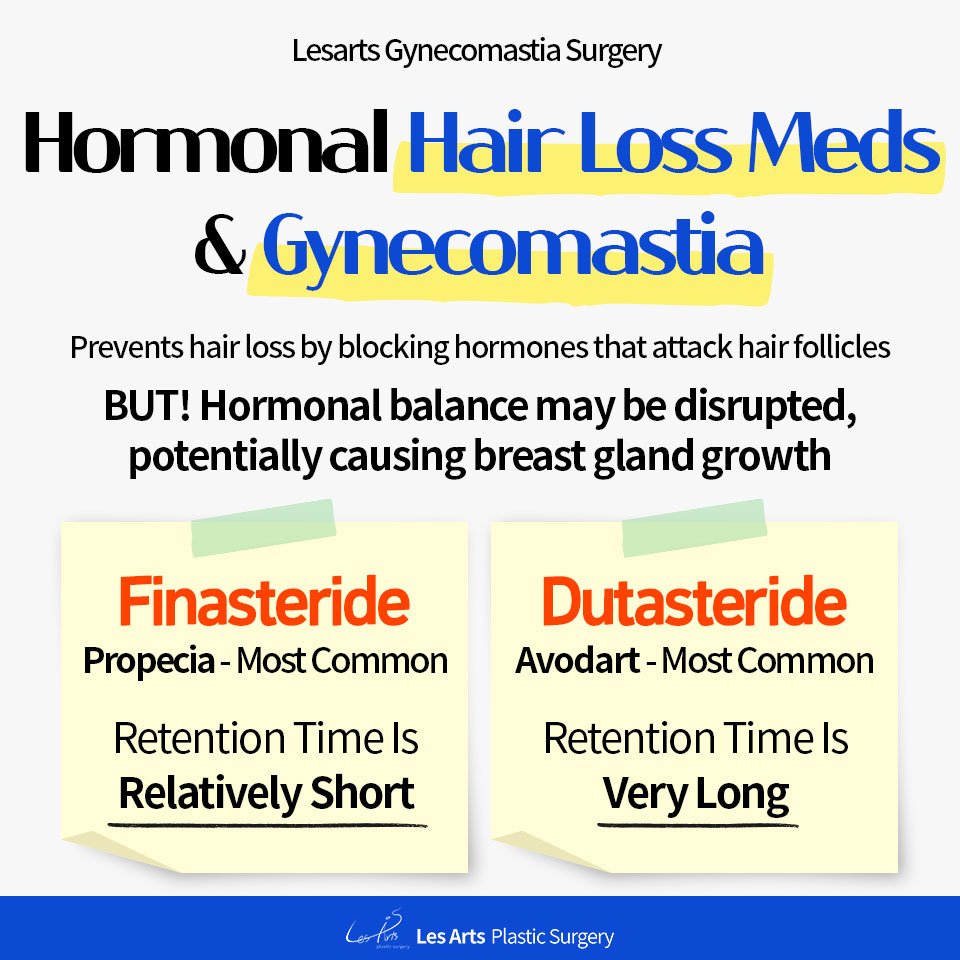
Finasteride, Dutasteride, and Gynecomastia - Dr. Jihoon Moon
① Finasteride (e.g., Propecia, Generic Finasteride)
Finasteride selectively blocks the Type II 5-alpha reductase isoenzyme predominantly localized in hair follicles.
Its hormonal suppression profile is comparatively mild, and its short plasma half-life allows systemic hormone levels to normalize rapidly if therapy is suspended.
② Dutasteride (e.g., Avodart, Generic Dutasteride)
Dutasteride dual-inhibits both Type I and Type II isoenzymes present across sebaceous glands and hair follicles.
While it provides potent DHT suppression, its prolonged terminal elimination half-life spans several weeks, meaning therapeutic agents persist within body tissues for extended durations.
Patients frequently transition from finasteride to dutasteride seeking enhanced hair density;
however, because dutasteride drives wider shifts in systemic endocrine balance and remains active for longer intervals, its potential to stimulate latent glandular breast tissue and induce mastalgia or tissue enlargement is correspondingly higher.
3. Literature Statistics vs. Clinical Observations in Plastic Surgery
Standard medical literature and pharmaceutical packaging inserts report the incidence of gynecomastia secondary to 5-alpha reductase inhibitors as approximately 1% to 2%.
Furthermore, statistical models indicate that continuing standard doses after surgical excision carries a relatively low probability of clinically significant recurrence.
However, in specialized male body contouring practices, clinical observation reveals a noticeably higher frequency.
A considerable number of young men in their 20s and 30s present with true gynecomastia after sudden-onset areolar tenderness and firm lumps following years of long-term medication use.
While surgical excision thoroughly removes the hypertrophic glandular disc and contiguous fat, preserving delicate subareolar tissue margins is anatomically required to prevent chest wall depression or nipple ischemia.
If daily high-dose hormonal inhibitors are continued postoperatively without modification, residual microscopic glandular cells can potentially respond to ongoing endocrine shifts, introducing risks of tenderness or late recurrence.
Therefore, following gynecomastia surgery, a ‘strategic dosage titration plan’ is strongly recommended to protect your newly sculpted chest contours while sustaining hair retention benefits.
4. Dosage Adjustment Guidelines for Hair Loss Medication Post-Surgery
① For Patients Previously Taking Daily Finasteride (1 mg Daily)
For those previously on daily regimens, step-wise titration minimizes estrogenic stimulation of the breast envelope while maintaining follicular protection.
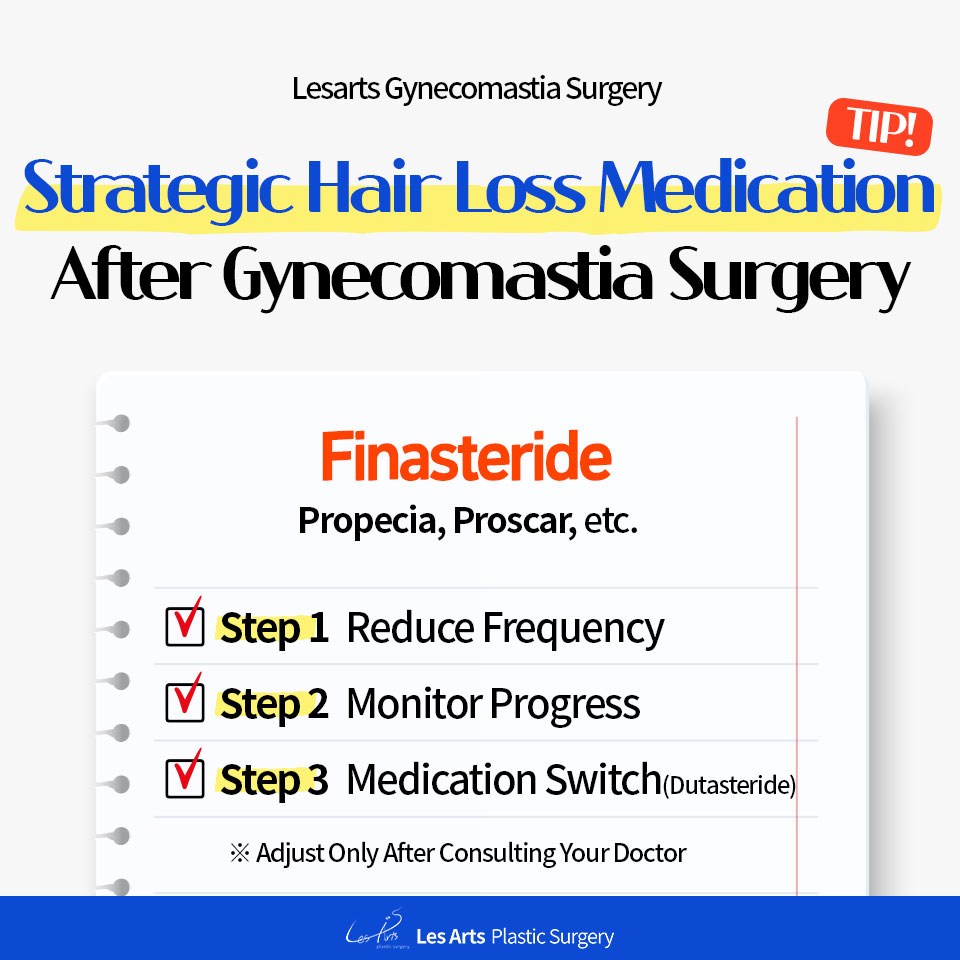
Post-Gynecomastia Surgery Hair Loss Medication - Finasteride
✔ Step 1 (Alternate-Day Scheduling): Transition from daily dosing to 3–4 times per week on alternate days (e.g., Monday, Wednesday, Friday, or Mon/Wed/Fri/Sun).
✔ Step 2 (Clinical Monitoring): Maintain this adjusted schedule for 3 to 6 months, monitoring for periareolar tenderness or nodularity while checking hair retention. In the absence of adverse symptoms, continue this maintenance protocol.
✔ Step 3 (Precautions for Medication Switching): If progressing hair loss necessitates switching to dutasteride, avoid daily dosing due to its prolonged half-life; start conservatively at 2–3 times per week to ensure safety.
② For Patients Previously Taking Daily Dutasteride (0.5 mg Daily)
Because dutasteride exhibits potent receptor inhibition and prolonged tissue retention, strategic interval spacing is especially critical.
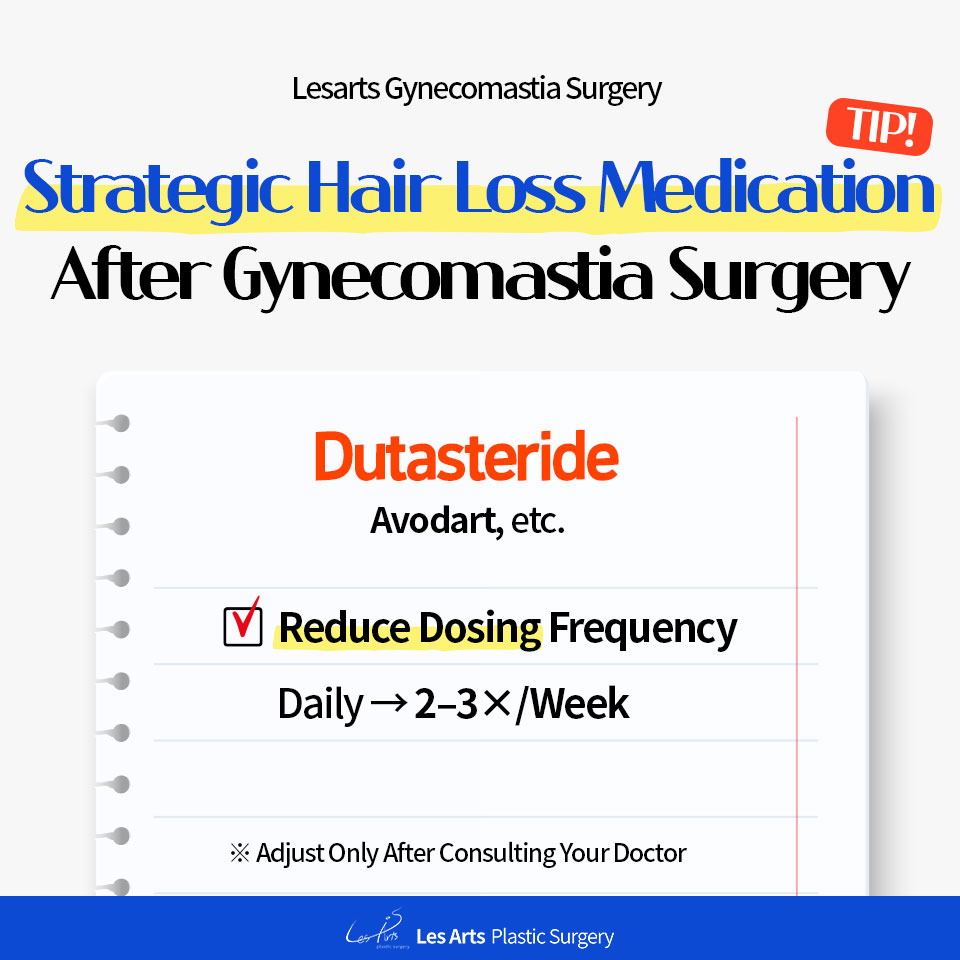
Dosing Protocol Post-Gynecomastia Surgery - Dutasteride
✔ Tailored Interval Dosing: Reducing intake frequency from daily to 2–3 times per week (e.g., Tuesday, Thursday, Saturday) reliably preserves follicular protection due to long pharmacodynamic half-lives while substantially decreasing endocrine stimulation to the chest.
5. The Golden Rule: Avoid Abrupt, Unsupervised Medication Discontinuation
Even upon learning that anti-androgen therapy can contribute to gynecomastia, abruptly discontinuing medication overnight must be strictly avoided.

When prolonged DHT suppression is abruptly halted, circulating hormones rebound sharply, often precipitating severe ‘acute rebound hair loss’ within weeks, resulting in distressing hair density loss.
Adjusting medication schedules or modifying agents post-gynecomastia surgery requires considering preoperative glandular volume, residual adiposity, and individual hair loss stage.
Rather than altering doses independently, consult with your board-certified plastic surgeon and hair loss specialist
to establish a tailored, safe regimen that preserves both your masculine chest contour and your hair density.
Gynecomastia Surgery FAQ
Q1. What is the physiological mechanism through which hair loss medications cause male breast enlargement?
A. Inhibiting DHT formation reduces localized androgenic activity and leads to relative estrogenic dominance.
This hormonal shift can stimulate dormant, immature glandular tissue in the male breast, causing enlargement and tenderness.
Q2. Which medication presents a higher risk of gynecomastia: finasteride or dutasteride?
A. Dutasteride carries a higher potential risk.
While finasteride selectively inhibits the Type II isoenzyme, dutasteride dual-inhibits Types I and II with a significantly longer half-life, creating wider hormonal shifts and greater potential for glandular stimulation.
Q3. Why must recurrence risks be considered even after surgical excision of glandular tissue?
A. While the hypertrophic glandular disc is excised, microscopic basal cells are intentionally preserved beneath the areola to prevent chest wall depression or nipple ischemia.
Daily high-dose medication use post-op can re-stimulate these cells under persistent hormonal shifts, introducing potential recurrence risks.
Q4. What is the recommended titration protocol for hair loss medications post-surgery?
A. Finasteride should be reduced from daily dosing to 3–4 times per week (alternate days), while dutasteride should be adjusted to 2–3 times per week.
These interval schedules reliably preserve hair density while substantially decreasing endocrine stimulation to the chest.
Q5. Why is abrupt cessation of hair loss medication discouraged if gynecomastia recurrence is a concern?
A. Abruptly stopping medication triggers a sharp rebound in suppressed DHT signaling, frequently leading to acute rebound shedding within weeks.
Dosage adjustments should always be phased in gradually under medical consultation rather than through self-directed cessation.
Dr. Jihoon Moon


Cases finding
similar to my profile
Customer Diagnostics


Select the surgery and
area you are interestedto see real
before andafter changes.


we
make you,
the art
Clinic hours
MON - FRI
10 am – 7pm
SAT
10 am – 4pm
Holiday
SUN, HOLIDAY
Location
Lesarts Moon Clinic Tower 4-5F, 40, Nonhyeon-ro 168-gil,
Gangnam-gu, Seoul, Republic of Korea

Medical institution name Lesarts Plastic Surgery
Address Lesarts Moon Clinic Tower 4-5F, 40, Nonhyeon-ro 168-gil, Gangnam-gu, Seoul, Republic of Korea
Representative Moon sung jun
