




Online Consultation
Please accurately enter the information below.
Quick Cost Consultation
Quick Consultation & Reservation
Cases finding
similar to my profile






Doctor's Note
Medical columns by our surgeons
“Only 2 Weeks Post-Op?” Visible Contour Changes at 2 Weeks After Thigh Liposuction
2026-10-08
“Only 2 Weeks Post-Op?” Visible Contour Changes at 2 Weeks After Thigh Liposuction
Written by Dr. Pyongrim Choi, Lesarts Plastic Surgery
This column was authored directly by our medical staff.
※ Unauthorized copying, editing, processing, or redistribution is strictly prohibited. ※
Q. Can noticeable contour improvements already be observed at just 2 weeks after thigh liposuction?
Although 2 weeks post-op is an early healing phase with residual swelling,
distinct contour refinement can be visible depending on the treated zones and extraction scope.
However, this does not represent the final endpoint, and healing rates vary individually.
[Lesarts Liposuction Surgery Guide]
One of the most frequent questions from patients considering liposuction is
how soon noticeable body contour changes become visible postoperatively.
Particularly when preparing for thigh liposuction,
patients naturally look forward to seeing slimmer legs immediately after surgery.
In reality, however, because substantial swelling and bruising occur after surgery,
the thighs may initially look even fuller than their preoperative baseline.
Generally, in large-volume liposuction,
primary swelling can persist for 2 to 3 weeks or longer,
and bruising may remain visible for about a month.
Subsequent fine edema, tissue firmness from bio-bands,
and internal healing processes continue over several months;
consequently, settling into the final thigh contour requires approximately 3 months,
and up to 6 months in select cases.
Yet across real clinical follow-ups,
there are cases where prominent contour refinement is evident
at merely 2 weeks postoperatively.
Why can distinct improvements in leg lines be appreciated
even at the 2-week mark when post-surgical swelling is still present?
1. Why Contour Refinement Appears Early at 2 Weeks Post-Op
Liposuction outcomes are not determined solely by the volume of fat removed.
Which anatomical zones are treated, across which subcutaneous depth, and how seamlessly
the treated planes connect with adjacent contours are far more crucial.
The thighs present varying fat depth, dermal thickness,
and fibrous architecture across different aspects.
Therefore, rather than extracting fat indiscriminately,
identifying areas requiring contour correction precisely
and aspirating with minimal tissue trauma is essential.
Minimizing tissue irritation intraoperatively
and executing delicate cannula passes that protect
subdermal vascular and lymphatic networks
helps reduce early postoperative edema and recovery burden.
Ultimately, sculpting natural thigh contours depends
not on absolute extraction volume,
but on how accurately targeted regions are refined.
2. Structured Postoperative Management Supports Edema Resolution
Edema and ecchymosis appear immediately following liposuction,
and as internal tissues reorganize during recovery,
temporary firmness or surface texture unevenness can develop.
Therefore, consistently wearing medical compression garments as guided,
maintaining appropriate daily ambulation and light movement,
and avoiding dietary habits that exacerbate swelling
are integral to supporting recovery.
However, edema does not resolve at identical rates for all patients.
Variations occur depending on aspirated fat volume, operative surface area,
dermal elasticity, baseline tissue conditions, and individual biological healing rates.
Consequently, comparing one's 2-week progress directly
against another patient's timeline is unnecessary.
3. Clinical Case: Thigh Contour Transformation at 2 Weeks
The clinical case presented today involves a female patient in her early 20s
who underwent thigh liposuction at 160 cm and 56 kg.
Through her before-and-after photographic documentation,
we examine the visual transformation observed at 2 weeks postoperatively.
[Preoperative Baseline View]

[Preoperative Clinical Appearance Before Thigh Liposuction]
[2-Week Postoperative Follow-Up & Comparison]
Because only 2 weeks have elapsed since surgery, this does not represent the final outcome.
However, close comparison with baseline records
demonstrates clear transformation across the overall thigh contour.
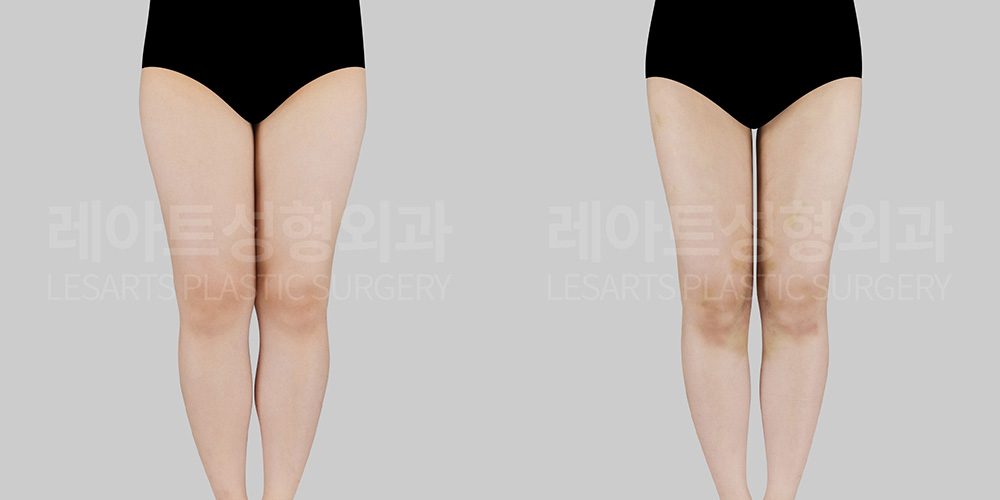
[2-Week Before-and-After Comparison - Lesarts Plastic Surgery]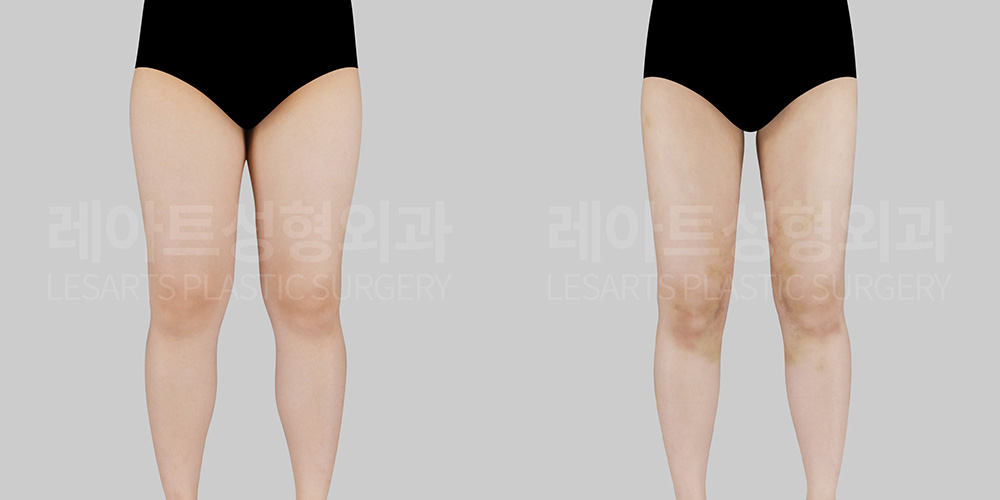
[Clinical Outcomes Immediately Following Suture Removal (2 Weeks Post-Op) - Lesarts Plastic Surgery]
1) Emergence of a Medial Thigh Gap at 2 Weeks
Preoperatively, accumulated medial thigh fat caused
broad skin-on-skin contact between the thighs when standing upright.
At 2 weeks postoperatively,
debulking the medial adipose volume sculpted a distinct clearance
between the thighs that was previously absent.
Accounting for anatomical curvature,
calibrating extraction volume across targeted zones
is vital to creating a natural, straight medial gap.
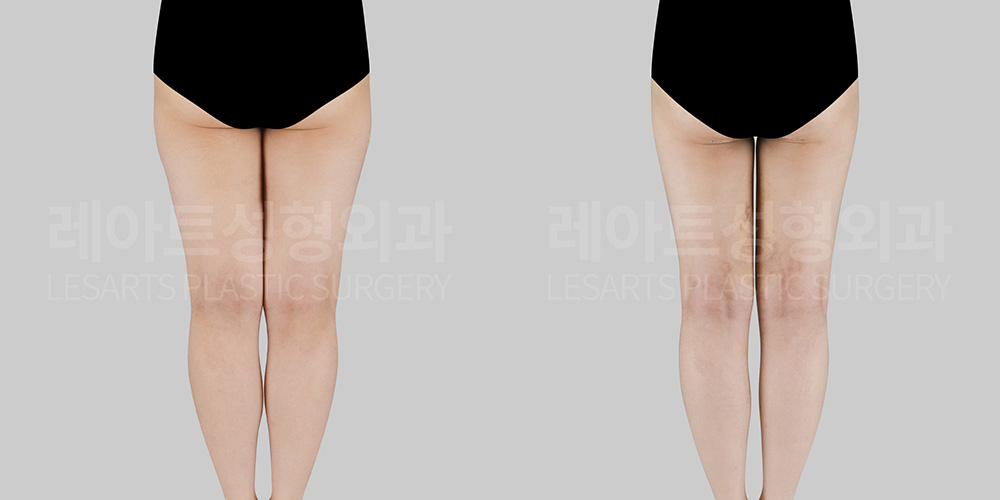
[Early Clinical Transformation - Dr. Pyongrim Choi, Lesarts Plastic Surgery]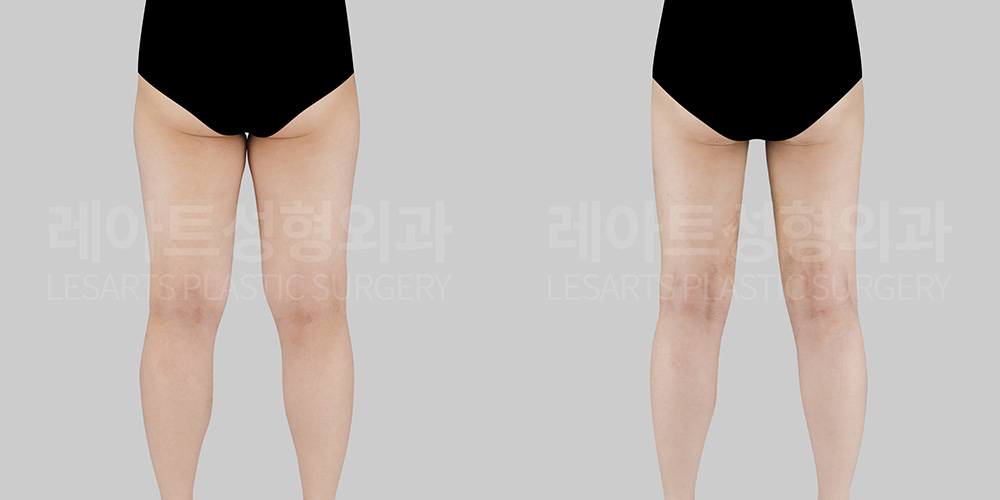
[2-Week Comparison of Medial and Saddlebag Debulking - Dr. Pyongrim Choi]
2) Saddlebag Transition Connecting the Hips to the Thighs
The second focal area is the lateral saddlebag contour transitioning from beneath the buttocks.
Preoperatively, lateral fullness bulging at the hip-thigh junction
made the lower frame appear wide and heavy.
At 2 weeks postoperatively, reduction of this outward protrusion
allowed the transition from hip to thigh to flow into a smoother, continuous curve.
Because gluteal projection must be maintained
while isolating and refining redundant lateral thigh fullness,
meticulously defining the operative boundaries is essential.
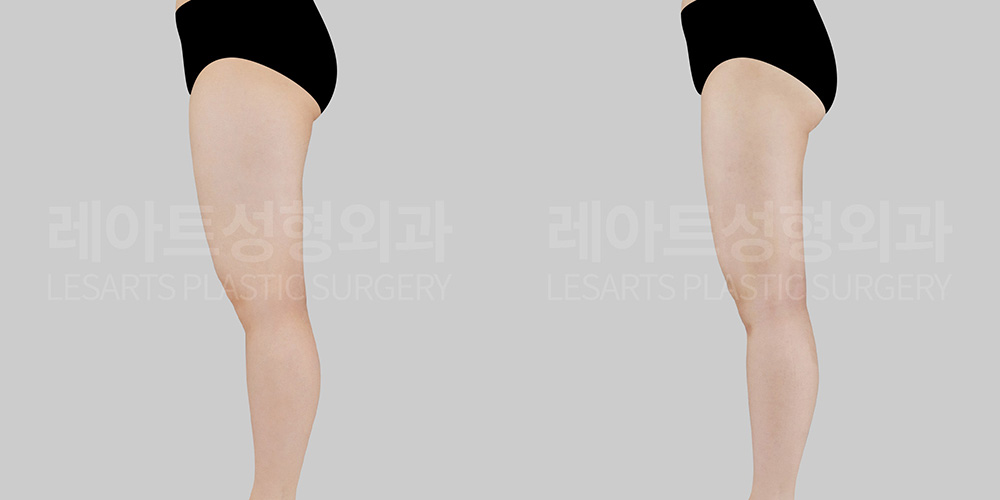
[Circumference Reduction Following Thigh Liposuction - Dr. Pyongrim Choi, Lesarts Plastic Surgery]
3) Anterior Quadriceps Refinement on Lateral Profile
Lateral profile documentation confirms volume reduction across the anterior thigh.
Beyond frontal narrowing,
debulking anterior forward projection
decreased anteroposterior thigh thickness noticeably.
The appearance at 2 weeks does not represent the definitive contour.
As residual edema continues to clear and internal tissues soften over coming months,
the leg silhouette will settle into an even smoother, more refined plane.
Ultimately, rewarding liposuction outcomes rely
not merely on early volume reduction,
but on establishing balanced, harmonious contours throughout the full recovery process.
Lesarts Plastic Surgery Thigh Liposuction
View More Clinical Case Analyses
▼▼▼
At 2 weeks postoperatively,
swelling has not fully subsided, making it premature to evaluate final results.
However, when based on precise preoperative design, targeted aspiration, and minimized tissue trauma,
the direction of aesthetic refinement is clearly recognizable even within this early 2-week window.
Because individual healing paces vary naturally,
comparing personal recovery with others is unnecessary.
While early contour changes at 2 weeks are encouraging,
allowing tissues to settle into smooth, cohesive lines over time
reflects the true measure of successful liposuction.
FAQ
Q1. How long does swelling typically last after thigh liposuction?
In large-volume procedures, primary swelling can persist for 2 to 3 weeks or longer,
and bruising may remain for about a month.
Final contour stabilization generally takes 3 to 6 months.
Q2. Can a thigh gap form as early as 2 weeks post-op?
In this clinical case, debulking medial adipose fullness
created a noticeable clearance between the thighs
at 2 weeks postoperatively.
Q3. Does thigh liposuction improve the saddlebag transition?
Aspirating outward lateral bulging allows the transition
from hip to thigh to flow into a continuous curve,
provided gluteal projection is preserved.
Q4. What is most important for post-surgical swelling management?
Wearing medical compression garments as guided,
maintaining light daily ambulation,
and avoiding sodium-rich foods that worsen fluid retention are essential.
Q5. Is the appearance at 2 weeks the final result?
No. Residual fine edema and tissue remodeling continue at 2 weeks.
As tissues stabilize over coming months,
thigh contours settle into an even smoother, more defined line.
Dr. Pyongrim Choi


Cases finding
similar to my profile
Customer Diagnostics


Select the surgery and
area you are interestedto see real
before andafter changes.


we
make you,
the art
Clinic hours
MON - FRI
10 am – 7pm
SAT
10 am – 4pm
Holiday
SUN, HOLIDAY
Location
Lesarts Moon Clinic Tower 4-5F, 40, Nonhyeon-ro 168-gil,
Gangnam-gu, Seoul, Republic of Korea

Medical institution name Lesarts Plastic Surgery
Address Lesarts Moon Clinic Tower 4-5F, 40, Nonhyeon-ro 168-gil, Gangnam-gu, Seoul, Republic of Korea
Representative Moon sung jun
