




Online Consultation
Please accurately enter the information below.
Quick Cost Consultation
Quick Consultation & Reservation
Cases finding
similar to my profile






Doctor's Note
Medical columns by our surgeons
Abdominal Liposuction | "A Belly That Won't Go Away with Exercise: It's Not That There's No Solution, It's That the Approach Was Wrong"
2026-10-08
Abdominal Liposuction | "A Belly That Won't Go Away with Exercise: It's Not That There's No Solution, It's That the Approach Was Wrong"
Written by Dr. Yongseung Seo, Lesarts Plastic Surgery
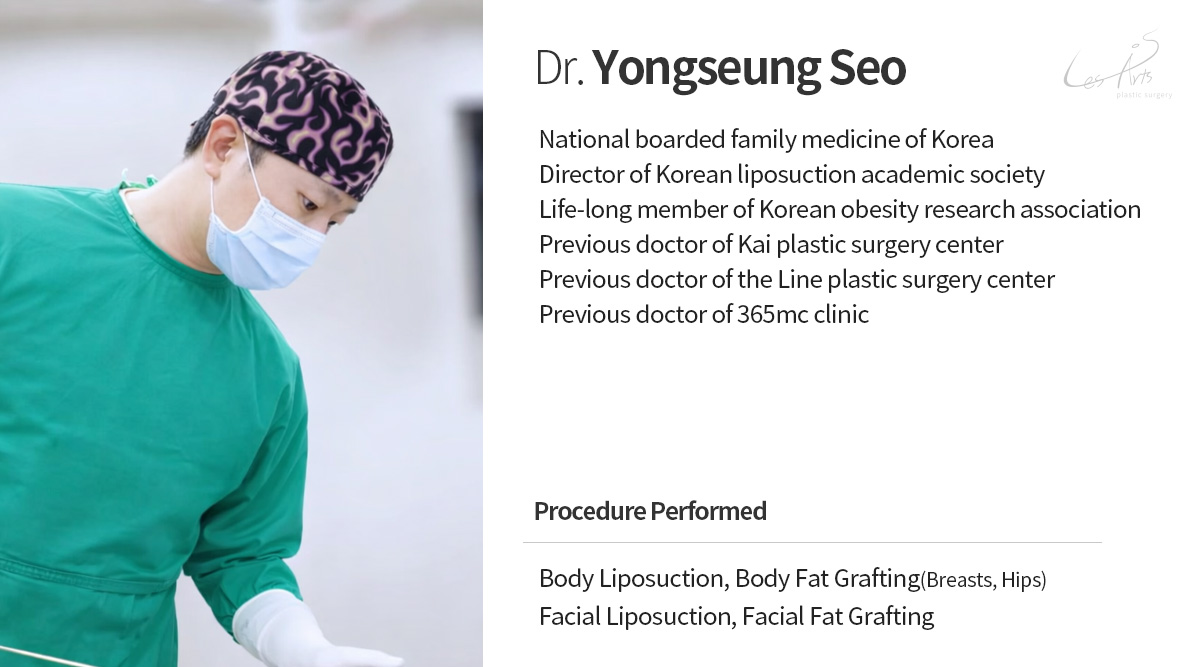
This column was authored directly by our medical staff.
Official Medical Column Directory
↓↓↓

※ Unauthorized copying, editing, or redistribution is strictly prohibited. ※
Q. How can stubborn abdominal fat that resists diet and exercise be improved?
When a thick layer of subcutaneous abdominal fat is present, liposuction can debulk redundant fat,
substantially refining torso circumference and abdominal contour lines.
However, if visceral adiposity is elevated, post-surgical dietary management must be maintained concurrently.
[View More Lesarts Abdominal Liposuction Cases]
Many individuals note that weight gain settles first in the abdomen, and even after dedicated weight reduction, belly fat stubbornly resists shrinking.
In clinical consultations, patients frequently share:
"Numeric scale weight is an issue, but my belly protrudes far more noticeably."
"Both my upper and lower abdomen stick out, so clothing completely lacks silhouette."
These concerns represent common and frustrating experiences.
Despite trying numerous diet regimens, the focal abdominal fat one wishes to lose resists depletion,
while volume in areas where fullness is desirable—such as the face, breasts, or hips—diminishes first,
often leading to diet fatigue and abandonment.
When adipose tissue concentrates disproportionately in the abdomen,
the bodily silhouette in the mirror can feel significantly larger than the scale number suggests.
The patient presented today presented with a generally full frame with elevated fat reserves,
yet her primary distress centered on anterior abdominal protrusion and stubborn torso circumference.
She visited Lesarts Plastic Surgery seeking definitive surgical correction for these localized concerns.
[Patient Profile]
Age: Early 20s
Height: 165 cm
Weight: 72.6 kg
BMI: 26.7 kg/m²
Body Fat Percentage: 41.5%
Visceral Fat Level: 15
※ Clinical outcomes of liposuction may vary individually depending on tissue distribution, muscular anatomy, and dermal condition, even among patients with similar physical specifications.
[Consultation & Diagnostic Findings]
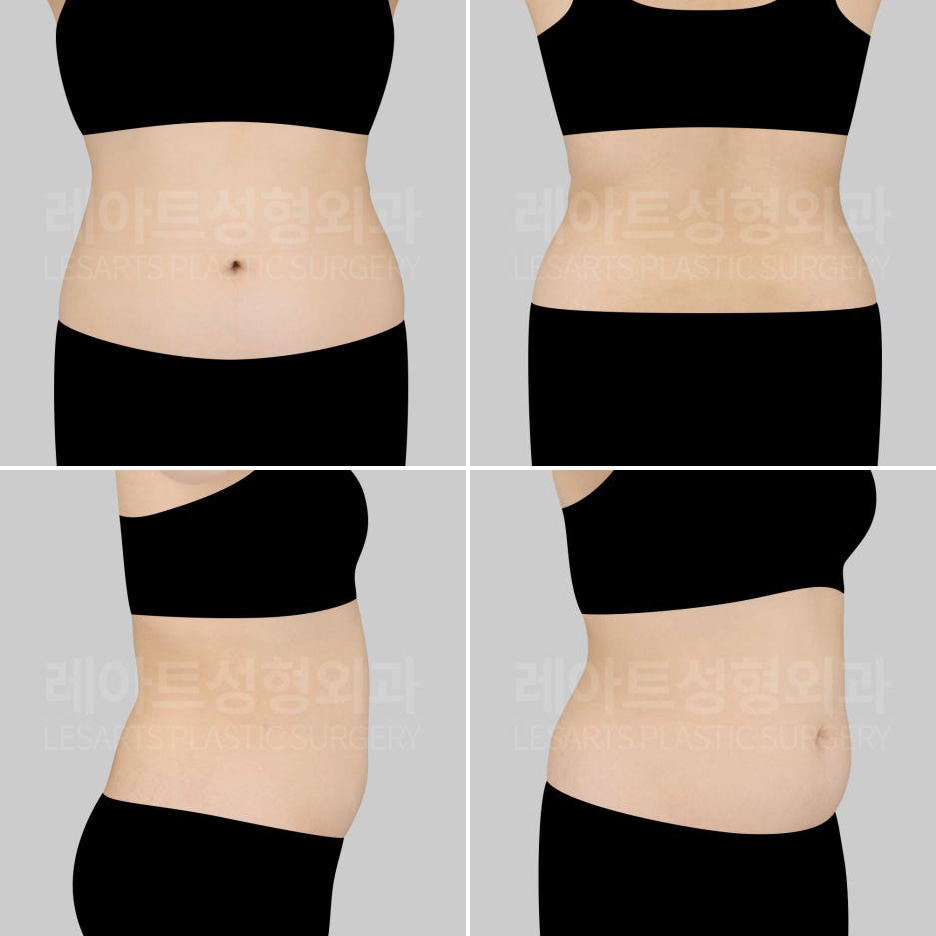
[Preoperative Diagnostic Evaluation for Abdominal Liposuction]
"My belly sticks out forward so much that I desperately want to reduce my overall torso circumference."
Her foremost concern was an abdomen that protruded noticeably forward whether standing or sitting.
She wanted to resolve the heaviness of her torso, which remained conspicuous even under loose clothing.
Physical palpation and examination revealed moderate adipose deposits across the flanks and love handles,
yet in contrast, her baseline waistline curvature was comparatively well preserved.
This provided a favorable anatomical foundation for sculpting a defined S-curve postoperatively.
We encouraged her that with careful post-operative maintenance following abdominal liposuction,
a graceful, tapered waistline could be successfully achieved.
However, as she had noted, the anterior abdominal wall projected outward heavily,
disrupting harmony with adjacent body regions and making the upper torso appear broad and bulky.
Diagnostic Ultrasound Findings:
Upper Abdomen: 44 mm, Lower Abdomen: 46 mm
Flanks: 19 / 17 mm, Love Handles: 18 / 18 mm
Ultrasound confirmed a substantially thick subcutaneous adipose layer throughout the abdominal wall.
In particular, subcutaneous fat depth across the anterior abdomen was more than twice as thick as contiguous areas.
Given such pronounced adipose depth, the absolute volume of extractable fat was substantial,
indicating that a marked reduction in torso circumference could be anticipated postoperatively.
However, because large extraction volumes were planned,
evaluating how well the dermal envelope could retract over the debulked volume was a critical clinical factor.
Accordingly, we provided thorough preoperative counseling regarding the potential for post-surgical skin laxity.
Fortunately, the patient was in her early 20s with resilient dermal tone
and well-maintained cutaneous elasticity.
We estimated that the probability of noticeable skin sagging following thorough fat evacuation was low,
and that any minor laxity would remain minimal.
However, because her visceral fat level was measured at 15 (significantly elevated),
we clearly advised her that unless dietary management was actively pursued alongside liposuction,
achieving a completely flat anterior abdominal profile would have inherent limitations.
Additionally, her medical history revealed intermittent abdominal cramping and loose stools when taking antibiotics.
Because this is a known, manageable drug-related side effect,
we confirmed that it posed no clinical impediment to safe surgical execution.
[Before & After Comparison: Abdominal Liposuction]
(Photographed 3 months postoperatively under identical lighting and clinical conditions)
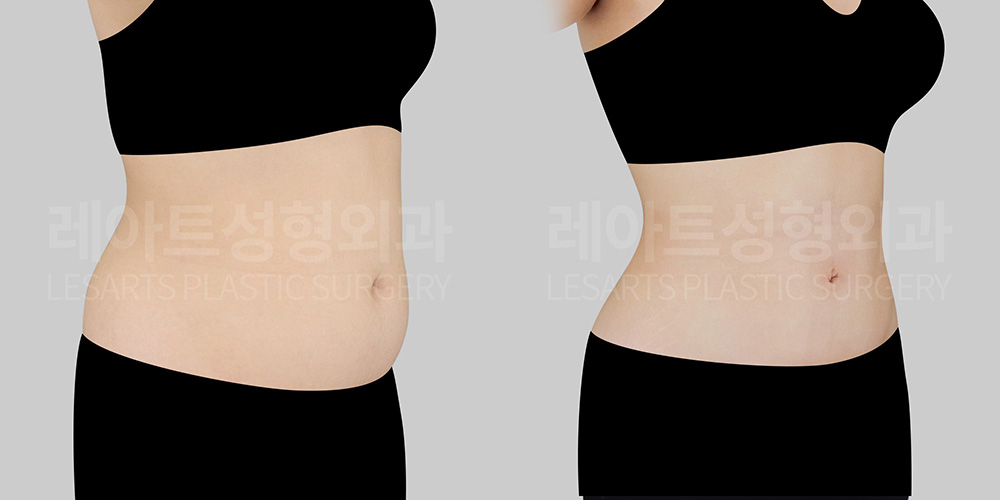
Preoperatively, the anterior abdominal wall exhibited broad outward projection from upper to lower segments.
On lateral profile, the contour flowing from beneath the inframammary line down to the suprapubic area
bulged forward continuously.
Postoperatively, the most pronounced improvement was observed across the anterior wall.
Periumbilical volume decreased visibly,
and the lateral profile from epigastrium to mons pubis flattened smoothly,
transforming into a flat, sleek abdominal silhouette.
This dramatic refinement reflects not only surgical fat extraction,
but also the patient's disciplined post-operative effort to reduce deep visceral adiposity.
We commended her dedication to ongoing lifestyle management.
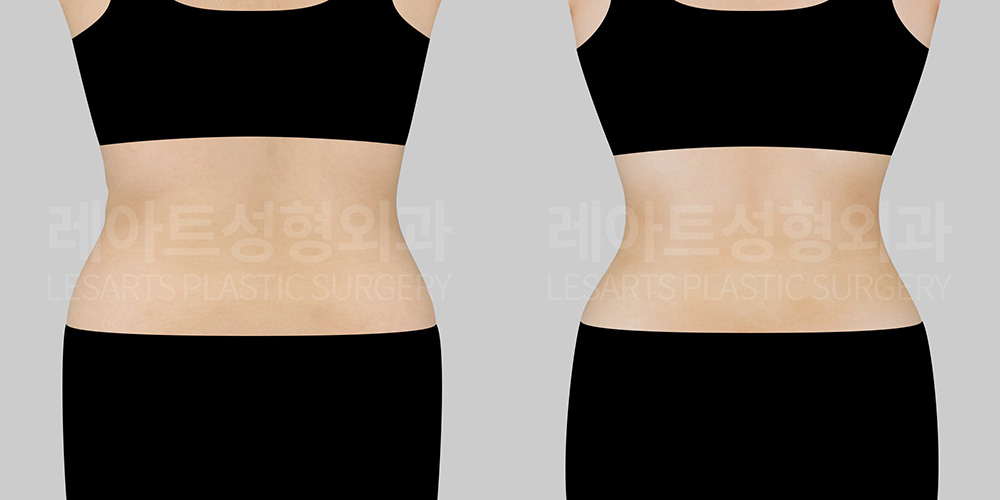
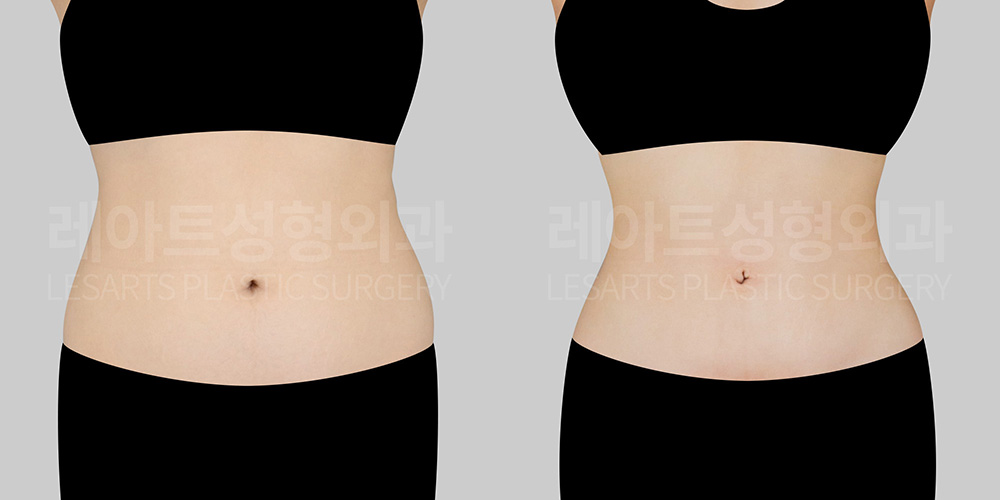
Preoperatively, her lateral flank line had retained noticeable waist indentation despite overall body fat reserves.
Following liposuction, this native curvature was preserved and accentuated into a refined contour,
making the inward waistline taper distinctly clearer.
Combined with debulking of anterior projection,
the proportional ratio between waist and pelvis improved toward an ideal aesthetic balance.
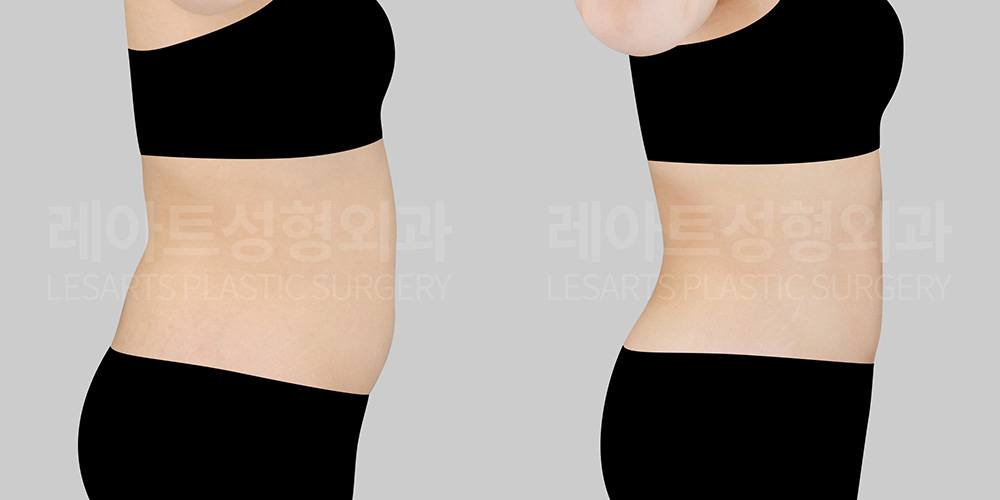
Preoperatively, the love handle region on posterior view presented soft folding
extending from below the bra line down to the upper gluteals.
Postoperatively, localized volume in this area diminished significantly,
streamlining the transition from mid-back into the waistline
and resolving tissue overhang above waistband lines.
Because this case involved extracting large volumes of adipose tissue,
our foremost clinical concern preoperatively had been post-surgical skin laxity.
However, at 3 months post-op,
the cutaneous envelope retracted smoothly over the reduced frame without noticeable wrinkling or drooping,
displaying a taut, streamlined surface.
Her young dermal elasticity and baseline skin tone
allowed her to achieve a natural, balanced body contour without the laxity
often feared in large-volume extraction.
Lesarts Abdominal Liposuction
View More Before & After Case Analyses
↓↓↓

Many patients visit our clinic troubled by localized contours
even when overall scale weight has remained stable.
This occurs not because they fail to see the value of lifestyle management,
but because repeated dietary plateaus create frustration,
or because a body adapted to metabolic set points
resists localized change despite ongoing effort.
While liposuction is not intended as a weight-loss tool,
it frequently offers meaningful, practical breakthroughs for individuals struggling with resistant local deposits.
When losing weight through diet and exercise,
adipocytes shrink in size while the total cell count remains unchanged.
Conversely, liposuction physically removes subcutaneous fat cells from targeted areas,
meaning that even if body weight rises slightly in the future,
treated areas resist expanding as readily as before.
Furthermore, seeing resistant contours refine visibly
often provides the psychological motivation to sustain healthy habits.
It serves as an inspiring catalyst to reignite body maintenance routines.
However, choosing liposuction solely as an alternative to healthy lifestyle habits is contraindicated,
and requires clear clinical understanding.
While higher adipose volumes allow for noticeable contour transformations,
the risk of post-surgical skin laxity also rises.
Therefore, accurately assessing dermal elasticity preoperatively
and establishing a plan that incorporates recovery and post-care are essential.
If persistent abdominal contours cause ongoing concern despite dedicated efforts,
we welcome you to consult with Lesarts Plastic Surgery to find a personalized clinical solution.
FAQ
Q1. Can abdominal liposuction flatten a protruding belly?
When a thick subcutaneous fat layer is present,
liposuction effectively debulks anterior abdominal volume.
However, if visceral adiposity is elevated, concurrent lifestyle management is required.
Q2. Can abdominal liposuction create a defined waist S-curve?
Contouring redundant fat along the flanks and love handles
accentuates waistline indentation
and refines the anatomical transition from waist to pelvis.
Q3. Can skin laxity develop after abdominal liposuction?
As extraction volumes increase,
the risk of skin laxity can rise proportionally.
Evaluating baseline dermal elasticity preoperatively is therefore essential.
Q4. What changes are observed at 3 months post-abdominal liposuction?
In this clinical case, anterior protrusion and torso circumference decreased significantly by 3 months,
with the skin retracting into smooth, contoured lines without noticeable laxity.
Q5. Is dietary management necessary after abdominal liposuction?
Liposuction targets subcutaneous fat rather than systemic weight reduction.
Particularly when visceral fat is elevated,
maintaining dietary discipline postoperatively is essential to achieving an optimal abdominal contour.
Dr. Yongseung Seo


Cases finding
similar to my profile
Customer Diagnostics


Select the surgery and
area you are interestedto see real
before andafter changes.


we
make you,
the art
Clinic hours
MON - FRI
10 am – 7pm
SAT
10 am – 4pm
Holiday
SUN, HOLIDAY
Location
Lesarts Moon Clinic Tower 4-5F, 40, Nonhyeon-ro 168-gil,
Gangnam-gu, Seoul, Republic of Korea

Medical institution name Lesarts Plastic Surgery
Address Lesarts Moon Clinic Tower 4-5F, 40, Nonhyeon-ro 168-gil, Gangnam-gu, Seoul, Republic of Korea
Representative Moon sung jun
