




Online Consultation
Please accurately enter the information below.
Quick Cost Consultation
Quick Consultation & Reservation
Cases finding
similar to my profile






Doctor's Note
Medical columns by our surgeons
[Medical Column] Myths and Facts of the Simon Classification for Gynecomastia
2026-10-13
[Medical Column] Myths and Facts of the Simon Classification for Gynecomastia
Q. What are the core diagnostic criteria of the Simon Classification for gynecomastia, and what is the most common misconception held by the general public?
A. The Simon Classification is a morphological grading system based strictly on external breast enlargement and cutaneous redundancy (ptosis) from Grade 1 to Grade 3, rather than the absolute internal dimensions of glandular tissue.
Therefore, even if diagnostic ultrasound reveals a substantial glandular disc measuring over 3 cm, the presentation is classified as Grade IIa if skin laxity is absent; conversely, even with a smaller glandular mass, significant skin redundancy can warrant a Grade III classification.
[ Learn More About Lesarts Gynecomastia Surgery ]
Written by Dr. Jihoon Moon, Lesarts Plastic Surgery
This column was authored directly by our medical staff.
※ Unauthorized copying, editing, processing, or redistribution is strictly prohibited. ※
One of the most frequent clinical scenarios encountered during patient consultations is hearing questions such as:
“Doctor, another plastic surgery clinic diagnosed my gynecomastia as Grade IIa. Why is it evaluated as Grade IIb here?”
or
“I was told my internal glandular tissue is quite large. Does that automatically make it severe Grade III?”
Searching for male gynecomastia online readily brings up the Simon Classification grading chart.
However, most articles and hospital informational brochures merely list basic dictionary-style definitions from Grade 1 through Grade 3,
failing to explain how these criteria are applied in clinical practice and what practical boundaries they encompass.
In this column, we explore the intuitive structural framework of the Simon Classification—widely regarded as an international benchmark—
and clarify essential clinical facts that are often misunderstood.

1. The Simon Classification System: An Intuitive Three-Tiered Framework
Introduced by Dr. Simon in 1973, this grading system remains a widely referenced standard in breast surgery and plastic surgery worldwide over five decades later.
Its structure is direct and straightforward:
it categorizes chest morphology based on the degree of anterior breast prominence (breast volume) and the presence of cutaneous redundancy (skin ptosis).
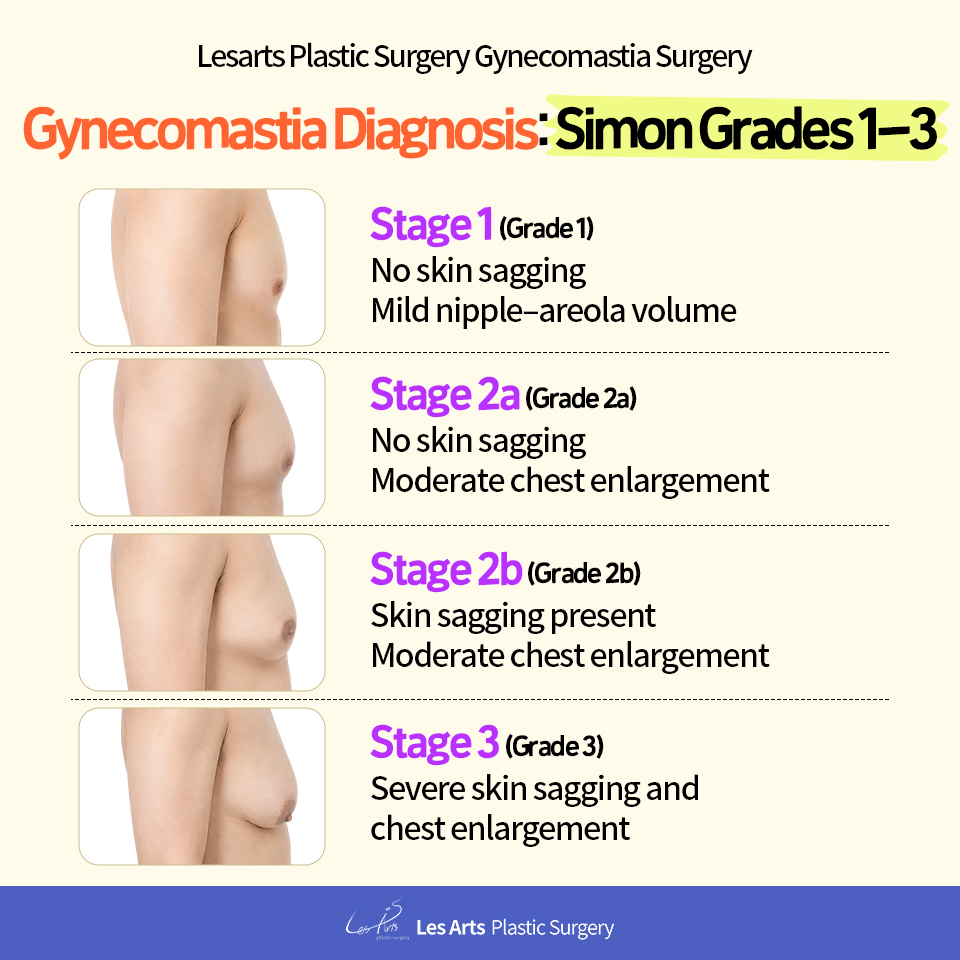
* Grade 1:
Minor breast enlargement localized predominantly to the retroareolar region without cutaneous redundancy.
* Grade IIa:
Moderate breast enlargement with glandular and adipose volume, without cutaneous redundancy or downward ptosis.
* Grade IIb:
Moderate breast enlargement accompanied by mild-to-moderate skin redundancy and early areolar descent.
* Grade 3:
Marked breast enlargement with severe cutaneous redundancy and true feminine ptosis hanging downward.
The primary utility of this system lies in its direct clinical applicability:
it enables a surgeon to evaluate morphological stage through visual inspection and physical palpation during physical examination.
2. Why Clinical Grades May Vary Between Clinics for the Same Anatomy
With such a direct grading structure, why do diagnostic evaluations sometimes differ between Grade IIa and Grade IIb across various clinics?
The decisive factor stems from the clinical judgment inherent in morphological assessments.

The Simon Classification is not defined by strict millimeter measurements (such as a fixed numerical cutoff for vertical descent).
Most diagnostic discrepancies occur along the transitional boundary between Grade IIa and Grade IIb.
When breast volume is moderate and cutaneous laxity is borderline or subtle,
Surgeon A may evaluate the presentation as Grade IIa based on preserved dermal recoil,
while Surgeon B may diagnose Grade IIb noting early inframammary fold skin folding.
Subtle grading variations across multiple consultations reflect the inherent nature of qualitative morphological classification systems rather than diagnostic error.
What matters most is not the numeric label on paper, but how the surgeon evaluates dermal elasticity and tissue laxity to tailor the operative plan—including glandular excision volume, liposuction boundaries, and compression protocols.
3. The Most Common Misconception: Glandular Tissue Dimensions Do Not Dictate Simon Grades
Patients frequently ask: “My diagnostic ultrasound showed a glandular disc exceeding 3 cm; does that automatically classify me as advanced Grade 3?”
This represents the most widespread misunderstanding regarding the Simon Classification.

Performing high-resolution ultrasound during the diagnostic workup is essential.
It differentiates pseudogynecomastia (adipose accumulation alone) from true gynecomastia (hypertrophic glandular proliferation stimulated by hormonal imbalance),
confirming clinical criteria for surgical planning and health insurance considerations.
※ Core Fact: The Simon Classification does not incorporate the absolute diameter or thickness of glandular tissue seen on ultrasound as a grading criterion.
Even if ultrasound shows a modest glandular disc around 2 cm, severe cutaneous redundancy hanging downward can warrant a Grade III diagnosis;
conversely, even with a large glandular mass measuring 3 to 4 cm or more, if the skin envelope remains resilient without ptosis, the presentation is classified as Grade IIa.
The Simon Classification evaluates external chest contour and cutaneous laxity,
not the volumetric weight or millimeter dimensions of the retroareolar glandular parenchyma.
4. Simon Grades Can Shift with Weight Fluctuations and Lifestyle Changes
A gynecomastia grade is not a permanent, unalterable classification.
Shifts in body weight and age-related changes in dermal elasticity can alter the Simon grade over time.

* During Weight Gain:
Subcutaneous fat accumulates around the glandular core, expanding global breast volume.
As tissue expands and stretches the cutaneous envelope downward, a baseline Grade 1 presentation can progress to Grade IIa or Grade IIb.
* Following Significant Weight Loss:
Strict weight reduction depletes subcutaneous fat volume.
However, overextended skin often fails to contract spontaneously, leaving an emptied envelope hanging downward under gravity.
In such cases, although adipose volume decreased, prominent skin folding can cause a baseline Grade IIa frame to present with Grade IIb ptosis.
Therefore, planning gynecomastia surgery requires evaluating prior weight trajectories, future fitness goals, and native dermal recoil capacity alongside current morphological presentation.
Conclusion: Tailored Comprehensive Evaluation Outweighs Standalone Grading
The Simon Classification remains a valuable international framework for surveying chest morphology and establishing foundational surgical approaches.
However, it serves as an initial clinical overview rather than a complete surgical blueprint.
Beyond visual Simon grades, executing successful gynecomastia surgery requires synthesizing
ultrasonographic parenchymal depth, subcutaneous adipose thickness, areolar dimensions, thoracic skeletal contours, and post-surgical dermal elasticity.
If prominent chest fullness or palpable nodularity causes concern, consulting with a board-certified plastic surgeon experienced in male chest anatomy for detailed ultrasound evaluation ensures a safe, evidence-based surgical plan tailored to your body.
Dr. Jihoon Moon


Cases finding
similar to my profile
Customer Diagnostics


Select the surgery and
area you are interestedto see real
before andafter changes.


we
make you,
the art
Clinic hours
MON - FRI
10 am – 7pm
SAT
10 am – 4pm
Holiday
SUN, HOLIDAY
Location
Lesarts Moon Clinic Tower 4-5F, 40, Nonhyeon-ro 168-gil,
Gangnam-gu, Seoul, Republic of Korea

Medical institution name Lesarts Plastic Surgery
Address Lesarts Moon Clinic Tower 4-5F, 40, Nonhyeon-ro 168-gil, Gangnam-gu, Seoul, Republic of Korea
Representative Moon sung jun
