




Online Consultation
Please accurately enter the information below.
Quick Cost Consultation
Quick Consultation & Reservation
Cases finding
similar to my profile






Doctor's Note
Medical columns by our surgeons
Thigh Liposuction & Pelvic Fat Grafting | Contours That Liposuction Alone Cannot Complete: Why Fat Grafting Is Essential
2026-10-15
Thigh Liposuction & Pelvic Fat Grafting | Contours That Liposuction Alone Cannot Complete: Why Fat Grafting Is Essential
Q. Can thigh liposuction alone create a smooth, continuous line from the pelvis down to the legs?
A. Debulking prominent saddlebags or excess thigh fat can reduce contour step-offs;
however, liposuction alone cannot replenish hollowed areas where native volume is inherently lacking, such as the lateral pelvis (hip dips).
In such cases, an integrated surgical approach combining both extraction and replenishment—debulking excess fat while transferring autologous fat into volume-deficient depressions—can be strategically planned.
[ View More Real Lesarts Thigh Liposuction & Pelvic Fat Grafting Cases ]
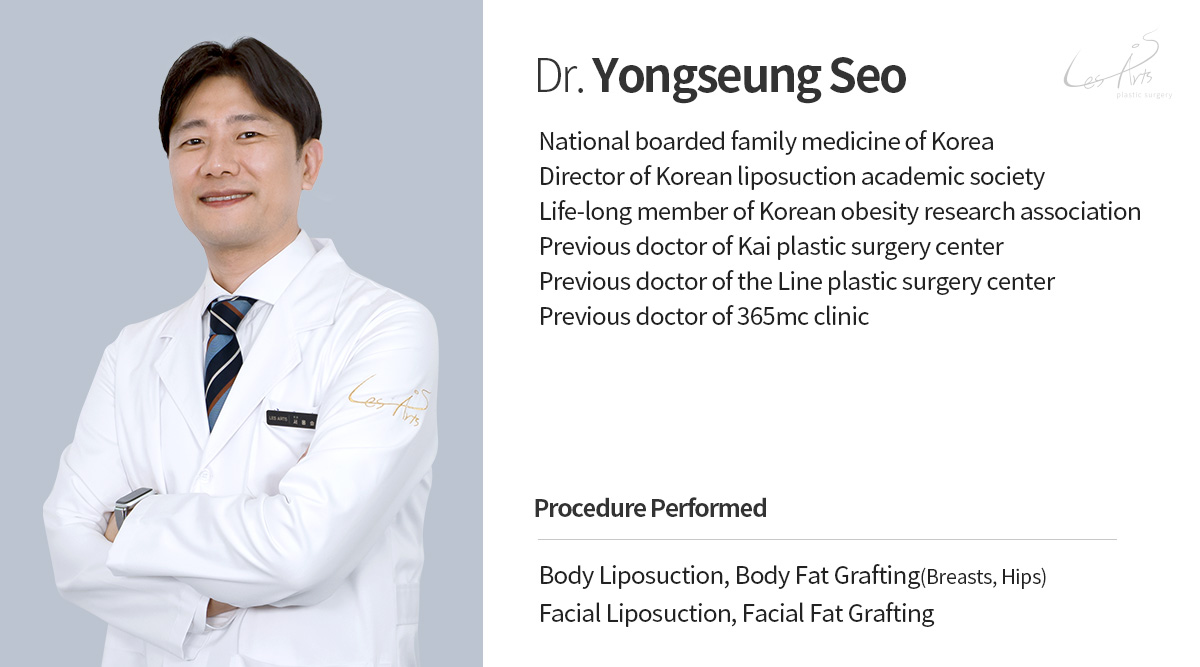
Written by Dr. Yongseung Seo, Lesarts Plastic Surgery
This column was authored directly by our medical staff.
※ Unauthorized copying, modification, editing, or redistribution is strictly prohibited. ※
Among patients visiting our clinic for liposuction,
many express that while they desire overall circumference reduction,
an isolated depression in a specific zone
makes their overall body silhouette appear awkward or disjointed.
Debulking protruding adipose deposits reduces adjacent step-offs,
which can soften the visual prominence of adjacent hollows to some degree.
However, reducing fat volume alone cannot connect all structural contours smoothly;
therefore, concurrently replenishing volume-deficient hollows with autologous fat grafting is often necessary.
In essence: extracting where excessive, replenishing where deficient.
Certain body frameworks require evaluating both components together
to harmonize global anatomical balance.
The patient presented today possessed a comparatively lean upper body, yet struggled with resistant thigh fat that resisted weight reduction,
causing prolonged frustration over an unbalanced upper-to-lower body ratio.
She visited our clinic seeking to debulk global thigh and gluteal volume
while simultaneously replenishing sunken lateral pelvic hollows (hip dips).
[Patient Profile]
Age: Late 20s
Height: 153 cm
Weight: 46.3 kg
BMI: 19.8 kg/m²
Body Fat Percentage: 25.8%
※ Clinical outcomes of liposuction may vary individually depending on adipose distribution, skin elasticity, and muscular framework, even among patients with similar physical specifications.
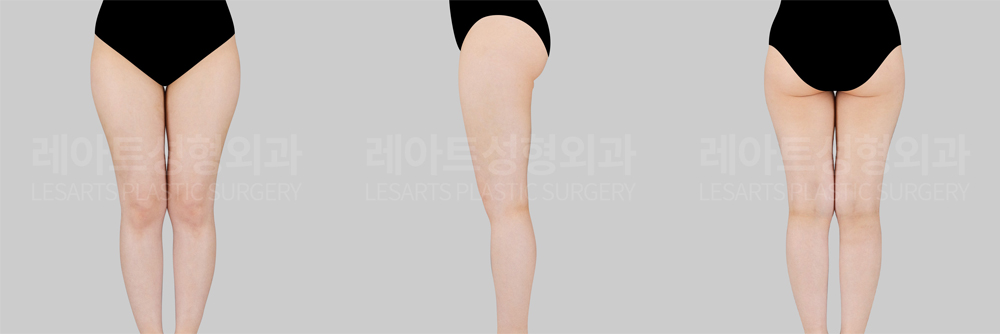
[Preoperative Thigh Liposuction & Pelvic Fat Grafting Baseline - Lesarts Plastic Surgery]
[Consultation & Diagnostic Findings]
During initial consultation, the patient shared:
“No matter how much weight I lose, my breasts shrink first while my thigh fat remains completely untouched.
People tell me I look slender when looking only at my upper body,
but my lower body stays full, and this disproportion has been a major insecurity.”
She had experienced prolonged distress over this upper-to-lower body imbalance,
seeking to downsize overall thigh and gluteal volume
while smoothly filling the hollowed lateral pelvic depressions.
On physical examination, the inner thighs touched closely from groin to knee without clearance,
giving the lower limbs a crowded appearance.
On posterior view, prominent bilateral saddlebags projected outward,
broadening the horizontal span flowing from the pelvis into the thighs.
On lateral profile, the thighs formed a continuous, thick outward curve from below the pelvis to the knees,
accentuating the anteroposterior depth of the legs.
[Diagnostic Ultrasound Findings]
- Lateral (Saddlebag): 32 / 23 mm
- Medial (Inner Thigh): 16 / 17 mm
- Anterior (Front Thigh): 12 / 14 mm
- Posterior (Back Thigh): 9 / 10 mm
- Knee (Peripatellar): 13 / 11 mm
Ultrasound confirmed thick subcutaneous adipose depth across all zones,
with a notable bilateral asymmetry in the saddlebags measuring 32 mm on one side versus 23 mm on the other.
When pre-existing bilateral fat distribution differs significantly,
we explained preoperatively that achieving absolute mathematical symmetry postoperatively remains difficult,
even when aspiration is carefully calibrated to minimize the discrepancy.
Additionally, while adipose stores along the medial thighs were abundant,
the overlying dermis was thin;
we counseled her that fine cutaneous wrinkling could emerge as volume decreased.
Along the infragluteal region, a long, well-defined gluteal fold was already present.
Debulking the saddlebags can make an existing infragluteal fold appear relatively lower; therefore,
aspirating fat beneath an already elongated crease could compromise buttock aesthetics.
Accordingly, we planned to preserve the infragluteal fat cushion without aspiration.
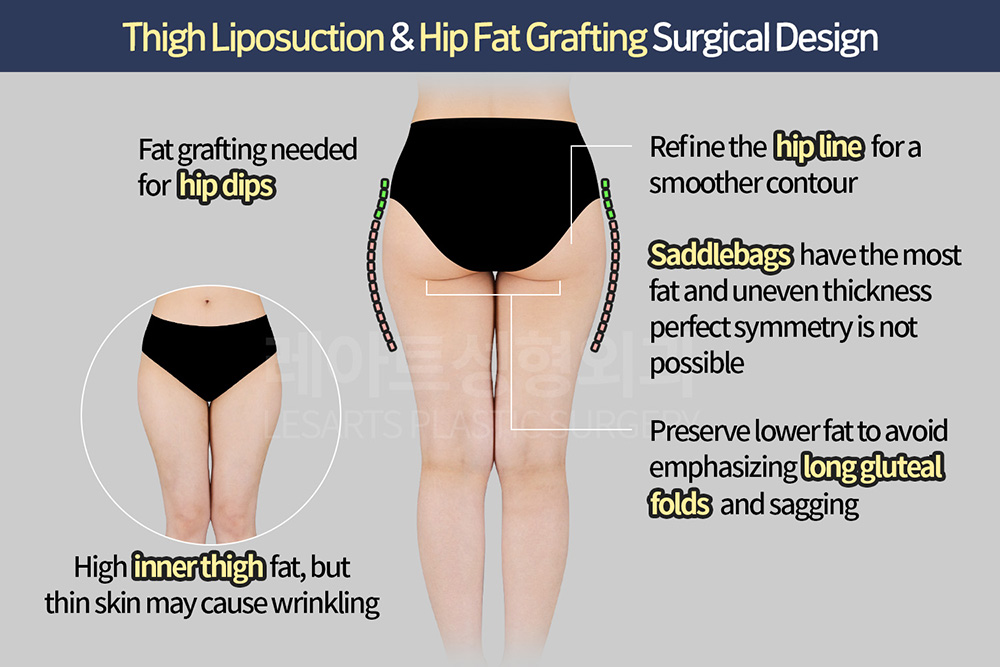
[Surgical Plan: Thigh Liposuction & Pelvic Fat Grafting - Dr. Yongseung Seo]
The surgical plan focused on global circumference reduction
and sculpting a smooth, continuous pelvic-thigh transition.
✔ Lateral Thighs & Saddlebags
This area presented the greatest fat volume and notable bilateral asymmetry.
We planned targeted debulking of the saddlebags to create
an uninterrupted outer line flowing from the knees to the pelvis.
✔ Posterior Hip Contours
Contouring adjacent hip zones
reduced bulk along the transition from saddlebag to buttock.
✔ Medial Thighs (Inner Thighs)
Given ample fat reserves, significant clearance was anticipated;
however, because the skin is thin, potential fine wrinkling was counseled preoperatively.
✔ Infragluteal Crease
To avoid accentuating the pre-existing long gluteal fold,
fat directly beneath the buttocks was preserved.
✔ Lateral Pelvic Fat Grafting (Hip Dips)
Autologous fat harvested from the thighs was processed and grafted
into the lateral pelvic hollows to establish a seamless pelvic-thigh silhouette.
[Before & After Comparison: Thigh Liposuction & Pelvic Fat Grafting]
(Photographed 2 months postoperatively under identical lighting and clinical conditions)
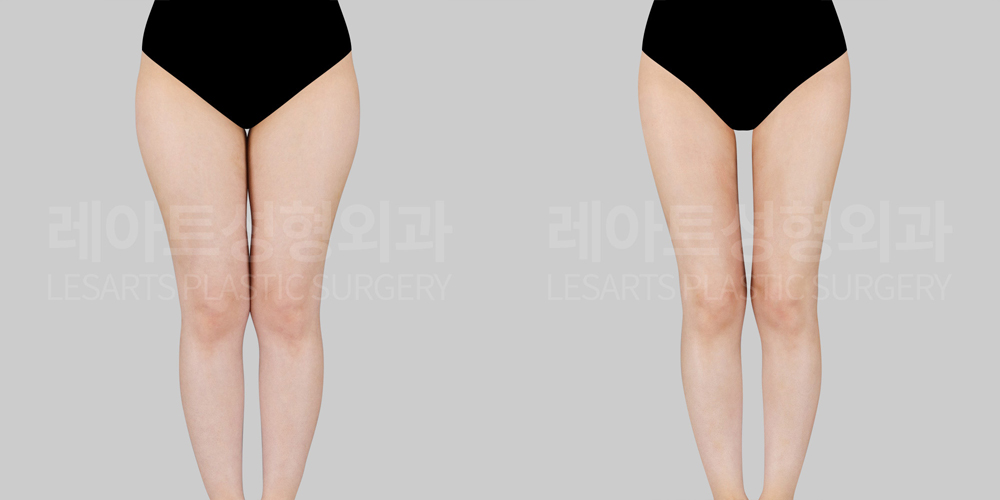
[Contour Changes: Thigh Liposuction & Pelvic Fat Grafting - Dr. Yongseung Seo, Lesarts Plastic Surgery]
Preoperatively, the inner thighs touched tightly with virtually no clearance;
postoperatively, a natural medial clearance (thigh gap) formed,
resolving the heavy, crowded impression.
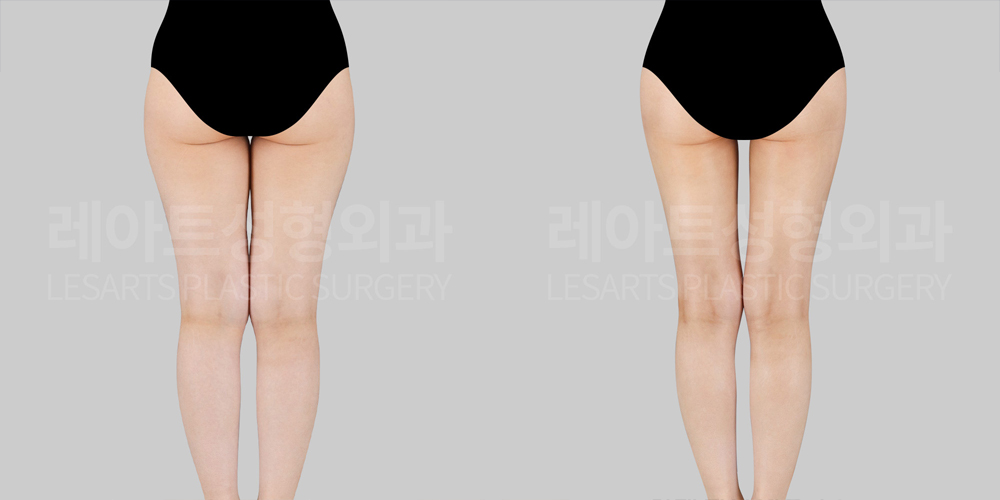
[Thigh Contour Changes After Saddlebag Debulking - Lesarts Plastic Surgery]
On posterior view, debulking lateral saddlebags
connected the outer transition from pelvis to thigh into a smooth line.
Meanwhile, along the infragluteal area where fat was intentionally preserved,
the natural gluteal fold and contour remained stably maintained.
As counseled preoperatively, minor bilateral discrepancy along the saddlebags persisted,
which the patient found acceptable and was unconcerned by.
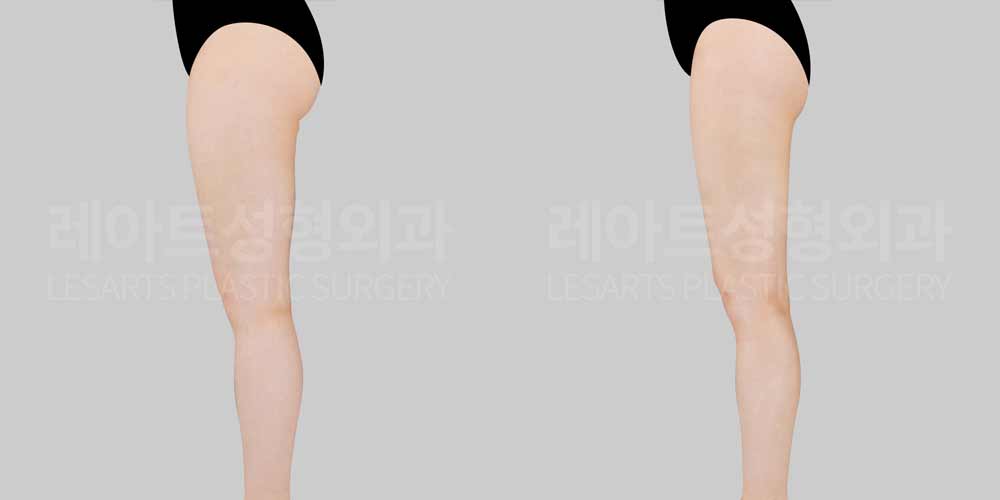
[Anterior Thigh Changes Before and After Liposuction - Dr. Yongseung Seo]
On lateral profile, the prominent anterior quadriceps bulge softened noticeably.
Streamlining the outward curve from below the pelvis to the knee
refined the entire lower limb into a continuous, slender silhouette.
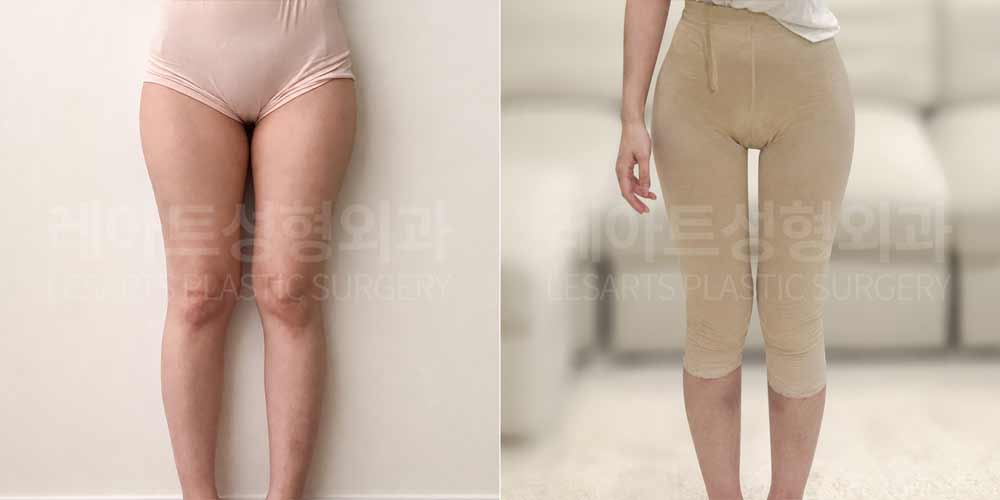
[Patient Selfie Review at 3 Weeks Post-Op - Lesarts Plastic Surgery]
Although early swelling caused temporary discomfort,
by 3 weeks post-op, the patient expressed satisfaction that her inner thighs
no longer rubbed together when wearing leggings.
Because 2 months represents an active healing milestone rather than the final endpoint,
we will continue monitoring her progress as residual edema resolves and tissues settle.
[ View More Thigh Liposuction & Pelvic Fat Grafting Cases ]
Why Fat Grafting Is Essential for Contours Liposuction Alone Cannot Complete
While liposuction reduces localized adipose deposits,
certain physical frameworks cannot achieve desired contours through extraction alone.
Protruding zones like saddlebags can be debulked via liposuction,
but depressions where volume is natively deficient—such as lateral hip dips—
cannot be filled simply by debulking adjacent areas.
In such cases, planning global circumference reduction while grafting autologous fat
into deficient hollows establishes seamless contour integration.
However, combined liposuction and fat grafting does not yield identical outcomes across all patients.
As seen in this case, baseline bilateral asymmetry in saddlebag fat,
inner thigh skin thickness, and pre-existing infragluteal crease anatomy
directly influence surgical design and final results.
Therefore, rather than pursuing extraction volume alone,
it is critical to evaluate bilateral fat distribution, dermal thickness,
and native pelvic-gluteal contours to distinguish
which zones to debulk, which to preserve, and which to replenish.
Thigh Liposuction & Pelvic Fat Grafting FAQ
Q1. Does liposuction of the saddlebags eliminate hip dips?
Debulking saddlebags can soften the step-off along the lateral pelvis;
however, if the hip dip itself lacks baseline volume, the depression will persist.
In such cases, pelvic fat grafting can be concurrently considered.
Q2. Can thigh liposuction and pelvic fat grafting be performed simultaneously?
Yes. Autologous fat harvested during thigh liposuction is processed and purified,
then grafted into volume-deficient pelvic hollows. Extraction scope and injection volume are customized to individual anatomy.
Q3. Can skin laxity occur if large volumes are extracted from the inner thighs?
When skin is thin or dermal elasticity is low, fine wrinkling or laxity can become apparent as underlying volume decreases.
Evaluating both fat depth and dermal tone is essential when planning extraction volume.
Q4. If bilateral thigh fat distribution is asymmetrical, can liposuction achieve perfect symmetry?
Surgery is planned to minimize discrepancies based on bilateral fat depth;
however, because human anatomy is not naturally symmetrical, absolute mathematical symmetry cannot be guaranteed.
Q5. Should infragluteal fat beneath the buttocks always be aspirated during thigh liposuction?
Not necessarily.
If an elongated infragluteal fold or tissue descent is present, removing fat beneath the crease can accentuate sagging;
preserving that buffer cushion is often the more appropriate choice.
Dr. Yongseung Seo


Cases finding
similar to my profile
Customer Diagnostics


Select the surgery and
area you are interestedto see real
before andafter changes.


we
make you,
the art
Clinic hours
MON - FRI
10 am – 7pm
SAT
10 am – 4pm
Holiday
SUN, HOLIDAY
Location
Lesarts Moon Clinic Tower 4-5F, 40, Nonhyeon-ro 168-gil,
Gangnam-gu, Seoul, Republic of Korea

Medical institution name Lesarts Plastic Surgery
Address Lesarts Moon Clinic Tower 4-5F, 40, Nonhyeon-ro 168-gil, Gangnam-gu, Seoul, Republic of Korea
Representative Moon sung jun
