




Online Consultation
Please accurately enter the information below.
Quick Cost Consultation
Quick Consultation & Reservation
Cases finding
similar to my profile






Doctor's Note
Medical columns by our surgeons
Gynecomastia Simon Grade IIb: 2-Week Follow-Up After Surgery
2026-10-15
Gynecomastia Simon Grade IIb: 2-Week Follow-Up After Surgery
Q. In gynecomastia presenting with both increased breast volume and cutaneous ptosis, such as Simon Grade IIb,
what factors must be evaluated prior to surgery?
A. Beyond debulking glandular tissue and adipose volume,
how well the remaining cutaneous envelope can contract
once underlying volume is evacuated must be carefully assessed.
Depending on dermal thickness and elasticity, wrinkling can develop around the areola or along the inframammary fold;
therefore, calibrating excision volume and soft-tissue redraping—alongside discussing adjuvant suspension taping
or potential secondary mastopexy if needed—is essential before proceeding.
[ View More Real Lesarts Male Gynecomastia Cases ]
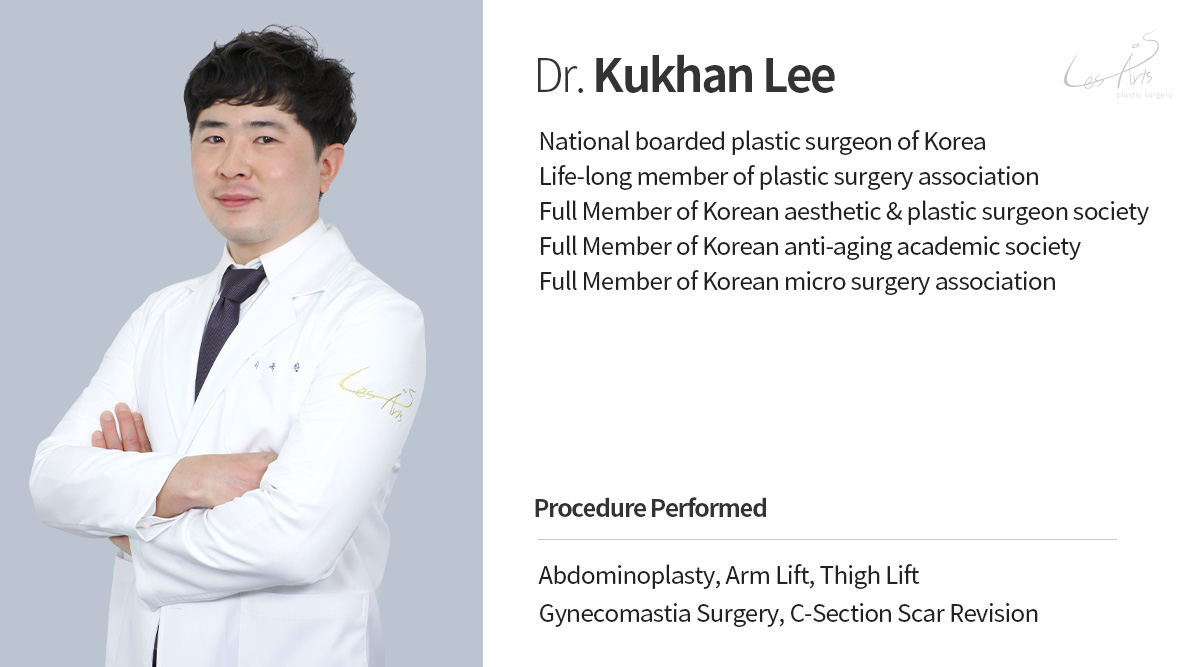
Written by Dr. Kukhan Lee, Lesarts Plastic Surgery
This column was authored directly by our medical staff.
※ Unauthorized copying, editing, processing, or redistribution is strictly prohibited. ※
The relentless summer heat has gradually subsided,
giving way to cooler seasons with broader daily temperature shifts.
As the weather cools, choosing thick layers feels slightly premature,
yet selecting thin, fitted tops comfortably remains challenging for many.
In particular, men troubled by prominent chest contours
often experience persistent discomfort not only when wearing thin t-shirts,
but also when wearing crossbody bags or engaging in communal daily activities.
For individuals who have long struggled with gynecomastia,
this transitional season often represents a comfortable window
to schedule surgical correction and begin recovery.
In this column, through the 2-week postoperative follow-up of a male patient in his 20s
diagnosed with Simon Grade IIb gynecomastia,
we examine what clinical considerations are required when chest enlargement is accompanied by cutaneous ptosis.
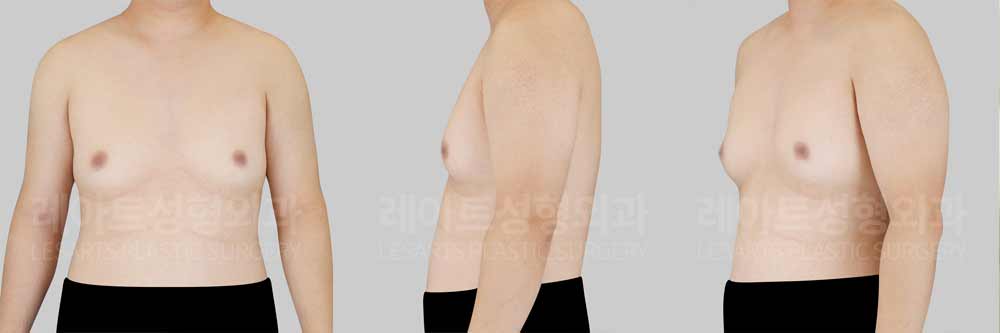
[Simon Grade IIb Gynecomastia Surgery - Lesarts Plastic Surgery]
The patient was a male in his 20s who recalled that his chest began enlarging
during a period of rapid weight gain in his teenage years.
Even after subsequent weight reduction and fluctuations,
the size and prominent shape of his chest remained unchanged;
as self-consciousness intensified during social and professional activities in his 20s,
he elected to seek surgical correction at our clinic.
At presentation, he measured 180 cm and weighed 88 kg.
Physical examination confirmed mild breast ptosis,
with cutaneous laxity causing the nipple-areolar complex
to descend inferiorly.
Furthermore, generalized tissue hypertrophy centered on the lower breast pole,
accompanied by areolar distension.

[Preoperative T-Shirt Fit: Gynecomastia - Lesarts Plastic Surgery]
Synthesizing these morphological findings,
the presentation was evaluated as Simon Grade IIb gynecomastia,
characterized by moderate breast enlargement coexisting with cutaneous laxity.
Diagnostic ultrasound confirmed true glandular hyperplasia
concentrated in the lower breast pole and retroareolar space,
with no other atypical pathology detected.
Thus, this was not pseudogynecomastia composed purely of adipose tissue,
but true gynecomastia verified by glandular proliferation,
morphologically graded as Simon Grade IIb.
The surgical technique to debulk glandular parenchyma and aspirate fat
is relatively direct in standard cases.
However, when cutaneous ptosis coexists,
the redraping behavior of the remaining skin envelope must be planned carefully.
If substantial internal volume is evacuated while overstretched skin remains,
wrinkling or folding can develop around or beneath the areola.
Particularly when skin is thin or dermal elasticity is compromised,
anticipating this recoil response is essential when designing the procedure.
To correct ptotic skin directly, mastopexy (skin excision) can be considered.
However, because mastopexy involves excising skin directly,
it carries the trade-off of permanent, visible linear scarring,
making it an intervention that patients do not elect lightly.
In such cases, performing primary gynecomastia surgery first,
monitoring natural dermal retraction over time,
and applying supportive measures such as post-surgical suspension taping is clinically prudent.
Because this patient presented potential risks of postoperative skin wrinkling,
- The potential for skin folding as redundant volume is reduced
- The option to apply suspension taping if indicated
- The possibility of evaluating secondary mastopexy if ptosis persists after full recovery
were thoroughly discussed preoperatively.
After reviewing these clinical factors, the patient elected to proceed,
and we performed subcutaneous mastectomy with circumareolar access
combined with circumferential chest liposuction.
[2-Week Postoperative Follow-Up]

The central technical priority during this procedure
was preventing surface wrinkling
after debulking internal volume.
Simply evacuating fat and glandular tissue indiscriminately
does not guarantee a favorable outcome.
Differentiating zones requiring complete debulking from areas where buffer layers must be retained,
and carefully calibrating and redraping subcutaneous tissues
ensures the skin adapts smoothly over the newly contoured chest wall.

[Simon Grade IIb Gynecomastia Surgery: Before & After - Lesarts Plastic Surgery]
With these principles in mind,
prominent lower breast volume was thoroughly reduced,
while subcutaneous buffer tissue across wrinkle-prone margins
was preserved and feathered smoothly.
While this surgical technique minimizes the risk of folding,
it cannot eliminate the risk entirely in all patients.
Fortunately, this patient presented with relatively resilient dermal tone and thick dermis,
allowing his skin envelope to adapt smoothly over the reduced volume.
Accordingly, we elected to monitor recovery without supplemental suspension taping,
and sutures were removed at 2 weeks postoperatively.

[Gynecomastia Ptosis and Inframammary Folding - Dr. Kukhan Lee, Lesarts Plastic Surgery]
On frontal view, rounded glandular fullness centered on the lower breast pole has resolved,
flattening the overall chest plane into a masculine contour.
This structural transformation is even more apparent
on oblique and lateral profiles.

[Pre- and Postoperative Gynecomastia with Cutaneous Laxity - Dr. Kukhan Lee]
Preoperatively, the slope falling from the clavicle to the breast mound
formed an elongated, outward curve characteristic of feminine breast morphology.
Postoperatively, debulking lower breast fullness
allowed the masculine contours of the pectoralis major to emerge naturally.
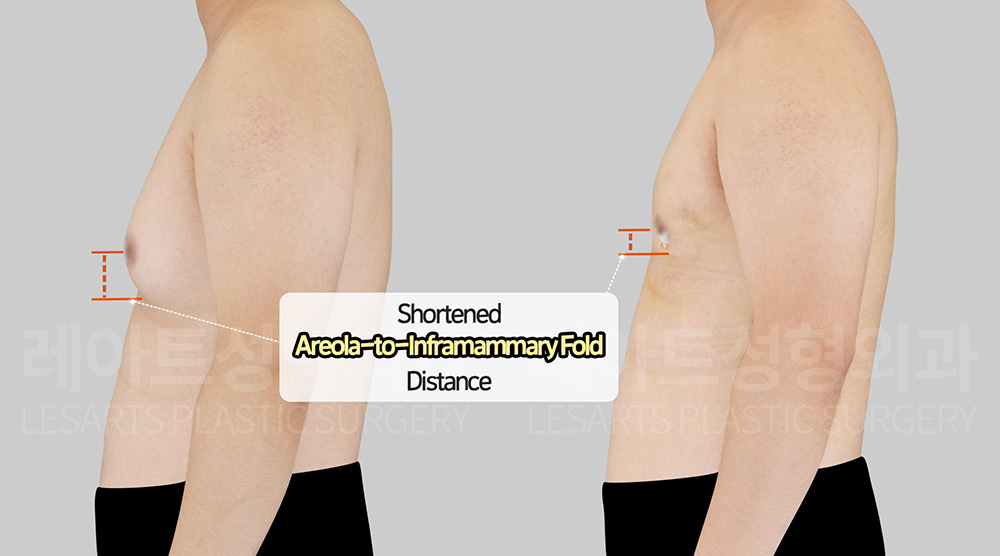
[Inframammary Line Changes Post-Gynecomastia Surgery - Dr. Kukhan Lee]
Furthermore, the vertical distance from the areola to the inframammary fold
shortened noticeably compared to baseline.
Dermal elasticity in this specific zone
and how effectively it contracts postoperatively
is a critical variable determining
whether cutaneous wrinkling develops.
Fortunately, the cutaneous wrinkling feared prior to surgery has not manifested,
and healing is progressing stably without adjuvant taping.

[T-Shirt Fit at 2 Weeks Post-Op - Dr. Kukhan Lee, Lesarts Plastic Surgery]

[Early Transformation Post-Gynecomastia Surgery - Lesarts Plastic Surgery]
Because sutures were removed recently at 2 weeks post-op,
this represents an early phase of recovery.
It is premature to evaluate the current appearance
as the final clinical outcome;
further time is required for post-surgical edema to subside
and for deep subcutaneous tissues to soften and stabilize.
Nonetheless, within two weeks, prominent bulging has resolved,
and the patient expressed satisfaction with his streamlined chest profile in t-shirts.
Regaining everyday confidence without the long-standing burden of chest prominence
marks a meaningful clinical step.
We will continue monitoring his recovery as residual swelling resolves
and subcutaneous tissues settle into their permanent contour.
[ View More Simon Grade IIb Gynecomastia Cases ]
[Why Evaluating Dermal Characteristics Is Vital in Simon Grade IIb]
Even when gynecomastia appears similar on initial inspection,
underlying morphology and tissue composition differ significantly across individuals.
Dermal ptosis, skin thickness, elasticity, glandular-to-adipose ratios, and areolar positioning
directly guide operative approach and recovery milestones.
In Simon Grade IIb presentations where breast enlargement coexists with cutaneous laxity,
surgical planning must extend beyond simple tissue extraction;
evaluating post-debulking skin recoil, calibrating excision volume,
and guiding dermal contraction are essential components.
While this patient's resilient skin allowed for unassisted recovery,
thinner or less elastic skin envelopes may require adjuvant suspension taping
to support uniform redraping.
Ultimately, gynecomastia surgery cannot rely on a standardized template;
it demands precise diagnostic assessment of current tissue architecture
to establish an individualized plan.
If chest prominence has long impacted wardrobe choices or caused social inhibition,
we encourage you to schedule a consultation to identify your anatomical grade
and determine the most effective corrective approach.
Simon Grade IIb Gynecomastia FAQ
Q1. What defines Simon Grade IIb gynecomastia?
It is characterized by moderate breast enlargement coexisting with cutaneous ptosis.
The nipple-areolar complex may sit lower, and lower pole skin redundancy is present.
Q2. Does gynecomastia with skin laxity always require mastopexy (skin excision)?
Not necessarily.
Evaluating dermal elasticity allows surgeons to perform primary gynecomastia surgery first to observe spontaneous contraction,
supported by adjuvant suspension taping if indicated.
Secondary mastopexy is evaluated only if significant laxity persists after full healing.
Q3. Can wrinkling develop around the areola post-surgery?
If substantial volume is debulked and overstretched skin cannot contract fully, wrinkles may emerge around the areola or along the inframammary line.
The degree varies according to dermal thickness, elasticity, and extraction volume.
Q4. Is post-surgical suspension taping necessary for every patient?
It is not universally required.
Its indication depends on baseline skin elasticity and early postoperative dermal contraction.
Q5. Is the chest shape finalized at 2 weeks post-op?
No. Two weeks represents an early recovery phase with residual edema and tissue healing.
As swelling clears and subcutaneous planes soften over several months, the chest contour stabilizes into its permanent plane.
Dr. Kukhan Lee


Cases finding
similar to my profile
Customer Diagnostics


Select the surgery and
area you are interestedto see real
before andafter changes.


we
make you,
the art
Clinic hours
MON - FRI
10 am – 7pm
SAT
10 am – 4pm
Holiday
SUN, HOLIDAY
Location
Lesarts Moon Clinic Tower 4-5F, 40, Nonhyeon-ro 168-gil,
Gangnam-gu, Seoul, Republic of Korea

Medical institution name Lesarts Plastic Surgery
Address Lesarts Moon Clinic Tower 4-5F, 40, Nonhyeon-ro 168-gil, Gangnam-gu, Seoul, Republic of Korea
Representative Moon sung jun
