




Online Consultation
Please accurately enter the information below.
Quick Cost Consultation
Quick Consultation & Reservation
Cases finding
similar to my profile






Doctor's Note
Medical columns by our surgeons
[Medical Column] Did the Nipple and Areola Darken After Gynecomastia Surgery? From Underlying Causes to Laser and Topical Management
2026-10-15
[Medical Column] Did the Nipple and Areola Darken After Gynecomastia Surgery? From Underlying Causes to Laser and Topical Management
Q. The color of my nipple and areola became darker after gynecomastia surgery compared to before. Will it stay like this permanently?
A. Following gynecomastia surgery, the nipple-areolar complex may temporarily appear darker due to areolar skin contraction as internal breast volume diminishes,
or as a result of reactive inflammatory responses occurring during tissue healing.
In most cases, it gradually lightens over time as internal tissues and skin settle,
and supplementary clinical management—such as pigment toning lasers or topical formulations—can be considered depending on progress.
[ View More Real Lesarts Male Gynecomastia Cases ]
Written by Dr. Jihoon Moon, Lesarts Plastic Surgery
This column was authored directly by our medical staff.
※ Unauthorized copying, modification, editing, or redistribution is strictly prohibited. ※
During follow-up consultations following gynecomastia surgery,
there is a question patients frequently ask:
“Most of the post-surgical swelling has resolved, but the color of my nipples and areolas looks much darker than before surgery.
Will this hyperpigmentation remain permanent?”
Immediately after surgery, primary focus centers on swelling and incision healing;
as time passes, however, patients sometimes become concerned upon noticing
that the pigmentation of the nipple-areolar complex appears darker than baseline.
Observing such changes can lead to anxiety
over whether an issue occurred during the surgical procedure.

However, darkened areolar appearance following gynecomastia surgery
does not stem from a single factor alone.
Today, we explain the underlying causes of post-surgical nipple and areolar darkening,
the expected timeline of physiological recovery, and the medical options—including
dermatological lasers and topical therapies—that can be considered if needed.
1. Why the Areola May Appear Darker After Gynecomastia Surgery
Post-surgical darkening of areolar tone is influenced
not only by true melanin hyperpigmentation, but also by morphological changes
in the cutaneous envelope following volume reduction, alongside normal physiological
healing reactions.
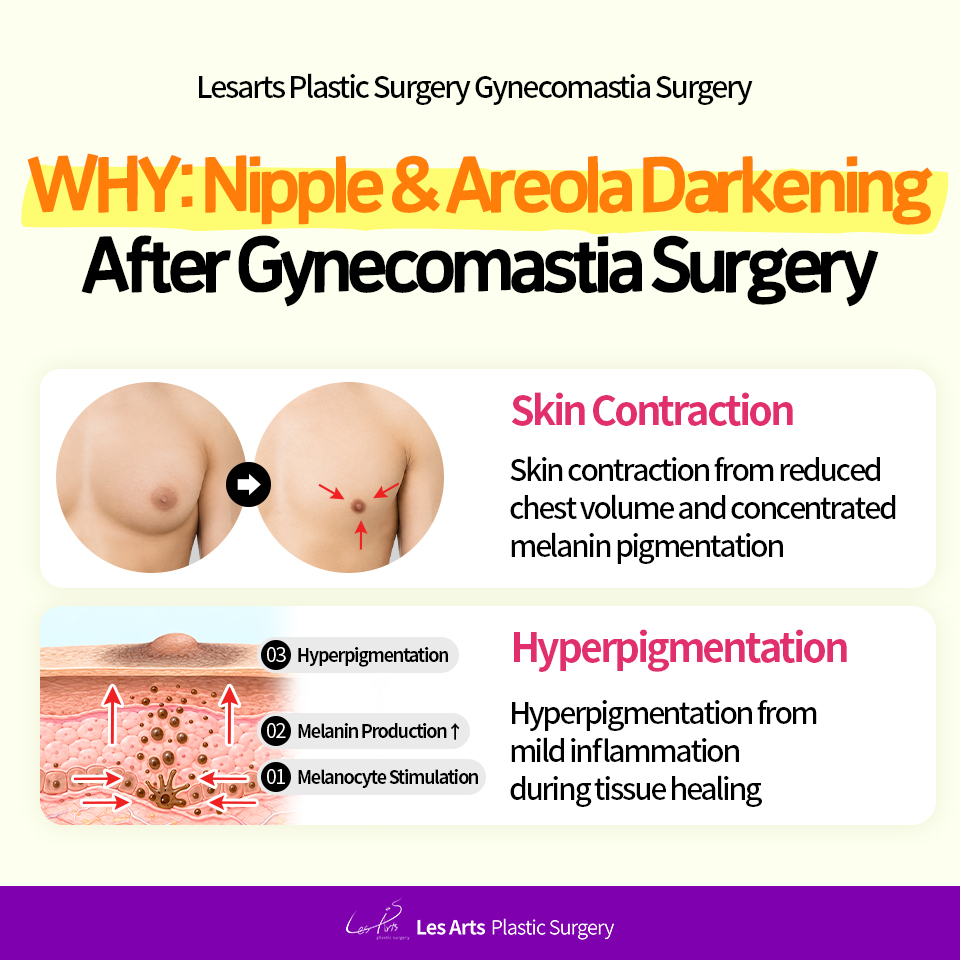
① Areolar Skin Contraction Following Internal Volume Evacuation
When proliferated glandular parenchyma and subcutaneous fat are resected,
the internal volume that previously supported the areolar envelope is eliminated.
Consequently, the overlying areolar skin contracts over the reduced bed,
reducing the total surface diameter of the areola.
To illustrate this concept intuitively, consider what happens
when staying in cold water at a swimming pool or beach.
When the areola contracts due to cold temperatures or tactile stimulation,
its diameter shrinks, causing the pigmentation
to appear noticeably more concentrated, darker, and more vivid.
Similarly, following gynecomastia surgery,
as internal volume decreases and tissues remodel,
the areolar skin contracts, concentrating pre-existing pigment over a smaller surface area
and creating the optical perception of a darker color.
Therefore, beyond biological pigment changes,
the optical density increase resulting from areolar surface contraction
must be accounted for.
② Post-Inflammatory Hyperpigmentation (PIH)
Another significant driver is post-inflammatory hyperpigmentation (PIH),
which can occur during normal wound healing.
Surgical manipulation naturally stimulates local soft tissues,
eliciting a mild, transient inflammatory cascade throughout recovery.
Because the nipple and areola naturally contain
a higher baseline concentration of melanin than adjacent skin,
when local melanocytes are stimulated during the inflammatory phase,
a temporary surge in melanin synthesis can cause the areola to appear darker.
Thus, areolar darkening post-gynecomastia surgery
does not arise from an identical mechanism in every patient.
It is essential to recognize that optical changes from skin contraction
and true post-inflammatory pigment responses frequently occur together.
2. Parallels with Gestational and Lactational Areolar Changes
The dynamic nature of areolar pigmentation over time
can also be observed during pregnancy and lactation in women.
In female physiology, hormonal shifts and glandular development
throughout pregnancy, childbirth, and nursing cause the nipple
and areola to darken considerably.
Once nursing concludes and systemic hormones
and breast parenchyma stabilize,
the darkened areolar tone gradually fades back toward its prior baseline.

While the biological pathways of pregnancy and post-gynecomastia surgery differ,
this comparison provides helpful clinical context:
in both scenarios, areolar pigmentation shifts dynamically and temporarily
in response to melanin activation and structural tissue remodeling.
Similarly, darkened areolar tone following gynecomastia surgery
progressively softens and lightens as cicatricial tissue remodels,
dermal contraction stabilizes, and reactive melanocyte activity subsides over time.
3. Recovery Milestones: When Does Areolar Hyperpigmentation Lighten?
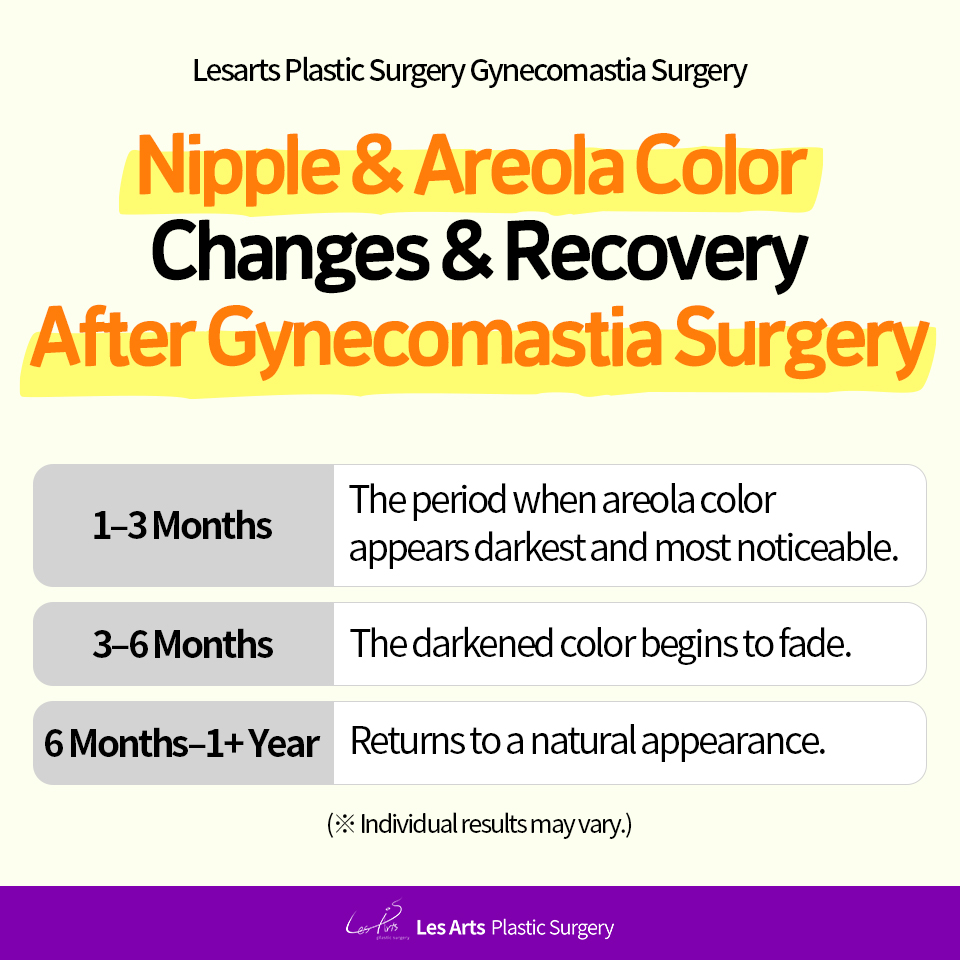
Areolar pigment evolution is not static postoperatively;
it progresses through distinct chronological healing stages.
* 1 to 3 Months Post-Op: Cutaneous Contraction and Maximum Visual Darkening
During early recovery, internal volume reduction causes the areolar envelope to contract,
while early subclinical inflammatory reactions remain active;
consequently, the nipple and areola often appear comparatively dark and vivid.
Judging the appearance at this early stage as permanent
is clinically premature.
* 3 to 6 Months Post-Op: Tissue Stabilization and Pigment Softening
Internal induration softens, and the cutaneous flap
enters an active stabilization phase over the pectoral fascia.
As inflammatory stimulation resolves, darkened areolar pigmentation
progressively softens and begins to lighten.
* 6 Months to 1 Year and Beyond: Long-Term Tissue Maturation
Even past 6 months, areolar skin texture and tone continue to remodel.
While individual timelines vary depending on skin phototype and baseline pigmentation,
with sufficient time, areolar dimensions and dermal tone
gradually settle toward a natural state close to baseline.
Therefore, if areolar tone darkens during early recovery,
allowing adequate time for physiological healing is recommended before drawing conclusions.
4. Clinical Approaches to Accelerate Pigment Resolution: Lasers and Topicals
While most cases resolve spontaneously with time,
if hyperpigmentation lingers or causes significant personal concern,
targeted medical modalities can be evaluated based on clinical assessment.
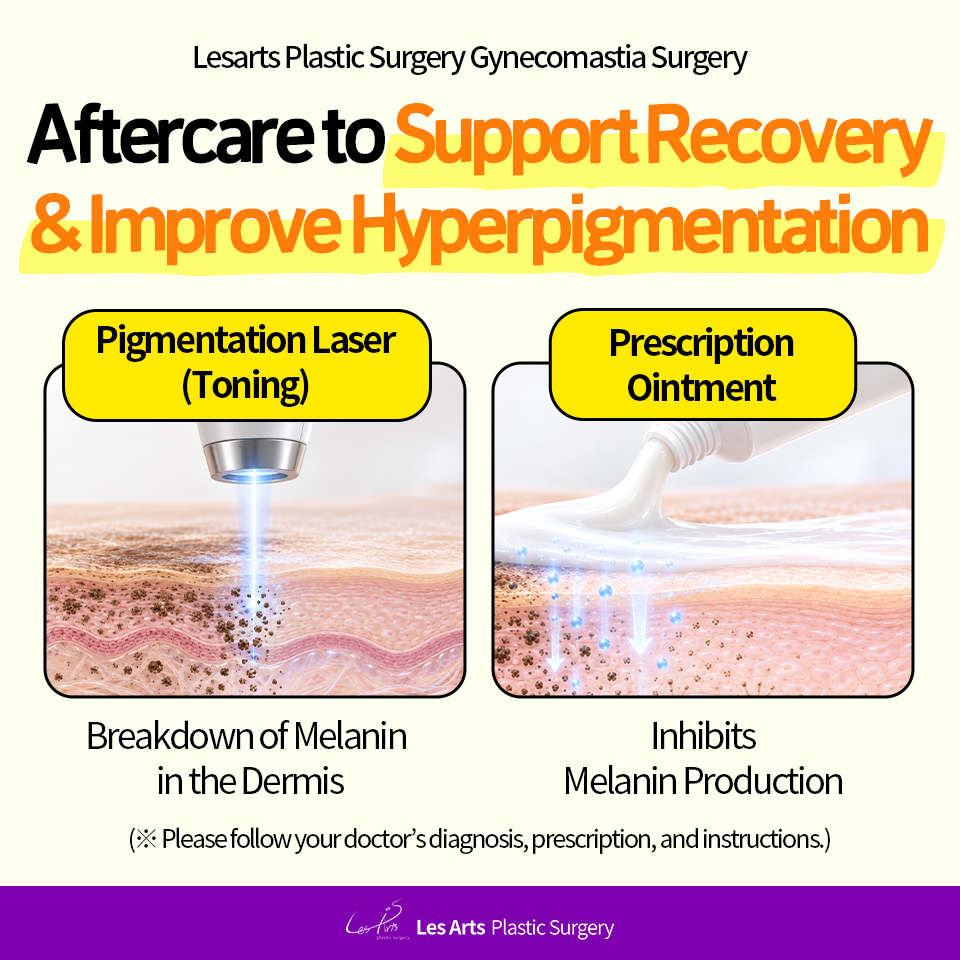
① Pigment Laser Toning & Medical Aesthetics
* Dermatological Laser Toning
If pigmentation persists despite sufficient recovery time
or if active improvement is desired,
selective melanin-targeting laser treatments,
such as low-fluence Q-switched Nd:YAG or picosecond toning lasers, can be considered.
Because the nipple and areola exhibit distinct melanin density compared to typical skin,
laser parameters and fluence must be precisely calibrated
following professional diagnostic examination.
* Depigmenting Agents and Scar Ointments
Once incisions are fully epithelialized and stable,
medical depigmenting creams that regulate melanin synthesis
or topical scar formulations can be incorporated
in consultation with the medical staff.
Because formulations contain differing active agents,
selecting products aligned with current dermal recovery
is essential rather than applying unverified products arbitrarily.
② Clinical Guidelines on Topical Corticosteroid Usage
* Appropriate Prescription and Indication
During postoperative recovery,
patients occasionally experience localized pruritus or irritation.
A mild topical corticosteroid may be prescribed temporarily
to relieve pruritus and modulate early inflammatory reactions,
which can secondarily help mitigate
subsequent post-inflammatory hyperpigmentation.
* Risks of Overuse and Adverse Effects
However, arbitrary or unmonitored long-term application must be avoided.
Prolonged or excessive use of topical steroids carries potential side effects, including:
- Dermal atrophy (thinning of the skin)
- Telangiectasia (capillary dilation)
- Persistent periareolar erythema
Therefore, topical corticosteroids must only be used
under medical prescription, strictly following designated frequency and duration.
[ View More Gynecomastia Before & After Cases ]
[Conclusion: Guidance from the Medical Staff]
Nipple and areolar darkening following gynecomastia surgery
is a recognized physiological response associated with volume reduction and tissue remodeling.
Much like the temporary areolar contraction in cold water or changes following pregnancy and nursing,
these pigment shifts typically soften and fade naturally over time.
Rather than experiencing premature anxiety over early healing changes,
allowing adequate time for physiological recovery is recommended.
If hyperpigmentation persists long-term, diagnostic evaluation allows for
calibrated laser toning and topical therapies to achieve clear improvement.
Gynecomastia Areolar Hyperpigmentation FAQ
Q1. Is areolar darkening a common occurrence after gynecomastia surgery?
Yes. Following surgery, areolar skin contracts over the reduced volume,
and reactive post-inflammatory pigment processes can make the area appear darker.
The degree and duration of color changes vary individually.
Q2. Does a darkened areola indicate a surgical complication?
Areolar darkening alone does not indicate a surgical flaw.
It is evaluated as a physiological response encompassing cutaneous contraction and post-inflammatory hyperpigmentation throughout healing.
Q3. When does areolar pigmentation typically begin to lighten?
Pigmentation often appears darkest during the initial 1 to 3 months,
gradually softening and fading from 3 to 6 months onward as tissues stabilize.
The timeline varies according to skin phototype and individual pigment density.
Q4. Can laser toning be performed for persistent areolar hyperpigmentation?
If pigmentation persists after sufficient recovery, laser toning modalities—such as picosecond or Nd:YAG lasers—
can be evaluated based on cutaneous condition.
Timing and fluence parameters should be determined following professional consultation.
Q5. Will continuous application of steroid ointments speed up pigment lightening?
Unmonitored long-term application is strongly advised against.
While mild topical steroids may be prescribed briefly to control acute inflammation or pruritus,
prolonged use risks dermal atrophy and telangiectasia; therefore, medical instructions must be followed strictly.
Dr. Jihoon Moon


Cases finding
similar to my profile
Customer Diagnostics


Select the surgery and
area you are interestedto see real
before andafter changes.


we
make you,
the art
Clinic hours
MON - FRI
10 am – 7pm
SAT
10 am – 4pm
Holiday
SUN, HOLIDAY
Location
Lesarts Moon Clinic Tower 4-5F, 40, Nonhyeon-ro 168-gil,
Gangnam-gu, Seoul, Republic of Korea

Medical institution name Lesarts Plastic Surgery
Address Lesarts Moon Clinic Tower 4-5F, 40, Nonhyeon-ro 168-gil, Gangnam-gu, Seoul, Republic of Korea
Representative Moon sung jun
