




Online Consultation
Please accurately enter the information below.
Quick Cost Consultation
Quick Consultation & Reservation
Cases finding
similar to my profile






Doctor's Note
Medical columns by our surgeons
Abdominal Liposuction | Stop the Yo-Yo Cycle! High-Volume Torso Contouring to Reveal Hidden Lines
2026-07-14
Abdominal Liposuction | Stop the Yo-Yo Cycle! High-Volume Torso Contouring to Reveal Hidden Lines
If weight fluctuations keep recurring, can abdominal liposuction alone resolve weight-related struggles?
Abdominal liposuction debulks dense subcutaneous fat,
refining your silhouette and providing powerful motivation
for long-term body management.
However, because surgery does not eliminate visceral fat or alter daily habits,
consistent nutritional habits and regular exercise remain essential
to maintain your refined contours over time.
▶ Lesarts Liposuction Procedure Guide
Hello, I am Dr. Yongseung Seo, Plastic Surgeon at Lesarts Plastic Surgery Clinic.
Many start dieting to achieve a toned, well-proportioned physique,
yet repeated cycles of weight loss and regain
often make long-term maintenance frustrating.
When chronic yo-yo dieting and restrictive regimens persist,
lean muscle mass declines while visceral fat ratios tend to rise.
Not only does this make satisfying aesthetic contouring harder to achieve,
but future weight reduction efforts
also become increasingly difficult.
For taller individuals, disciplined management produces
an elongated, statuesque silhouette;
however, sudden weight gain combined with height and midsection bulk
can make the overall frame appear substantially broader.
In this clinical case, a tall patient struggling with chronic weight fluctuations
consulted our clinic for a definitive reduction and reshaping of her abdominal contour.
[Patient Profile]
Age: Late 20s
Height: 173 cm
Weight: 62 kg
BMI: 20.7
*Even with similar height and weight metrics, individual outcomes vary
based on adipose distribution, skin elasticity, and muscular anatomy.
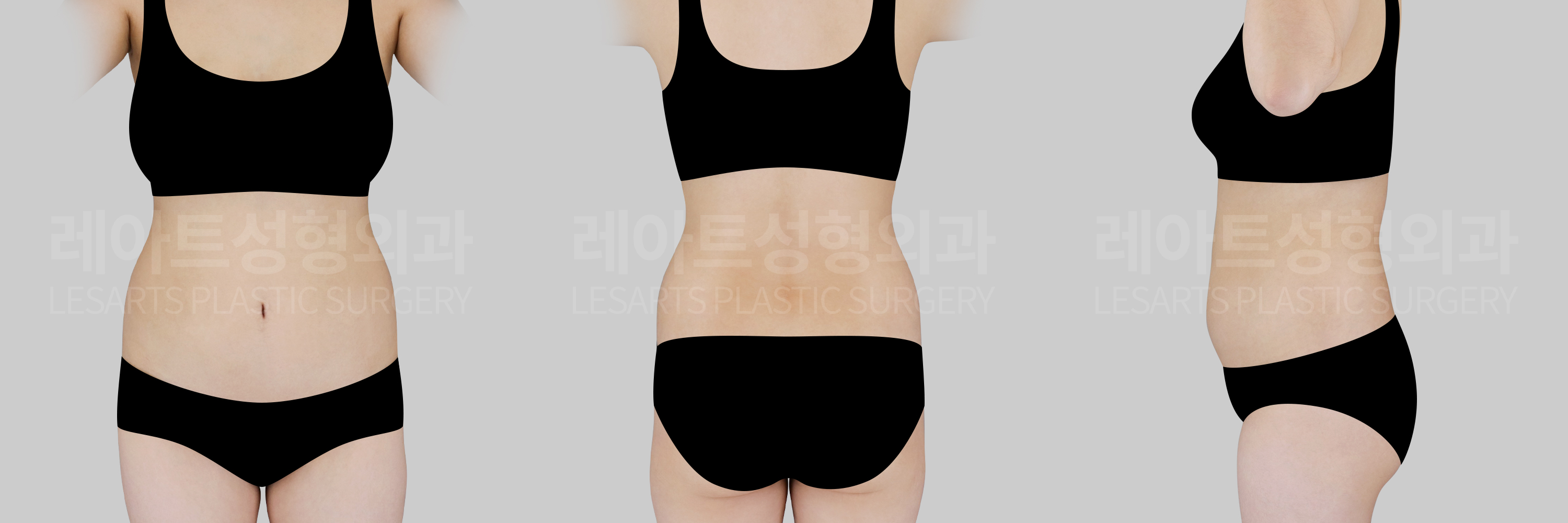
[Pre-Operative Adipose Distribution: Epigastrium, Lower Abdomen, Flanks & Love Handles]
[Pre-Operative Body Contour Assessment]
With disciplined management, the patient typically maintained around mid-50 kg;
however, during weight gain phases, her weight surpassed 60 kg and peaked at 65 kg,
exhibiting wide cyclical fluctuations.
At consultation, her weight was elevated above her baseline,
and generalized abdominal fullness caused her frame to look heavier
than her actual height and scale weight suggested.
Because visceral fat also contributed to abdominal projection, post-operative dietary discipline
and lifestyle maintenance were essential considerations from the start.
Pre-operative ultrasound measured fat thickness at 21/20 mm (love handles), 15/15 mm (flanks),
30 mm (upper abdomen), and 31 mm (lower abdomen), confirming a substantial,
extractable subcutaneous adipose layer throughout the entire torso.
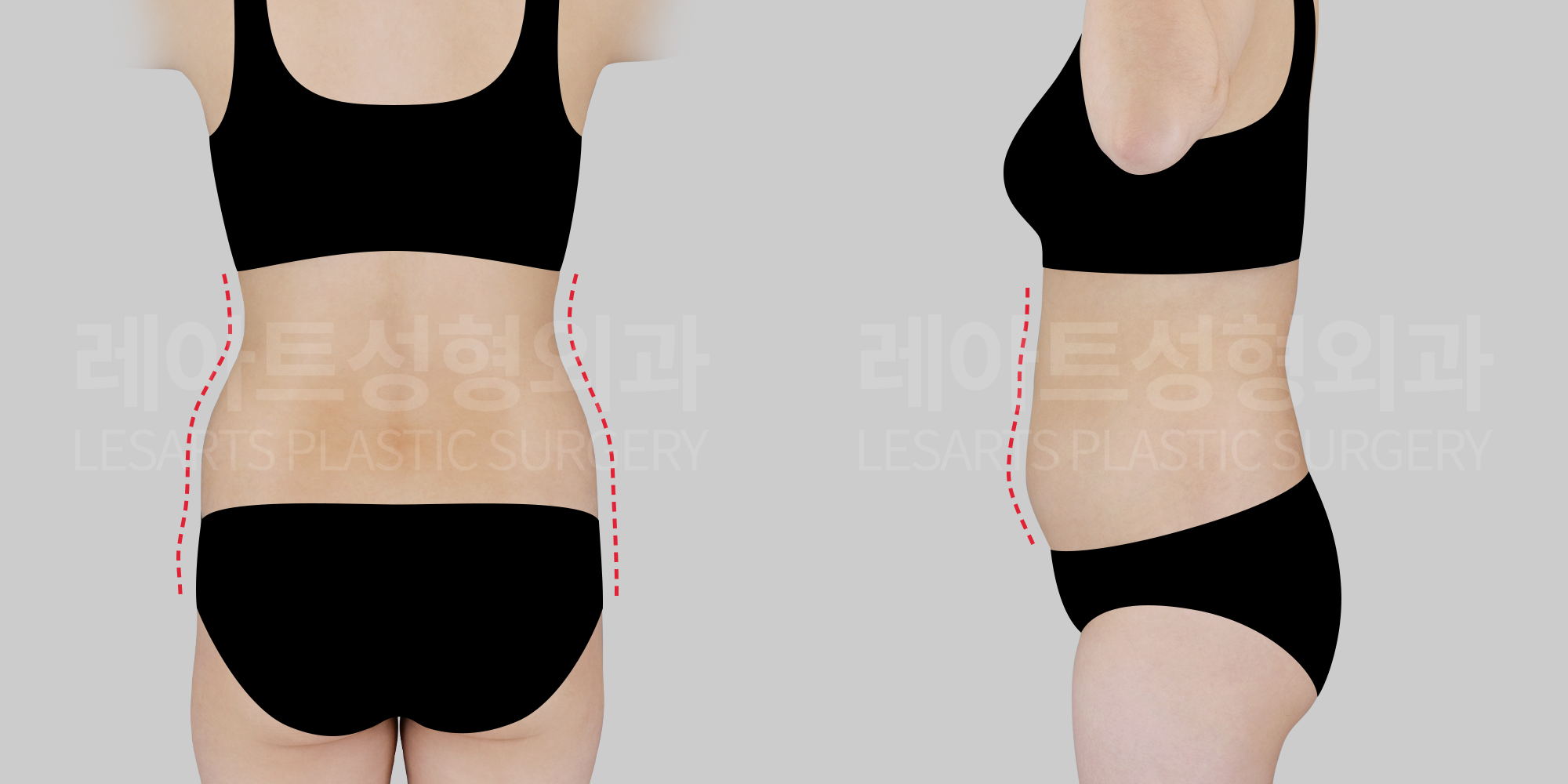
[Surgical Design: High-Volume Abdominal Contouring]
The patient emphasized her aesthetic goal: “I want the maximum volume removed without leaving excess fat.”
Accordingly, a high-volume 360 abdominal liposuction encompassing upper and lower abdomen,
lateral flanks, and posterior love handles was formulated to thin the subcutaneous layer
to the safest possible physiological margin.
During pre-operative counseling, three key anatomical aspects were thoroughly clarified.
First, pre-existing skeletal and muscular asymmetries between her left and right waist
meant that even with uniform, balanced fat extraction,
baseline structural nuances could remain slightly perceptible.
Second, liposuction exclusively debulks
subcutaneous adipose tissue residing above the fascia.
Deep visceral fat behind the abdominal wall
must be managed through post-operative nutritional and aerobic discipline.
Third, liposuction is not the end of personal weight management.
While local adipocyte numbers are permanently reduced,
subsequent weight gain can cause remaining adipocytes to hypertrophy
or accumulate in untreated areas.
Consistent maintenance after surgery is vital
to preserve newly contoured lines long-term.
[Abdominal Liposuction: Before & After Comparison]
*Photographed under standardized studio lighting and positioning pre-op and 2.5 months post-op.
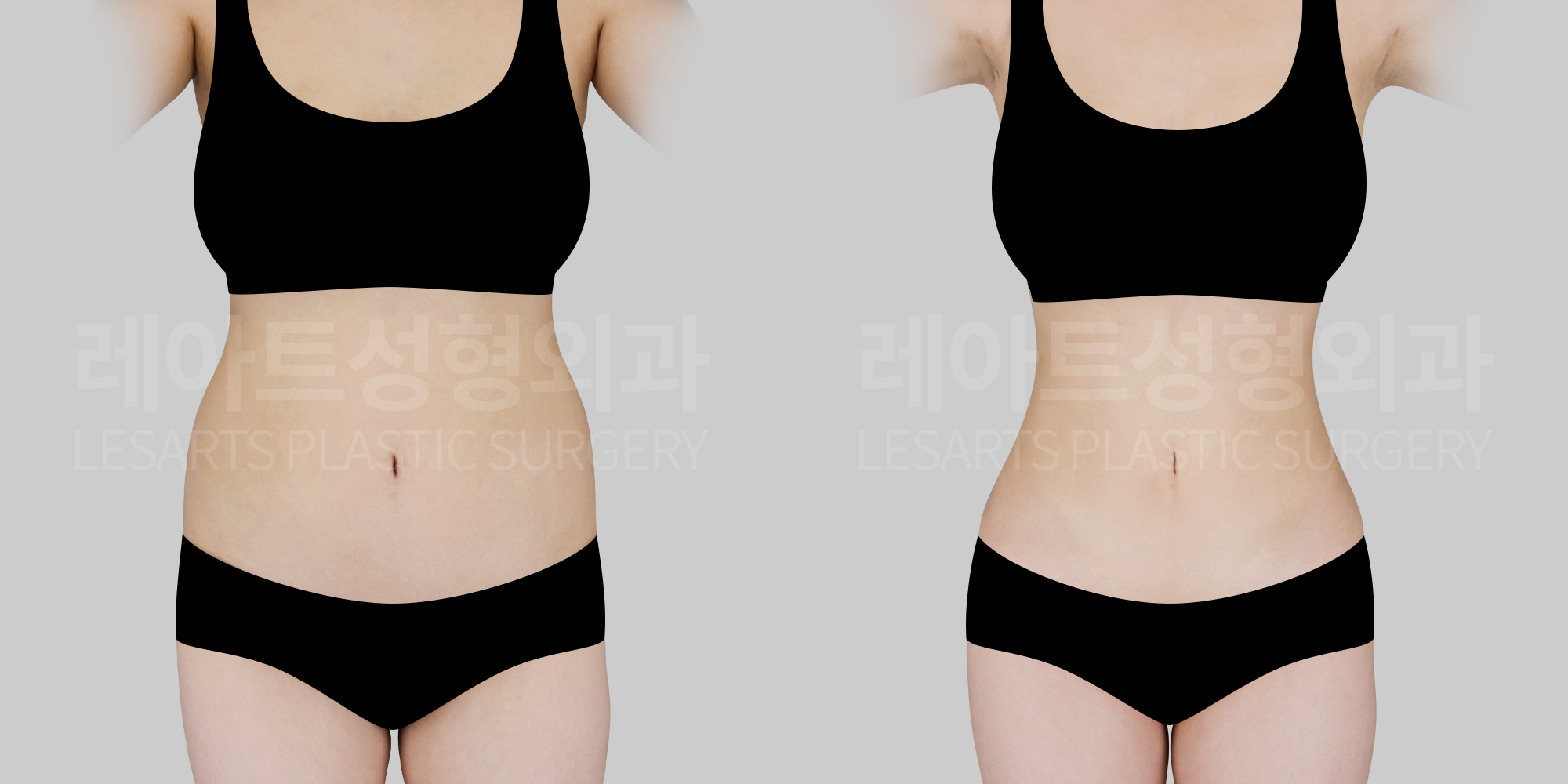
[Anterior View 2.5 Months Post-Op: Upper/Lower Abdomen and Waistline Refinement]
Aligning with the patient's goal of thorough debulking,
the dense subcutaneous fat layer exceeding 30 mm across the epigastrium
and lower abdomen was substantially slimmed down.
Eliminating flank and love handle bulges that previously showed through clothing
unveiled a sleek, narrow waistline,
highlighting the elegant vertical proportions of her 173 cm frame.

[Posterior View 2.5 Months Post-Op: Love Handle Debulking & Waist Silhouette]
On posterior view, while baseline skeletal asymmetry noted pre-operatively
remains subtly visible, the overall volume reduction across the waist and love handles
produces a much lighter, graceful, and natural silhouette.
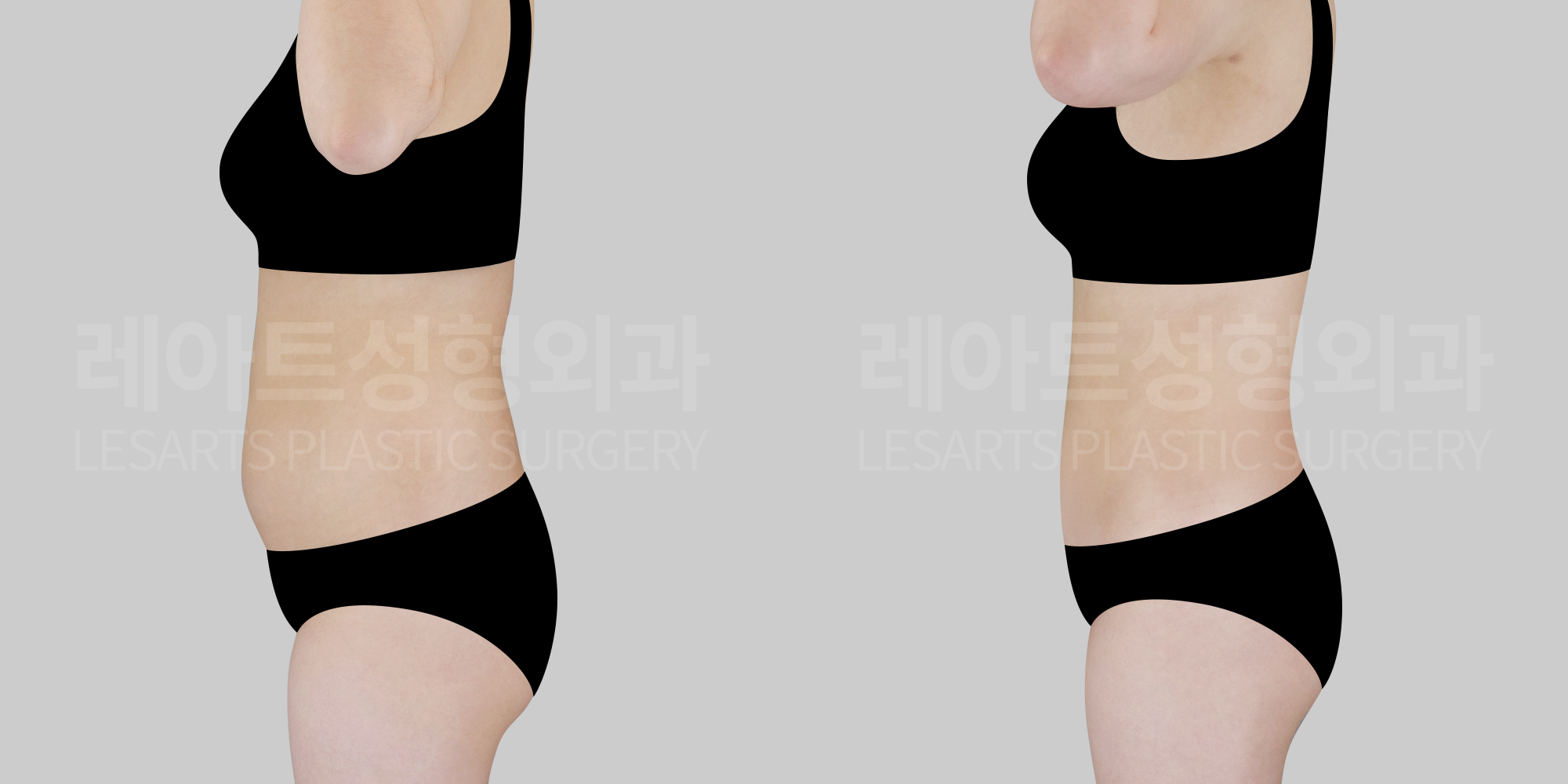
[Lateral View 2.5 Months Post-Op: Subcutaneous Fat Reduction & Abdominal Profile]
The lateral profile clearly demonstrates the dramatic reduction
in abdominal subcutaneous fat thickness.
A soft curvature remains along the anterior wall
due to underlying visceral volume.
Considering that only 2.5 months have elapsed since surgery,
the patient's consistent post-operative lifestyle habits
are clearly reflected in her favorable healing progress.
With continued dietary management and core conditioning,
the anterior profile will flatten even further.
For patients experiencing cyclic weight fluctuations,
liposuction serves not as a finish line,
but as a powerful catalyst and motivator
to preserve a reshaped physique.
If recurring yo-yo dieting and stubborn midsection fullness
have made solo management discouraging,
we invite you to visit Lesarts Plastic Surgery Clinic to evaluate subcutaneous fat depth,
visceral fat influence, and musculoskeletal symmetry,
and determine the most suitable abdominal liposuction strategy
tailored to your anatomy.
Having restored an elongated, slender abdominal silhouette
that accentuates your vertical height,
we encourage you to sustain these beautiful lines
through healthy everyday lifestyle habits.
Abdominal Liposuction FAQ
1. Can abdominal liposuction remove visceral fat?
Liposuction strictly extracts subcutaneous fat beneath the skin.
Deep visceral fat inside the abdominal wall must be managed through diet and aerobic exercise.
2. Does high-volume liposuction make the stomach completely flat?
Subcutaneous depth is substantially thinned, but visceral volume, muscle tone,
and rib cage structure influence the final profile,
sometimes leaving slight curvature or natural asymmetry.
3. Can fat return after liposuction?
If overall body weight rises significantly, remaining fat cells can expand,
making consistent post-operative lifestyle management
essential to preserve results.
4. Does liposuction correct skeletal pelvic asymmetry?
Asymmetries caused by uneven fat deposits can be balanced,
but underlying pelvic tilt, rib flaring, and muscular asymmetry
will remain partially visible.
5. Is 2.5 months post-op considered the final outcome?
This is an active recovery stage.
As residual edema subsides and internal tissue induration (biobond) softens,
the abdominal contours continue to refine over 3 to 6 months.
Dr. Yongseung Seo


Cases finding
similar to my profile
Customer Diagnostics


Select the surgery and
area you are interestedto see real
before andafter changes.


we
make you,
the art
Clinic hours
MON - FRI
10 am – 7pm
SAT
10 am – 4pm
Holiday
SUN, HOLIDAY
Location
Lesarts Moon Clinic Tower 4-5F, 40, Nonhyeon-ro 168-gil,
Gangnam-gu, Seoul, Republic of Korea

Medical institution name Lesarts Plastic Surgery
Address Lesarts Moon Clinic Tower 4-5F, 40, Nonhyeon-ro 168-gil, Gangnam-gu, Seoul, Republic of Korea
Representative Moon sung jun
