




Online Consultation
Please accurately enter the information below.
Quick Cost Consultation
Quick Consultation & Reservation
Cases finding
similar to my profile






Doctor's Note
Medical columns by our surgeons
Thigh Liposuction | Sudden Weight Gain from Steroids & Hormonal Medications: What Can Be Done?
2026-07-21
Thigh Liposuction | Sudden Weight Gain from Steroids & Hormonal Medications: What Can Be Done? [Doctor's Notes by Dr. Yongseung Seo]
Can sudden thigh fat accumulation caused by steroids or hormonal medications be effectively treated with liposuction?
If rapid weight gain followed medication use,
evaluating the specific drugs taken and confirming systemic metabolic stability must come first.
Once pharmacological effects have stabilized,
if stubborn fat persists along the inner thighs and saddlebags,
candidacy for thigh liposuction can be determined
by assessing skin elasticity and subcutaneous fat depth.
Hello, I am Dr. Yongseung Seo, Plastic Surgeon at Lesarts Plastic Surgery Clinic.
While many women consistently maintain dietary control and exercise routines to sculpt their desired silhouette,
there are circumstances where rapid weight gain occurs
due to underlying factors
beyond personal willpower.
Representative culprits include therapeutic
corticosteroids and hormonal medications.
Although essential for treating medical conditions,
these therapies alter appetite and metabolic rates,
depositing adipose tissue into previously lean areas
and causing significant emotional distress.
Feeling anxious whenever looking in the mirror
and deeply wishing to return to your previous body contour
is a completely natural response.
Today, I share a clinical thigh liposuction case of a patient who experienced rapid weight gain
and localized inner thigh and saddlebag fat retention following corticosteroid treatment for a dermatological condition.
[Patient Profile]
Age: Late 20s
Height: 158 cm
Weight: 58.5 kg
BMI: 23.4
Body Fat Percentage: 34.9%
※ Even with similar height and weight metrics,
clinical outcomes vary based on individual adipose distribution,
dermal elasticity, and muscle mass.

[Pre-Operative Body Contour Assessment: Thigh Liposuction]
Following steroid medication prescribed for a skin condition,
the patient gained approximately 10 kg over an acute 2-month span.
Although she had successfully completed and discontinued the medication prior to consultation,
the rapid weight gain and heavy fat deposits
across her thighs proved resistant to natural reduction.
Her primary aesthetic concerns were
dense medial contact along the inner thighs
and protruding lateral saddlebag bulges.
[Diagnostic Ultrasound: Subcutaneous Adipose Depth]
Pre-operative ultrasound imaging measured
fat layer thickness across the following anatomical zones:
Saddlebags (Lateral): Right 35 mm / Left 40 mm
Inner Thighs (Medial): Right 23 mm / Left 23 mm
Anterior Thighs: Right 20 mm / Left 18 mm
Posterior Thighs: Right 15 mm / Left 14 mm
Medial Knees: Right 18 mm / Left 18 mm
Rather than being localized to a single point, substantial subcutaneous fat
spanned diffusely across the saddlebags, inner thighs, anterior quads, and medial knees.
Accordingly, rather than isolated spot reduction,
a comprehensive 360-degree circumferential debulking plan
was established to re-engineer an unbroken, sleek lower limb line.
[Surgical Design: Thigh Volume Reduction & Line Refinement]
Rather than requesting a specific leg shape,
the patient prioritized maximal safe debulking of thigh fat
to reduce overall circumference as much as possible.
However, having substantial fat volume does not mean aggressive, total evacuation
automatically yields the most attractive outcome.
Over-thinning the adipose layer can cause skin waviness or contour step-offs,
and over-aspirating the subgluteal fold
significantly elevates the risk of buttock sagging (gluteal ptosis).
Therefore, while thoroughly reducing medial and lateral saddlebag bulk,
we planned the liposuction procedure around intentionally preserving strategic adipose buffers
to support dermal smoothness and maintain fluid transitions.
[Treatment Scope Accounting for Dermal Elasticity]
Due to rapid acute weight gain,
the patient's skin envelope had stretched quickly,
and baseline dermal elasticity was somewhat diminished.
Under these conditions, significant volume reduction
carries the potential risk of superficial fine creasing
or loose skin laxity.
While retaining a thicker fat layer is standard to minimize wrinkle risks,
the patient was in an excellent position
to maintain structured post-operative skin elasticity care.
Accordingly, rather than leaving excessive residual fat,
we decided to thoroughly debulk overall thigh thickness,
planning skin-tightening aftercare protocols during recovery
should fine wrinkling or skin laxity appear.
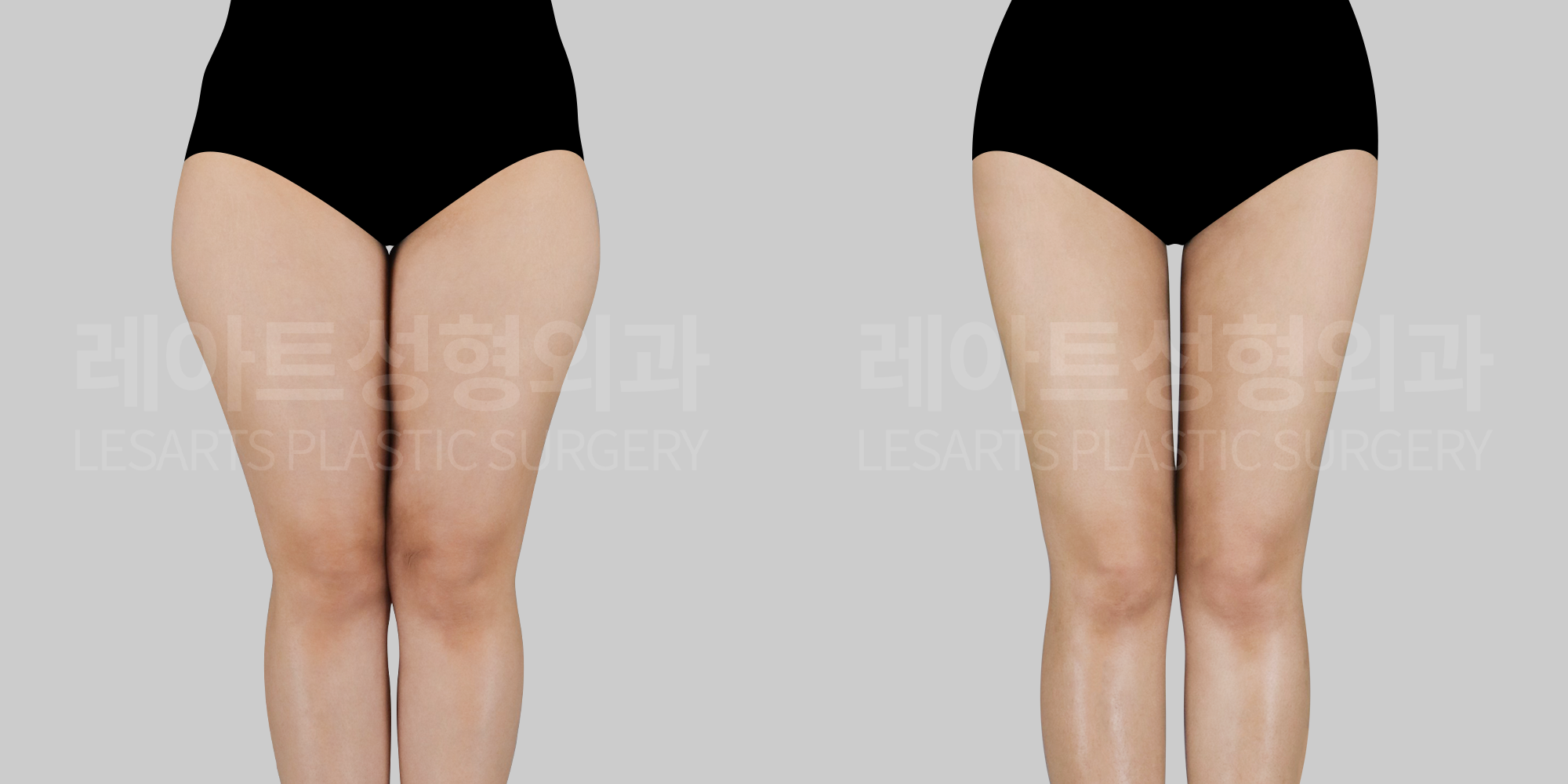
[Lesarts Thigh Liposuction: Anterior View Comparison by Dr. Yongseung Seo]
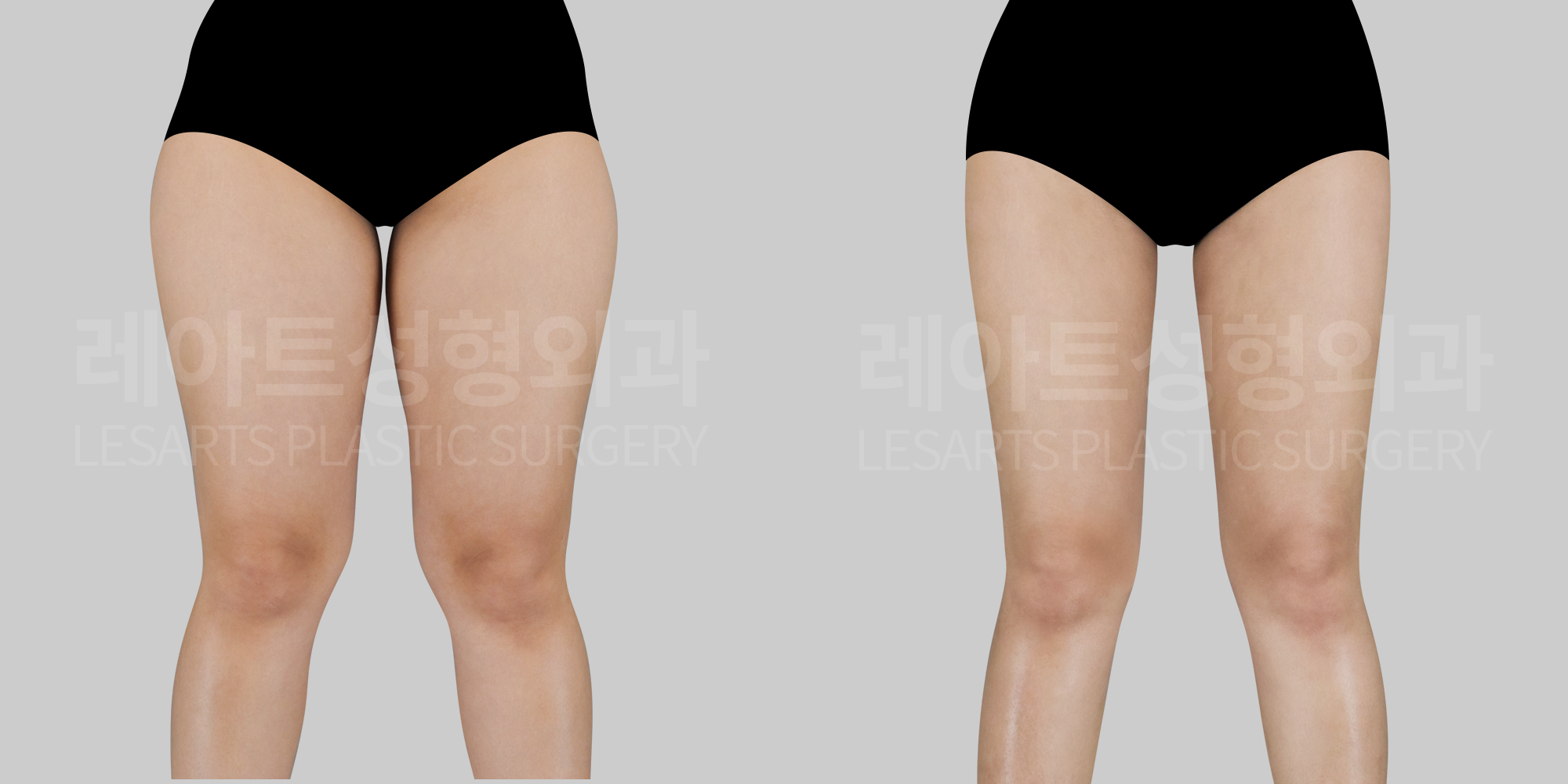
[Lesarts Thigh Liposuction: Anterior View Comparison by Dr. Yongseung Seo]
Pre-operatively, the medial thighs were touching broadly
with noticeable curvature along the medial contour line;
at 8 months post-op, debulking inner thigh volume
successfully created a clean, airy space between the legs.
The transition line extending from medial knee to proximal thigh
straightened into a continuous silhouette,
making the legs look visibly longer and more slender overall.
Although skin laxity was a pre-operative concern,
the comparative photographs demonstrate smooth, even skin recoil
without the feared fine wrinkling
or surface irregularities.
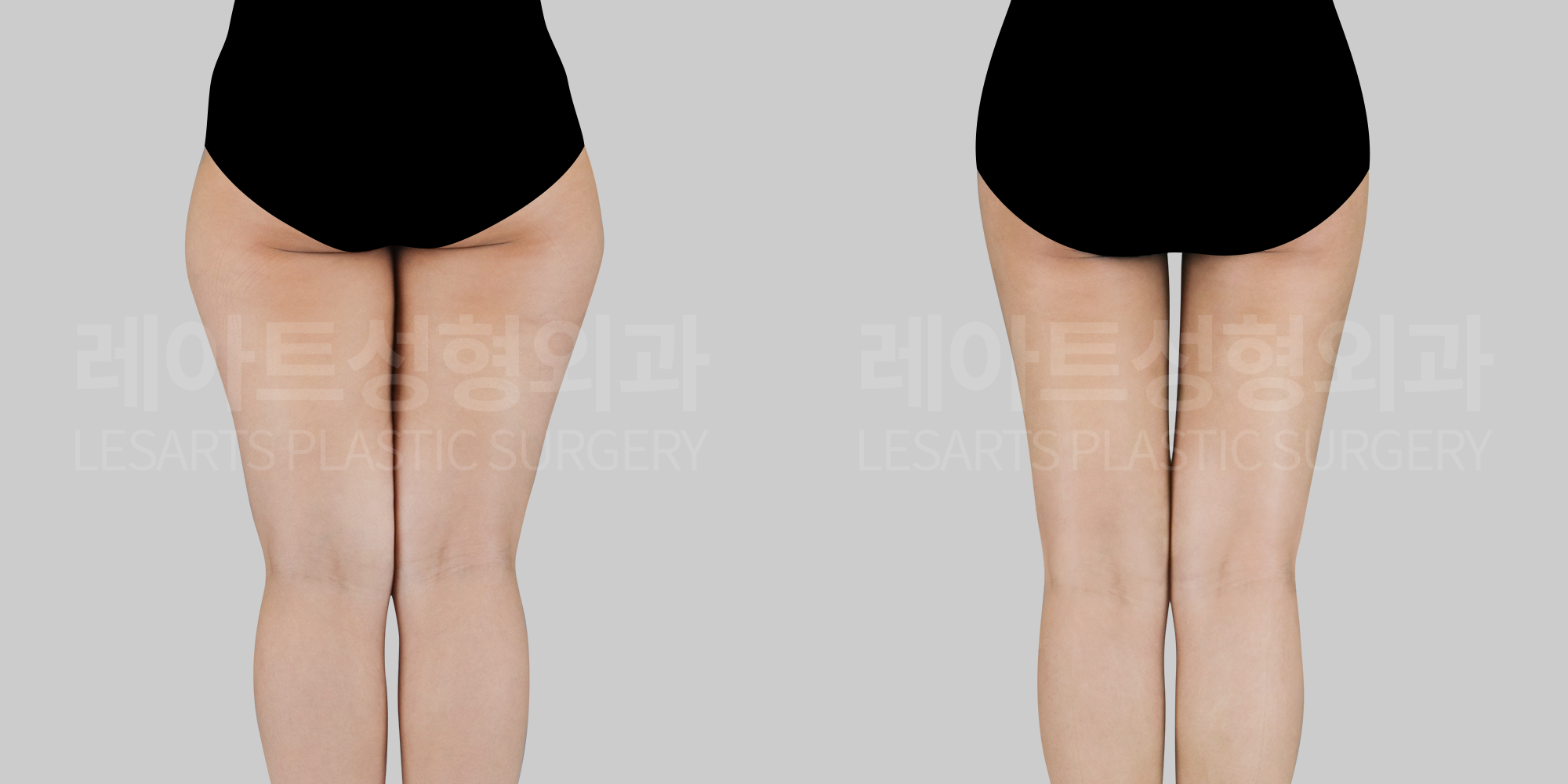
[Lesarts Thigh Liposuction: Posterior View Comparison by Dr. Yongseung Seo]
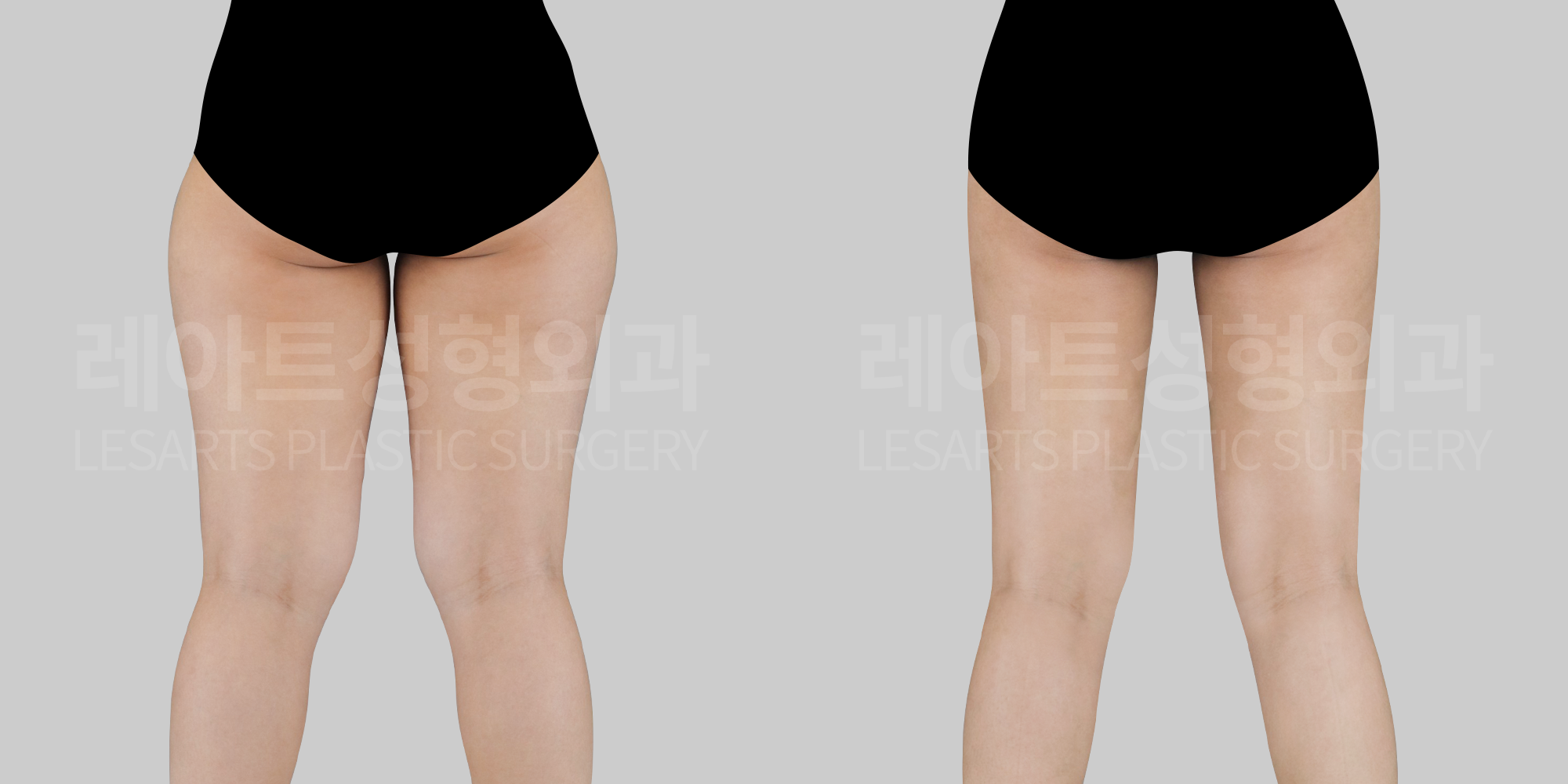
[Lesarts Thigh Liposuction: Posterior View Comparison by Dr. Yongseung Seo]
On posterior view, eliminating protruding lateral saddlebag flare along the outer thigh
significantly narrowed horizontal lower body width.
Before surgery, saddlebag projection caused the visual starting point of the legs to look low and stunted;
post-operatively, the transition from the subgluteal crease down through the thighs
connects in an uninterrupted, graceful arc.
Softening saddlebag convexity visually elevated the hip apex,
making the legs appear longer while cleanly defining the boundary between buttock and thigh.
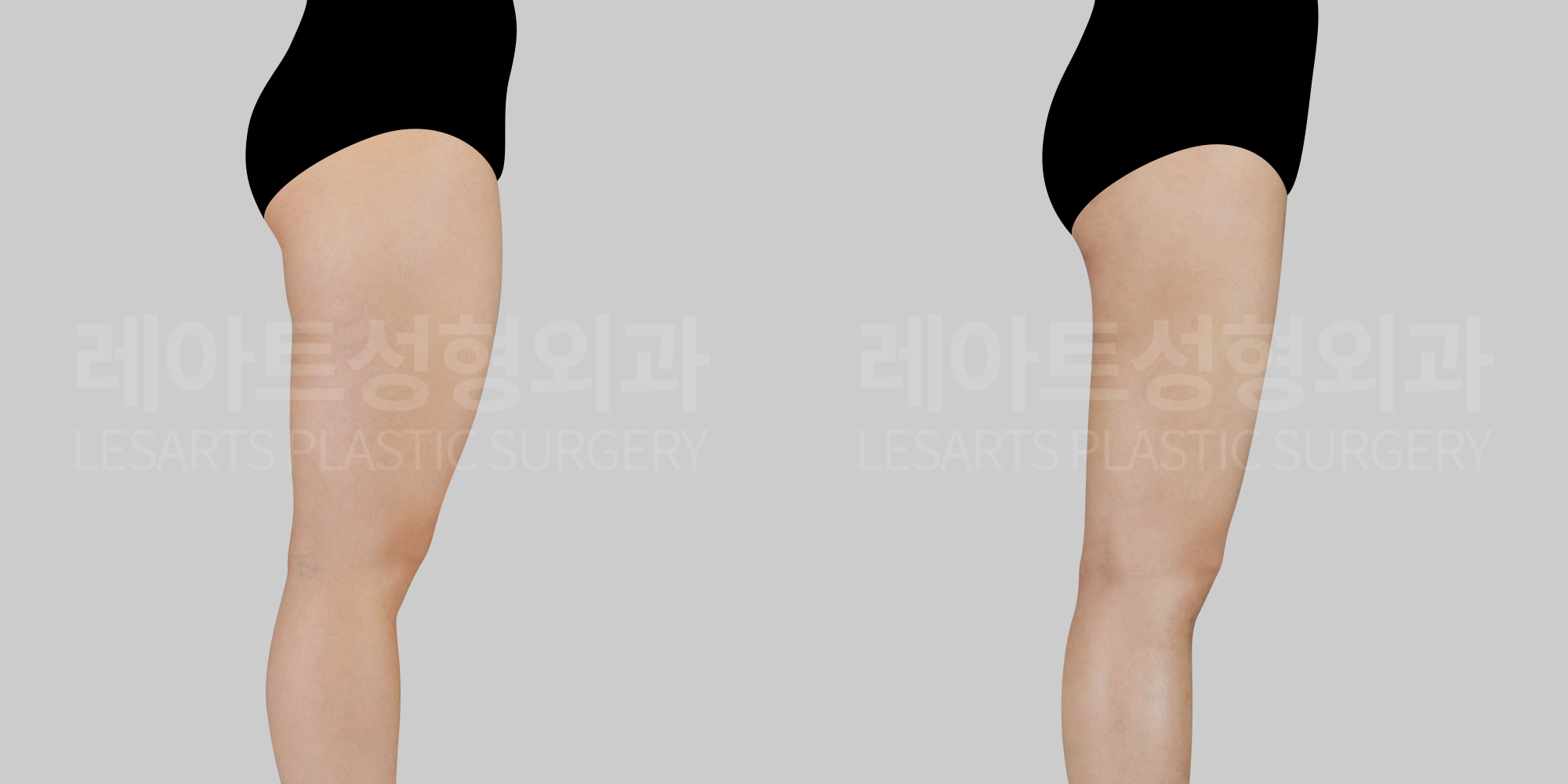
[Lesarts Thigh Liposuction: Lateral Profile (Right) Comparison by Dr. Yongseung Seo]
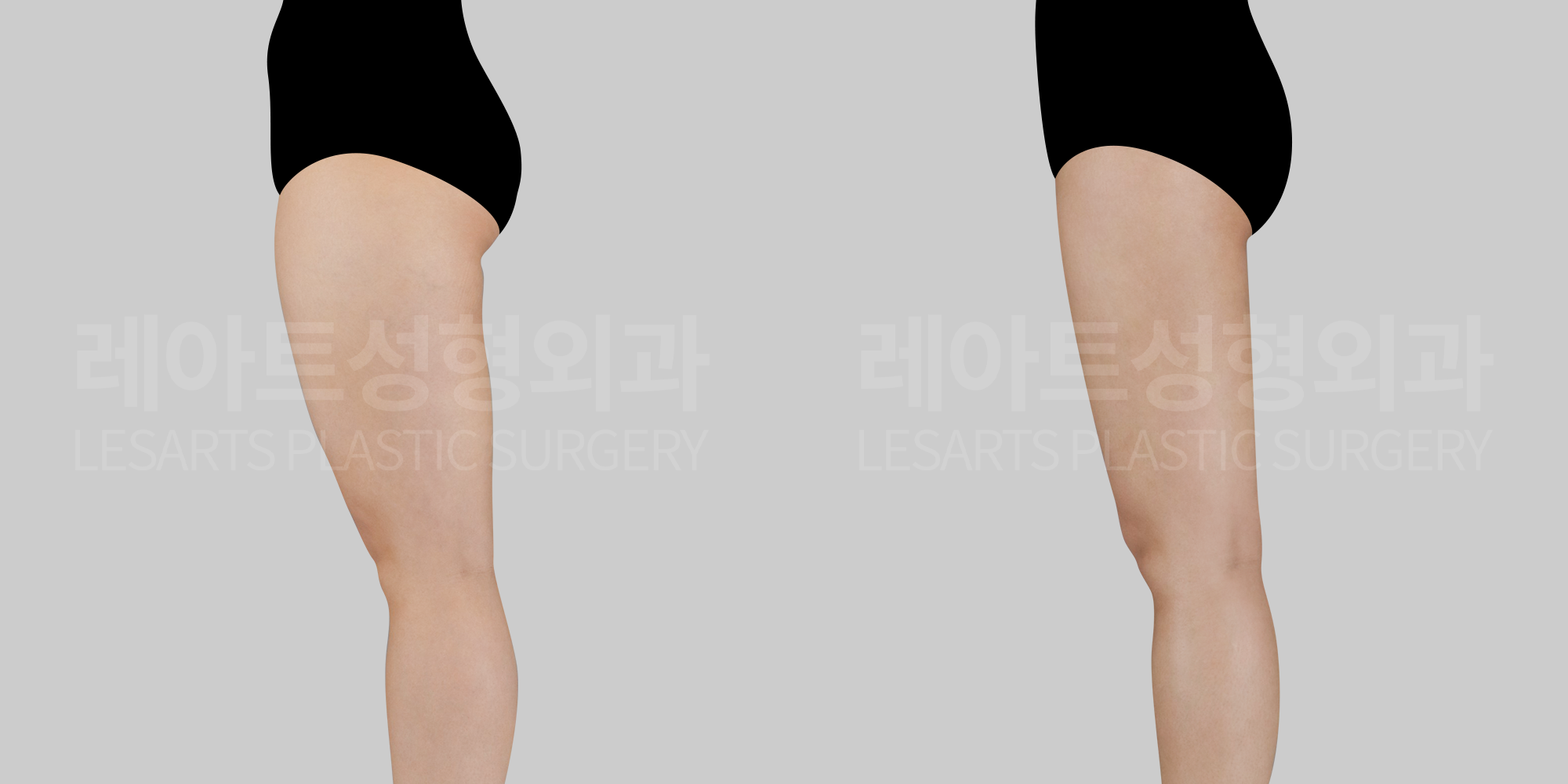
[Lesarts Thigh Liposuction: Lateral Profile (Left) Comparison by Dr. Yongseung Seo]
On the right lateral profile, debulking anterior quadriceps thickness
straightened the leg silhouette.
Rather than forcing an unnaturally rigid anterior line, essential adipose buffers were preserved
to harmonize the flow between knee, thigh, and pelvis.
Similarly on the left, anterior projection and overall circumference decreased,
making lower body profile depth appear substantially lighter.
Medication-Induced Weight Gain: Key Checks Before Liposuction
Experiencing weight gain following steroid or hormonal therapies
does not mean one should rush into liposuction immediately.
It is essential to verify whether the medication is still ongoing,
whether therapy has concluded, and whether weight fluctuations
have fully stabilized.
If medical treatment is active or weight continues to shift unpredictably,
surgical timing and safety must be thoroughly coordinated between the prescribing physician
and the plastic surgeon.
Furthermore, one cannot assume medication-induced weight gain
is exclusively subcutaneous adipose tissue.
Fluid retention (edema), appetite changes, and decreased physical activity
all contribute simultaneously, requiring clinical ultrasound diagnosis
to evaluate true residual fat depth and skin recoil.
In this case, the patient had discontinued medication, weight changes had stabilized,
and ultrasound confirmed ample subcutaneous fat across the thighs,
making surgical liposuction a reliable, safe plan.
In Thigh Liposuction, Balance Matters Far More Than Aspirate Volume
When sudden weight gain occurs involuntarily through medical treatments or hormonal shifts,
the contrast against your previous silhouette can feel deeply frustrating.
However, having substantial fat volume should never justify
extreme, maximum-volume aspiration as the sole objective.
One must carefully evaluate where fat is distributed,
how much the skin envelope can retract following volume loss,
and how seamlessly the transitions will connect into the gluteal fold and peripatellar knees.
For this patient, we successfully debulked overall thigh volume
while calibrating aspirate depth and scope across each anatomical zone
to prevent surface irregularities and preserve natural buttock lift.
Dr. Yongseung Seo


Cases finding
similar to my profile
Customer Diagnostics


Select the surgery and
area you are interestedto see real
before andafter changes.


we
make you,
the art
Clinic hours
MON - FRI
10 am – 7pm
SAT
10 am – 4pm
Holiday
SUN, HOLIDAY
Location
Lesarts Moon Clinic Tower 4-5F, 40, Nonhyeon-ro 168-gil,
Gangnam-gu, Seoul, Republic of Korea

Medical institution name Lesarts Plastic Surgery
Address Lesarts Moon Clinic Tower 4-5F, 40, Nonhyeon-ro 168-gil, Gangnam-gu, Seoul, Republic of Korea
Representative Moon sung jun
