




Online Consultation
Please accurately enter the information below.
Quick Cost Consultation
Quick Consultation & Reservation
Cases finding
similar to my profile






Doctor's Note
Medical columns by our surgeons
[Type M Full Tummy Tuck: Vertical C-Section Scar Revision Before & After – Dr. Kukhan Lee, Lesarts Plastic Surgery Clinic]
2026-07-21
[Type M Full Tummy Tuck: Vertical C-Section Scar Revision Before & After – Dr. Kukhan Lee, Lesarts Plastic Surgery Clinic]
If a C-section scar turns red, hard, and raised,
or creates an irregular step-off with surrounding tissue, how should it be treated?
Cesarean section scars mature differently depending on genetic healing diathesis, mechanical wound tension,
and the consistency of post-operative scar management.
If the scar tissue itself is the primary concern, intralesional injections, laser therapies,
or surgical scar revision can be considered;
however, when lower abdominal skin laxity and contour shelf deformities coexist,
a comprehensive approach including abdominoplasty (tummy tuck) may be necessary.
Hello, I am Dr. Kukhan Lee, Board-Certified Plastic Surgeon specializing in abdominoplasty
and scar reconstructive surgery at Lesarts Plastic Surgery Clinic.
The journey of childbirth and bringing new life into the world is deeply personal and unique for every mother.
Even when natural delivery is planned, unforeseen circumstances can arise where
an emergency Cesarean section becomes vital for the safety of mother and baby.
Thus, a C-section scar is far more than an incision mark—
it represents the profound endurance and devoted choices
borne by a mother during delivery.
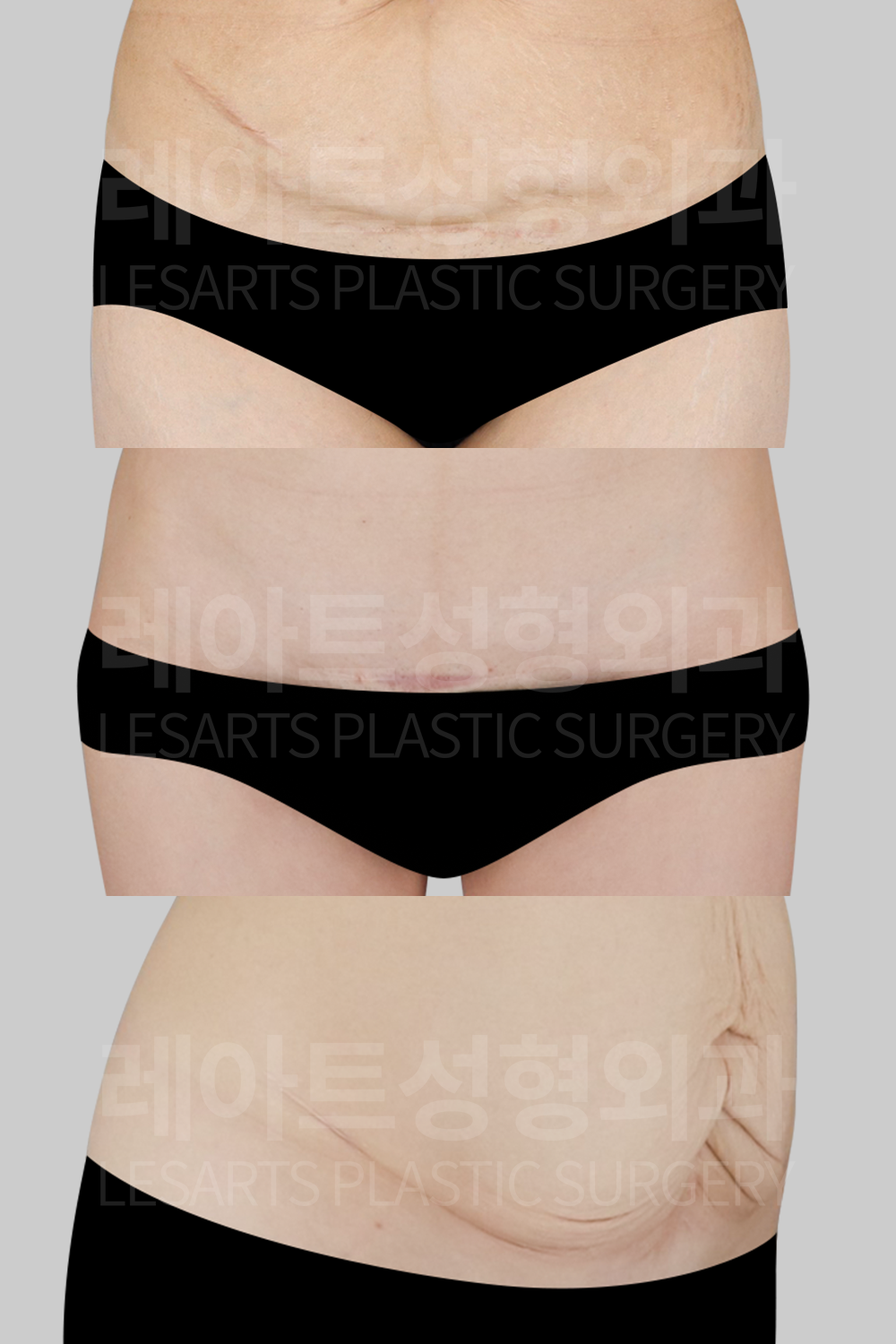
Yet, even long after childbirth,
if the scar spreads widely,
rises into a firm, raised ridge, or retains persistent dark erythema,
it naturally causes aesthetic frustration and distress.
Particularly when the scar indents inward while supra-incisional skin and fat
hang over like an apron (a C-section shelf deformity), the problem extends beyond
mere superficial scar color or thickness.
Today, I will explain why Cesarean scars heal differently among individuals,
and detail the staged non-surgical procedures and
surgical revision options available according to your scar's specific anatomical condition.
Q. Why do C-section scars heal differently across individuals?
Even with incisions placed at the same pelvic level with similar lengths,
the width, elevation, and pigmentation of a C-section scar
vary distinctly from patient to patient.
The final scar architecture is co-determined by individual wound-healing diathesis,
mechanical distraction forces along the incision line,
and the consistency of postoperative scar management.
1. Individual Genetic Healing Diathesis
The first critical factor to evaluate
is personal scar-forming predisposition.
In patients with a keloidal tendency, the biological wound-healing response
triggers excessive fibroblastic proliferation and collagen overproduction
far beyond typical physiological limits.
In such cases, scar tissue expands past the margins of the original incision,
elevating into an erythematous, indurated, and itchy nodular mass.
If you have a personal history of thickened scars following vaccinations, ear piercings, or past operations,
it is essential to share this clinical background with your surgeon during consultation.
2. Repetitive Biomechanical Distraction Tension
Even without a keloid diathesis,
incisions can heal red, raised, and thick.
These are clinically categorized as hypertrophic scars.
The lower abdomen housing a C-section scar is an anatomical zone subject to continuous skin stretching
whenever standing, straightening the lumbar spine,
or moving the torso.
In particular, substantial distraction tension concentrates along the central portion of the incision,
which often causes the midline of the scar to heal wider and thicker than the lateral edges.
3. Postoperative Scar Care Consistency
From the moment epithelialization completes until a scar fully matures,
a prolonged biological timeline is required.
Whether diligent hydration was maintained during this remodeling window,
whether medical-grade silicone sheets were applied appropriately,
and whether timely intralesional injections or laser treatments were administered
significantly alters the final maturation profile.
If intense erythema persists or the scar thickens rapidly,
rather than waiting passively, it is advisable to evaluate whether stage-appropriate clinical intervention
is warranted.
Detailed insights on scar maturation stages can be explored in our guide on
**Stage-by-Stage Scar Care Protocols**.

Non-Surgical In-Office Treatments for C-Section Scars
C-section scar therapy is never one-size-fits-all.
The therapeutic modality must be customized depending on whether the scar is elevated and indurated,
whether microvascular erythema or hyperpigmentation predominates,
or whether structural tethering and step-off deformities have developed.
Intralesional Corticosteroid Injections
Corticosteroid injections represent the primary non-surgical standard
for raised, firm, hypertrophic scar tissue.
By delivering triamcinolone acetonide directly into the lesion,
this intralesional technique suppresses fibroblast activity,
flattening and softening the hypertrophic collagen matrix.
Depending on scar thickness and tissue reactivity, visible softening may occur after a single session,
though serial treatments spaced over several weeks are commonly needed.
While minor procedural discomfort can occur, as collagen density breaks down
and tissue softens, injection discomfort diminishes substantially.
Rarely, localized dermal atrophy (depression),
telangiectasia, or hypopigmentation can develop,
and systemic absorption side effects cannot be entirely ruled out.
Therefore, if noticeable dermal thinning or unusual systemic symptoms arise,
inform your medical team promptly for clinical evaluation.
Botulinum Toxin Injections
For patients who experienced adverse effects from steroids or require alternative approaches,
intralesional botulinum toxin (Botox) can be evaluated.
Botulinum toxin temporarily immobilizes surrounding muscular pull,
relieving distracting tension across the healing scar margins.
Growing clinical evidence indicates that neuromodulators assist in reducing scar thickness and erythema,
broadening their therapeutic application in modern scar revision.
Suitability varies based on scar morphology and healing stage, so it is not universally applied to every Cesarean scar.
Laser Modalities
If your chief complaint centers on persistent microvascular erythema or dark post-inflammatory hyperpigmentation,
targeted laser therapy is a reliable option.
Vascular lasers or pigment-clearing toning lasers are selected according to tissue discoloration,
typically requiring staged multi-session regimens.
While lasers effectively calibrate pigment and erythema,
they cannot structurally release deep tethered adhesions or level severe apron shelf deformities on their own.
Surgical Revision for Refractory C-Section Scars
When a scar remains wide, firm, or tethered despite non-surgical injections and laser procedures,
surgical revision is indicated.
The standard surgical approach is surgical scar revision—excising the fibrotic scar tissue
and realigning the healthy wound edges under minimal tension.
Surgical Scar Revision
When abdominal skin laxity is negligible and only the C-section scar itself is wide or raised,
direct surgical scar revision is executed.
The pathological fibrotic scar is cleanly excised, and the dermal-fascial layers are advanced and sutured
in meticulous anatomical tiers to neutralize epidermal tension.
Compared to full abdominal undermining, the surgical scope is limited,
offering a faster recovery and minimal downtime.
However, excising an existing scar
does not mean zero surgical marks remain.
Because a new incision line must progress through biological wound healing, postoperative tension-relieving taping, hydration,
silicone therapy, and timely adjuvant lasers are essential to secure a fine, inconspicuous result.
Frequently More Than Just a Scar Issue
In clinical consultations for C-section scars,
we frequently observe complex structural changes in the surrounding abdominal wall.
Representative clinical findings include:
- True keloidal or hypertrophic scar formation
- Deep dermal tethering causing depressed groove step-offs
- A bulging overhang of skin and fat folding over the incision (C-section shelf deformity)
- Persistent postpartum lower abdominal dermatochalasis (skin laxity)
- Midline abdominal bulge driven by rectus diastasis (muscle separation)
When the scar base is firmly tethered to underlying fascia while loose skin and fat hang over it,
simply excising and re-suturing the scar line in situ
leaves the surrounding apron fold and height discrepancy intact.
Furthermore, if significant postpartum skin laxity and fascial diastasis coexist,
reconstructing the entire abdominal wall architecture proves far more effective than isolated scar surgery.
In this scenario, rather than focusing solely on the scar,
one must comprehensively diagnose supra- and infraumbilical skin elasticity, the extent of tissue laxity,
subcutaneous fat depth, and the grade of rectus diastasis.
For detailed surgical guidance on correcting postpartum laxity and C-section scars simultaneously,
explore our **[Abdominoplasty (Tummy Tuck) Guide]**.
Determining the appropriate treatment scope requires evaluating scar height, width,
and deep tissue tethering in unison.
Combining Abdominoplasty with Cesarean Scar Revision
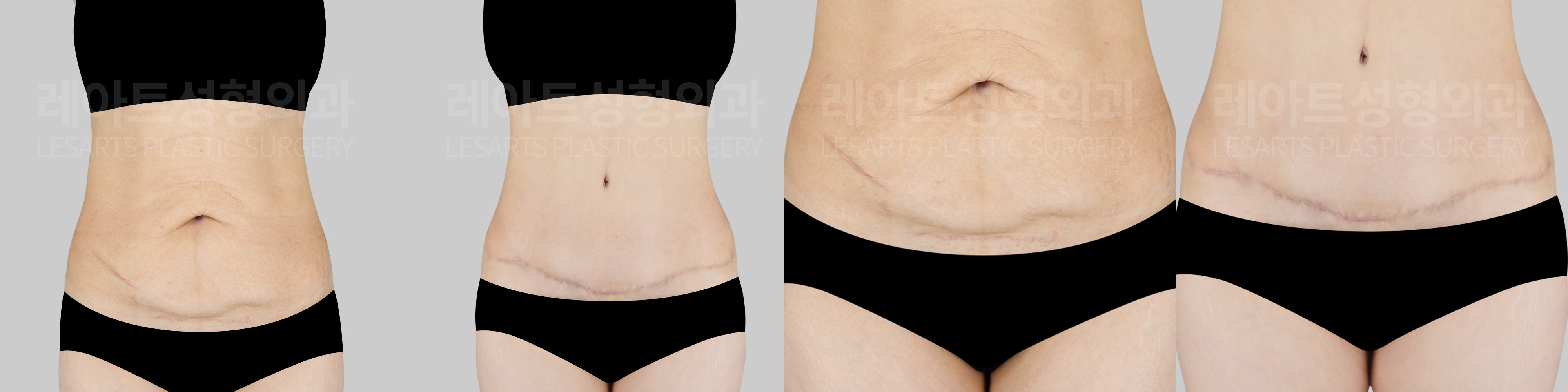
Type M Full Tummy Tuck: C-Section Scar Revision Before & After – Dr. Kukhan Lee, Lesarts Plastic Surgery Clinic
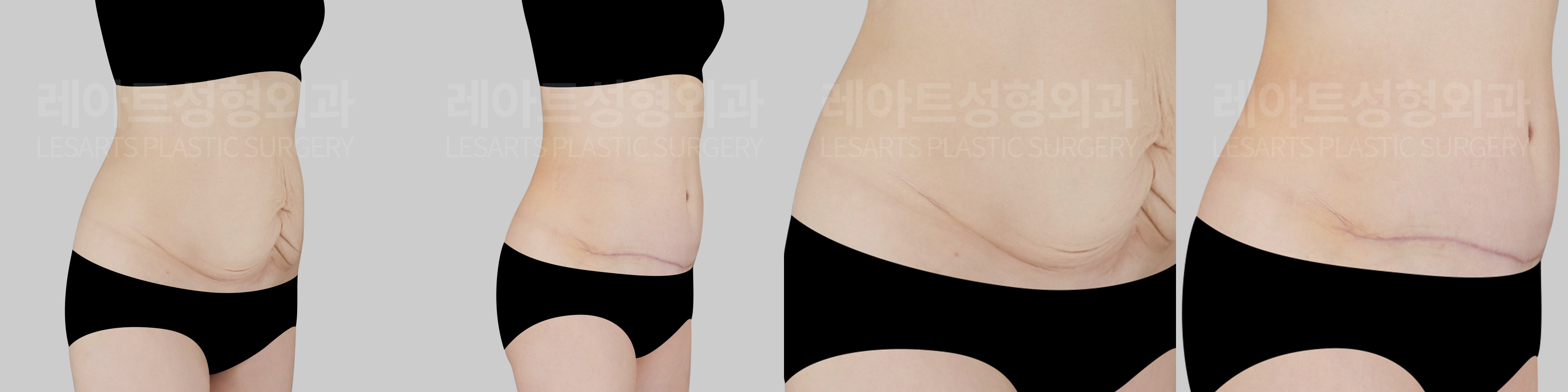
Type M Full Tummy Tuck: Vertical C-Section Scar Removal Before & After – Dr. Kukhan Lee, Lesarts Plastic Surgery Clinic
Abdominoplasty is a reconstructive contouring procedure that excises redundant, sagging skin and excess fat,
plicating separated rectus abdominis muscles to restore a firm, flat abdominal wall.
When an existing Cesarean scar lies within the planned resection zone of an abdominoplasty,
the pathological scar is entirely excised alongside the redundant tissue,
relocating the final incision line discreetly low beneath underwear margins.
Depending on the anatomical extent of tissue laxity, either a Type M full abdominoplasty or
a Type S mini abdominoplasty is indicated.
- The Cesarean scar is situated high on the lower abdomen
- Skin laxity spans across both the upper and lower abdomen
- Severe tethered depressions and apron step-offs extend broadly
- A vertical midline C-section scar is present
- Rectus diastasis causes noticeable central abdominal protrusion
During surgery, sagging tissue and the pre-existing scar are completely excised together,
placing the refined new closure low along the natural bikini crease.
When rectus diastasis is present, midline fascial plication is performed simultaneously,
resolving postpartum core weakness and abdominal protrusion together.
Thus, this approach offers an ideal solution for mothers seeking to correct
both a troublesome C-section scar and full-thickness abdominal wall laxity in a single operation.

Mini Tummy Tuck: C-Section Hypertrophic Scar Revision – Dr. Kukhan Lee, Lesarts Plastic Surgery Clinic
A Type S mini tummy tuck is considered when upper abdominal laxity is minimal
and skin excess and scar tethering are confined strictly below the umbilicus.
Rather than extensive supraumbilical undermining as required in Type M full abdominoplasty,
correction is focused exclusively on the infraumbilical zone.
Candidacy is evaluated in the following presentations:
- The C-section scar itself is the primary aesthetic concern
- Skin folds or bulges over the top of the scar line
- Mild lower abdominal skin laxity is present
- Epigastric skin tone remains well preserved
By excising infraumbilical skin that encompasses the Cesarean scar,
lower belly apron creasing and adjacent step-off shelves are eliminated.
However, the term 'mini' does not mean every incision is short
or that recovery is negligible.
The final incision length and surgical approach depend directly
on the transverse width of lower laxity, scar span, and required redraping tension.
Tailoring Scar Revision to Your Individual Abdominal Profile
The objective of C-section scar revision
is not to erase all surgical marks completely.
It is the refined process of softening induration, fading erythema and hyperpigmentation,
and leveling contour step-offs to create a smooth, natural, and discreet abdominal surface.
If a scar is primarily raised and red, intralesional injections or vascular lasers serve as the initial step;
if the scar is wide or refractory to non-surgical care,
surgical scar revision is indicated.
Conversely, when deep shelf tethering, abdominal wall bulging, and rectus diastasis coexist,
isolated scar treatments cannot achieve structural correction.
In such presentations, Type M full abdominoplasty or Type S mini abdominoplasty
excises the pathological scar and restores full abdominal wall integrity together.
Because healing diathesis, scar location, and abdominal laxity vary widely,
treatment strategies cannot be chosen solely from photographs or another patient's case.
Accurately diagnosing your specific scar morphology
alongside musculoskeletal and dermal changes is the essential first step toward a safe, successful outcome.
C-Section Scar FAQ
1. Will a C-section scar disappear completely on its own over time?
While early erythema and induration soften naturally during biological maturation,
widened scars, keloidal tissue, deep tethered depressions, and shelf overhangs do not resolve spontaneously.
2. What is the difference between a keloid and a hypertrophic scar?
Hypertrophic scars remain confined within the boundaries of the original incision,
whereas keloid tissue proliferates aggressively beyond surgical margins into surrounding normal skin.
Definitive diagnosis requires clinical examination of growth patterns and morphology.
3. How many corticosteroid injection sessions are needed for a C-section scar?
The required number of treatments depends on scar thickness, tissue firmness, and drug response.
While some scars soften after a single session, serial treatments at calibrated intervals are commonly required.
4. Does surgical scar revision completely eliminate the C-section scar?
Excising a scar creates a new surgical incision line that leaves a mark;
however, by resecting wide, irregular tissue and re-approximating wound edges under minimal tension,
the new scar heals as a significantly finer, less conspicuous line.
5. Is abdominoplasty necessary just to treat a C-section scar?
If only the scar is problematic and skin laxity is absent, surgical scar revision alone suffices.
However, if supra-incisional apron folds, deep tethering, lower abdominal dermatochalasis, or rectus diastasis coexist,
abdominoplasty provides the definitive structural correction.
Dr. Kukhan Lee


Cases finding
similar to my profile
Customer Diagnostics


Select the surgery and
area you are interestedto see real
before andafter changes.


we
make you,
the art
Clinic hours
MON - FRI
10 am – 7pm
SAT
10 am – 4pm
Holiday
SUN, HOLIDAY
Location
Lesarts Moon Clinic Tower 4-5F, 40, Nonhyeon-ro 168-gil,
Gangnam-gu, Seoul, Republic of Korea

Medical institution name Lesarts Plastic Surgery
Address Lesarts Moon Clinic Tower 4-5F, 40, Nonhyeon-ro 168-gil, Gangnam-gu, Seoul, Republic of Korea
Representative Moon sung jun
