




Online Consultation
Please accurately enter the information below.
Quick Cost Consultation
Quick Consultation & Reservation
Cases finding
similar to my profile






Doctor's Note
Medical columns by our surgeons
Arm Liposuction | Why Does My Upper Body Look Broad? Could Lifestyle Habits Be the Reason?
2026-07-23
Arm Liposuction | Why Does My Upper Body Look Broad? Could Lifestyle Habits Be the Reason? [Doctor's Notes by Dr. Yongseung Seo]
Why is arm fat so resistant to weight loss even after dieting?
Adipose accumulation in localized areas such as the upper arms, scapula, and bra line
is driven far more by genetic fat distribution patterns than simple lifestyle habits.
Even when total body weight decreases, stubborn fat in these specific regions often persists until the very end;
for targeted structural body contouring, liposuction provides an effective clinical solution.
[ Lesarts Liposuction Procedure Guide ]
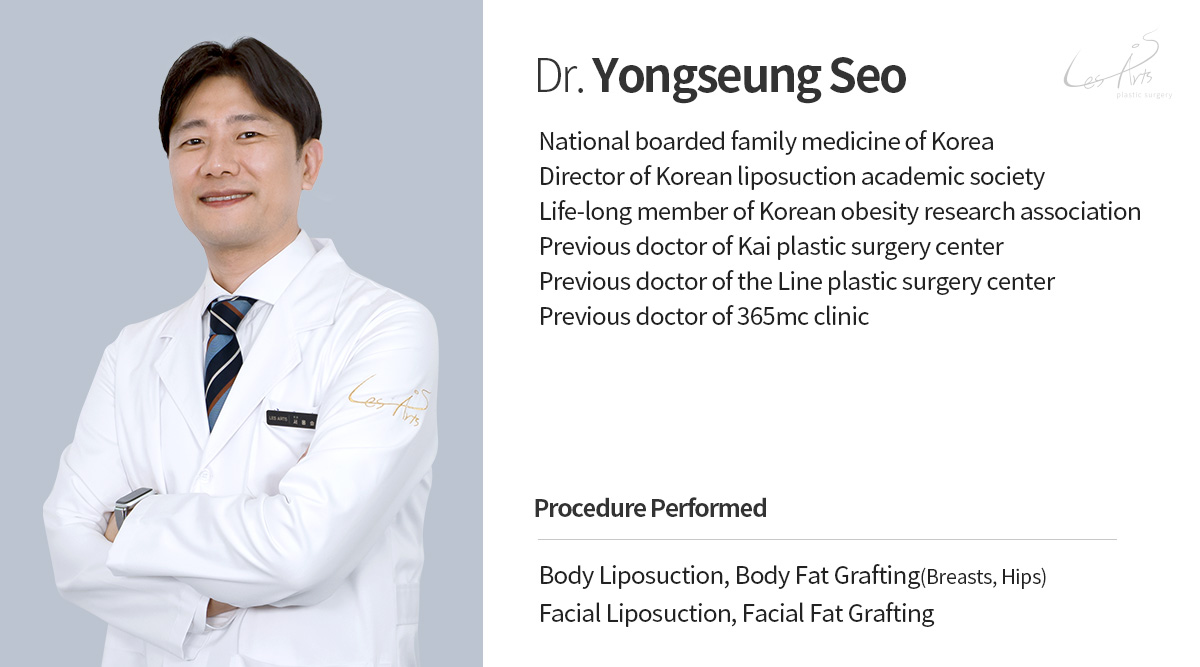
Hello, I am Dr. Yongseung Seo, Plastic Surgeon at Lesarts Plastic Surgery Clinic.
Why does your upper body appear disproportionately broad? Could poor lifestyle habits be to blame?
To state the clinical reality directly,
in most individuals, genetic constitutional predispositions play a far larger role than lifestyle habits.
Whether fat tends to accumulate preferentially across the upper torso
or gathers heavily along the lower extremities
stems primarily from inherited variations in regional adipocyte distribution.
Among patients visiting our consultation rooms troubled by a bulky, broad frame,
one of the most common laments we hear is
"Why is it that only my arm fat refuses to come off?"
Despite diligent dieting, the upper arms exhibit minimal change,
and even after hard-won weight reduction,
the upper arm is invariably the very first area
to regain volume the moment caloric vigilance lapses.
As noted, individuals who easily accumulate upper body fat
are usually governed by hereditary fat distribution patterns.
Consequently, when attempting to diet,
unwanted volume loss occurs first in areas like the face, breasts, or buttocks
rather than the arms,
inducing secondary emotional fatigue and
frequently causing patients to abandon their fitness efforts altogether.
If other areas slim down while stubborn upper arm fat remains unyielding,
targeted surgical liposuction provides
a far more direct and predictable method
to refine your upper torso silhouette.
In this clinical article, we examine an actual patient case
where combined liposuction of the arms, axillary margins, and bra line
effectively debulked upper-body heaviness and resolved chronic broad-shoulder concerns.
[Patient Profile]
Age: Late 20s
Height: 165 cm
Weight: 71.4 kg
BMI: 26.2
Body Fat Percentage: 38%
※ Even with identical or comparable physical measurements,
liposuction outcomes vary based on individual musculoskeletal anatomy and skin tone.
[Pre-Operative Assessment: Arms, Axillary Transitions & Bra Line]
Although the patient engaged in routine light aerobic exercise,
her arm contours showed virtually no reduction,
leaving her deeply distressed by an overall bulky, broad-framed upper torso.
Recent weight gain following a vacation
accentuated upper-arm thickness further,
prompting her to seek specialized surgical intervention.
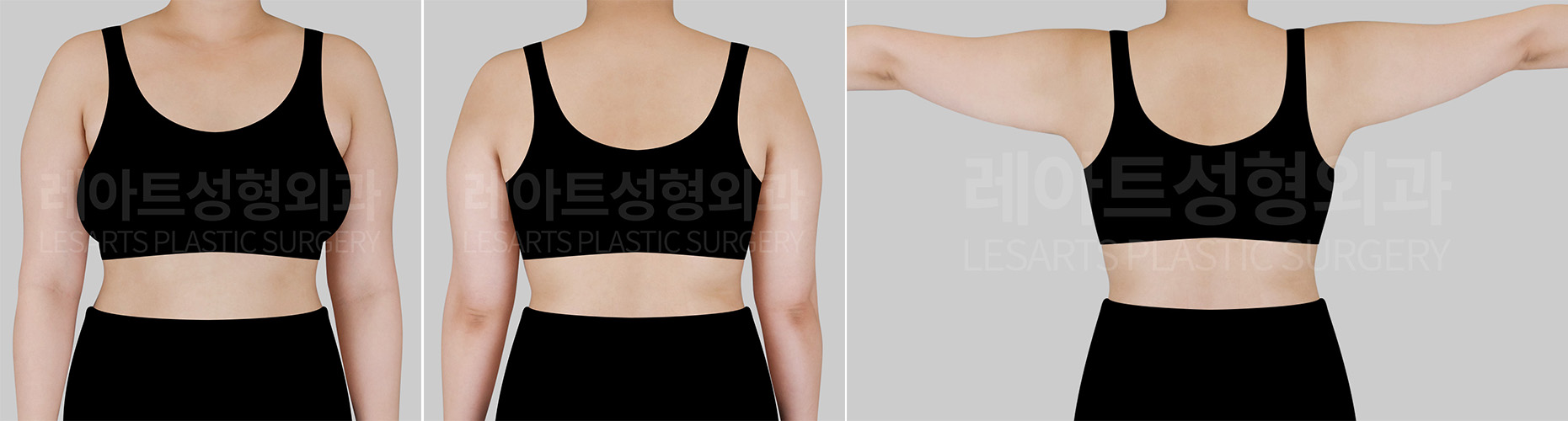
Heavy adipose tissue was densely concentrated along the posterior brachium,
commonly referred to as the triceps flaccid fat pad.
Consequently, in a neutral stance with arms resting at her sides,
posterior fat was pushed outward by the torso,
exaggerating the lateral width of the upper body and projecting a heavy, masculine frame.
In abduction,
the gravitational pull on excess fat mass
caused prominent lower-arm sagging,
while on lateral profile, posterior fat bulging
made the arm appear substantially thicker than it actually was.
Subcutaneous fat deposits along the scapular back and bra line
created visible step-offs and rolls across the back,
further contributing to upper-torso bulk.
While accessory breast and axillary fat volumes were moderate,
they directly disrupted the aesthetic transition into the chest wall;
therefore, a comprehensive surgical plan encompassing the arms, scapular back, and bra line,
as well as the accessory breast and axillae, was established.
Pre-operative diagnostic ultrasound measured the following adipose depth metrics:
Posterior Arm (Triceps): 21 / 20 mm
Anterior Arm (Biceps): 13 / 15 mm
Scapular Back: 11 / 14 mm
Bra Line: 13 / 14 mm
In contrast, deltoid muscle thickness measured 25 / 21 mm, indicating pronounced baseline muscular development;
we thoroughly explained pre-operatively that achieving a perfectly sharp 90-degree shoulder angle
would be anatomically limited by underlying muscle volume.
Furthermore, because bilateral muscle development differed between left and right sides,
subtle bilateral contour asymmetries could naturally persist
in final arm thickness even after complete, uniform fat evacuation.
Although the patient had various apprehensions prior to surgery,
positive feedback from acquaintances who underwent the procedure and our clinical diagnosis confirming sufficient fat depth
promising significant contour improvement solidified her decision.
By debulking heavy adipose layers surgically,
overall upper-body volume would be substantially reduced;
and while minor muscular asymmetry would remain,
her chief concern—a broad, heavy upper frame—would be definitively corrected
into a slender, feminine upper torso silhouette.

Arm & Back Liposuction Technique – Dr. Yongseung Seo, Lesarts Plastic Surgery Clinic
[Surgical Design: Minimizing Perceived Upper-Body Frame Width]
To make the upper torso appear visually slimmer,
it is crucial to reduce not only the horizontal width of the torso
but the lateral width of the upper arms simultaneously.
In clinical reality, when viewed from the front or back,
the point projecting furthest laterally
is rarely the true lateral side of the arm; rather, it is formed as posterior triceps fat wraps outward
past the lateral border of the torso.
Therefore, correcting this posterior-lateral bulge is the primary surgical priority.
However, aggressively stripping all posterior fat
causes the relatively thin deltoid tendon insertion to become overly prominent,
paradoxically making the proximal upper arm look top-heavy on lateral view.
For this reason, our surgical design intentionally preserved a smooth, uniform fat buffer
over the tendinous junctions to match natural muscular curvature.
After streamlining the posterior contour,
we sculpted the lateral outer arm.
Taking the peak outward projection of the deltoid—the outermost landmark of the shoulder—
as our anatomical reference point,
we focused on engineering a sleek line that tapers smoothly inward beneath it.
Conversely, over-resecting lateral subcutaneous fat
exaggerates the anatomical sulcus between the deltoid and triceps,
which can create the optical illusion of a heavier, more muscular arm.
To avoid this, we preserved a calibrated adipose layer
to create a continuous, elegant straight-line silhouette.
Because the scapular back and bra line
carry low risks of contour irregularity,
thorough debulking was executed within safe physiological parameters to flatten back rolls.
However, because dermal thickness across the back is substantial,
we clarified in advance that even after thorough fat evacuation,
a certain thickness of skin fold will naturally remain palpable.
Additionally, while not the primary driver of torso width,
in response to the patient's strong desire to wear sleeveless summer clothing,
the accessory breast and axillary fat pads were treated simultaneously.
We noted pre-operatively that thoroughly debulking accessory breast tissue can lengthen or deepen the anterior axillary crease,
and in select cases may introduce a minor secondary skin fold
as redundant skin contracts.
[Arm, Axillary & Bra Line Liposuction: Before & After Comparison]
(Photographed 2 months post-operatively under standardized studio lighting and positioning)
The patient's aesthetic goal was clear:
"I want to eliminate the bulky upper-body appearance and achieve a clean, straight arm line that flows smoothly into adjacent areas,"
and surgery was executed to fulfill this vision.
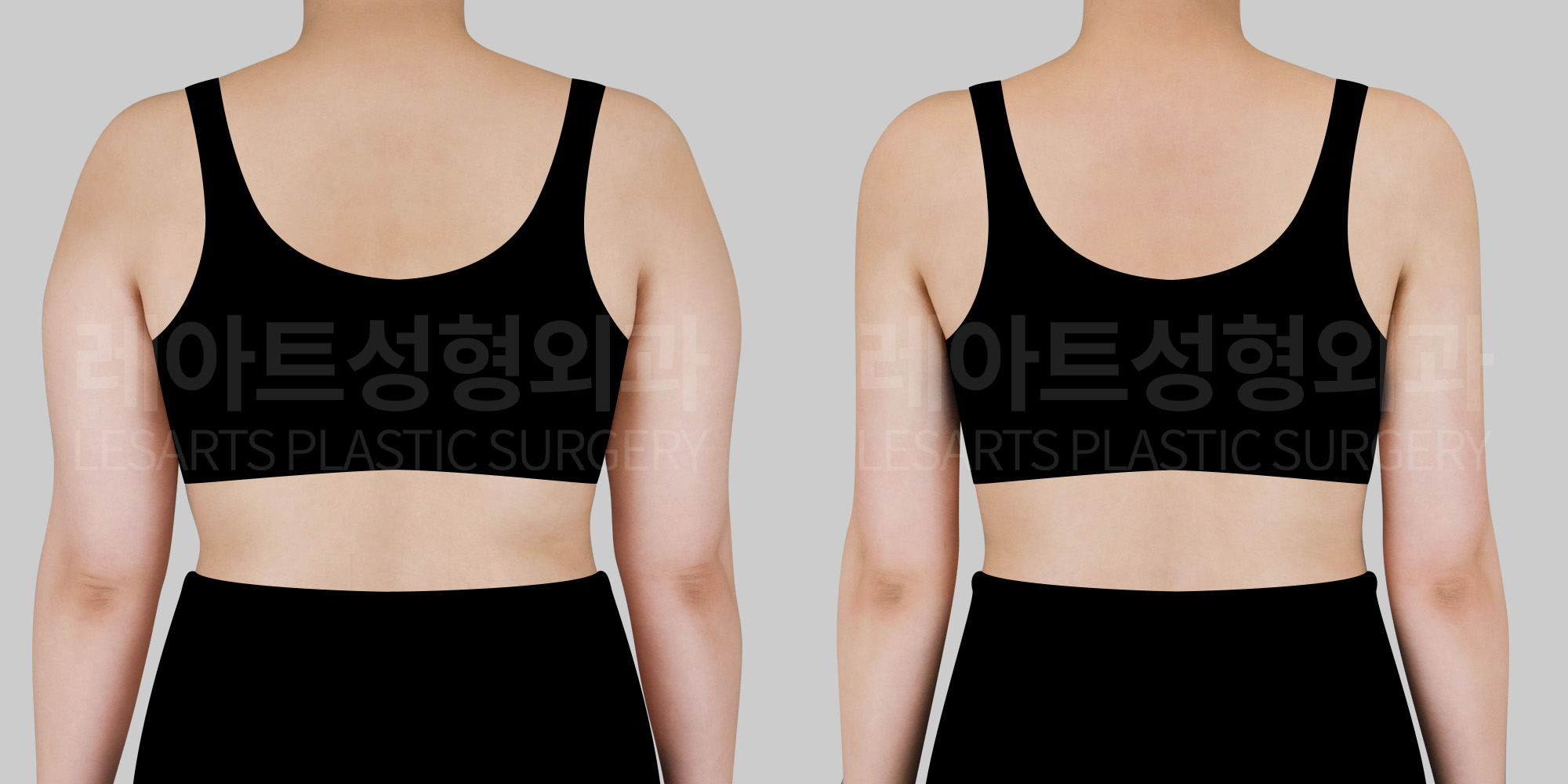
1. Lateral Outer Arm
Eliminating lateral outer arm flare smoothed and narrowed
the arm contour significantly.
While bilateral thickness discrepancies did not become glaringly apparent,
minor baseline asymmetries originating from underlying muscular differences
remain subtly visible as expected.

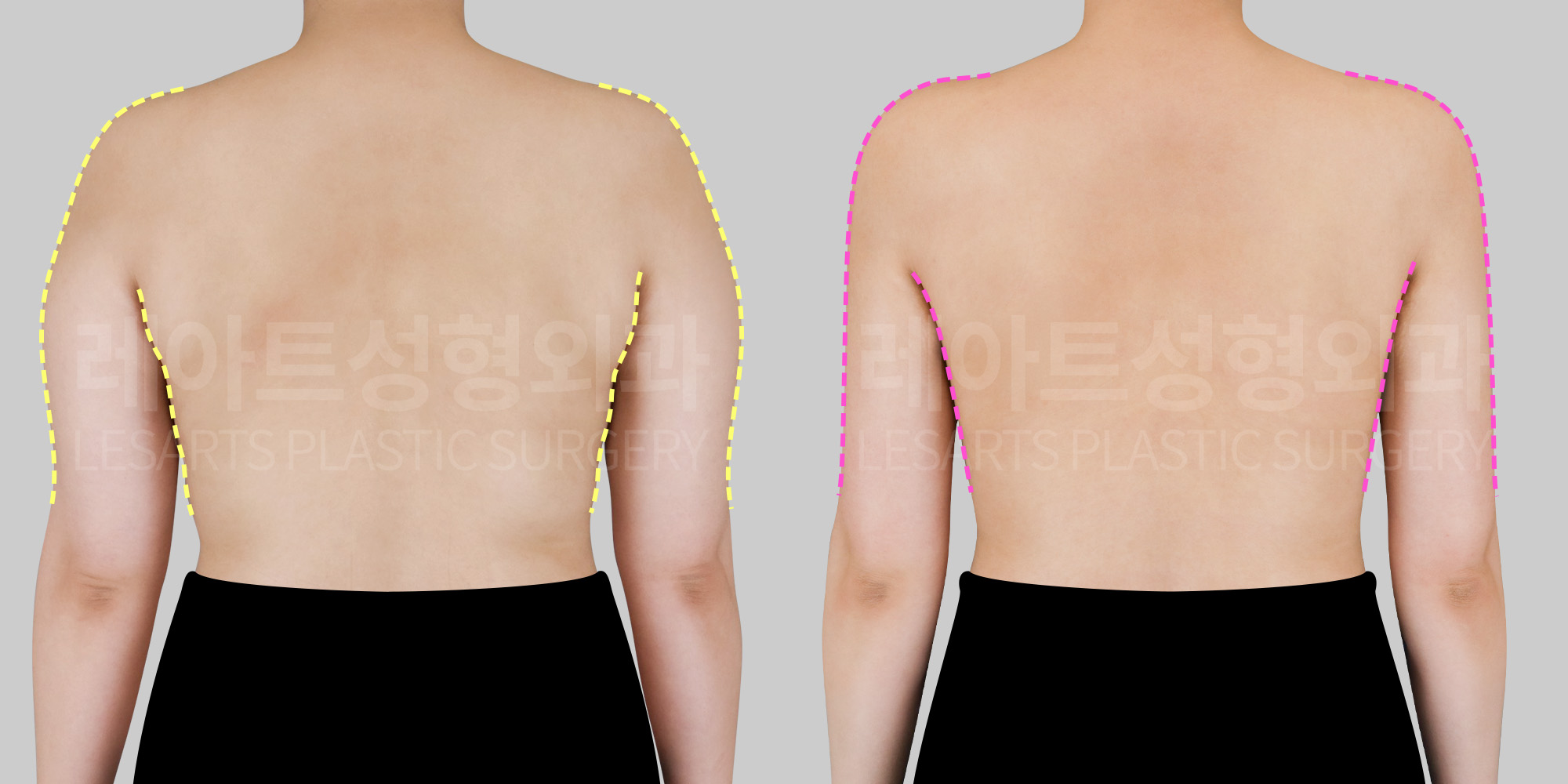
2. Posterior Arm & Back Line
Eliminating dependent sagging during arm abduction
and posterior bulging in resting neutral stance produced a much cleaner back profile.
Concurrently debulking the irregular scapular and bra line rolls
flattened the posterior torso into a cohesive, slender silhouette.
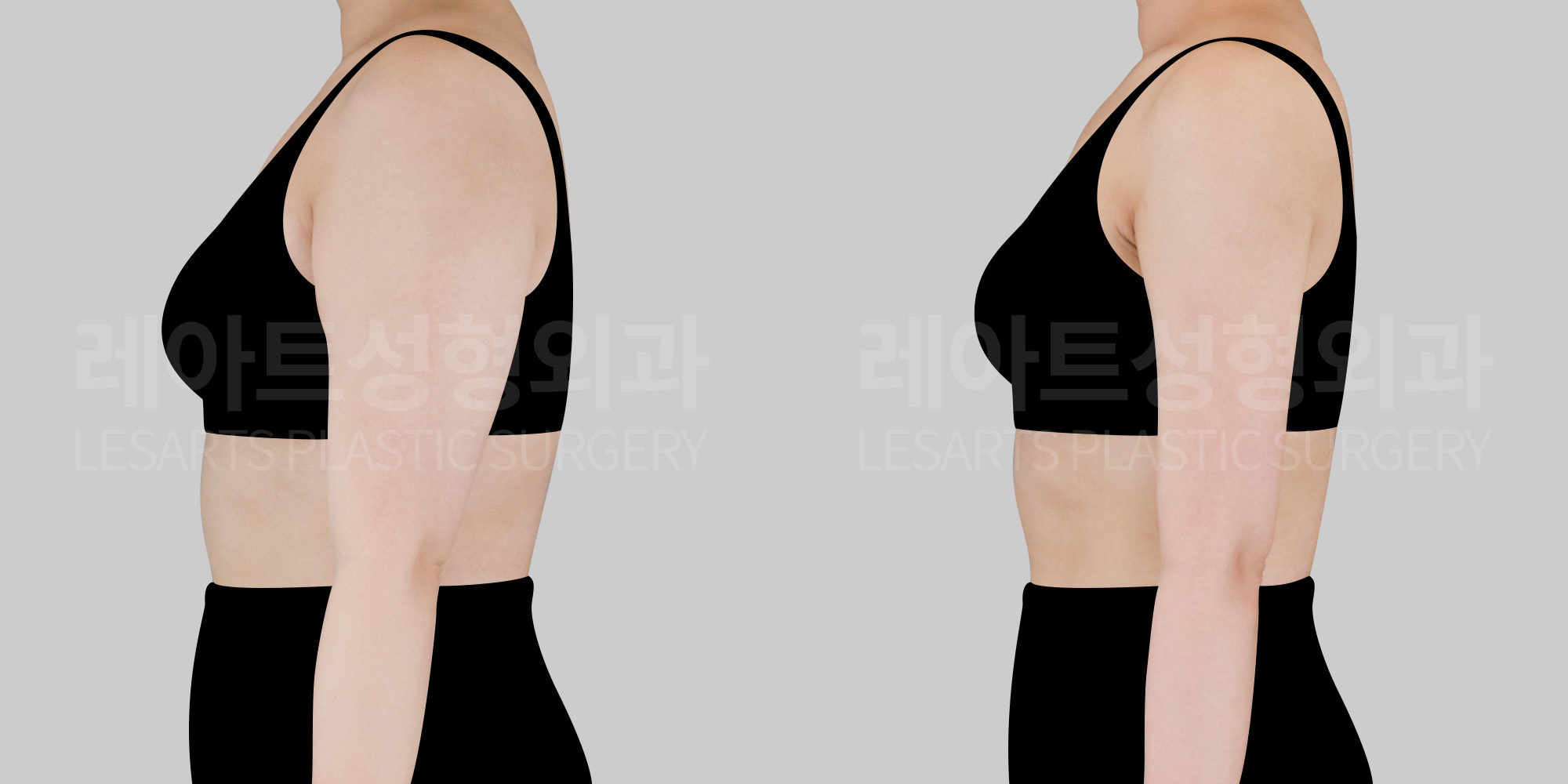
3. Anterior Arm
While the anterior profile shows subtle linear change,
evaluating the arm relative to the glenohumeral joint confirms
that overall limb mass decreased decisively.
The transition from the shoulder into the arm
flows naturally and smoothly,
contributing to a visibly lighter upper-body frame.

4. Accessory Breast
Debulking outward accessory breast fullness that previously masked the proximal arm line
clarified the anatomical connection between shoulder and brachium.
As explained pre-operatively,
a subtle, short crease line appeared along the axilla
as thinned tissue adapted.
5. Axillary Hollows
Debulking heavy axillary deposits that caused a cramped appearance
allowed the inner line to recess naturally,
completing a noticeably slimmer upper-body silhouette.
These comparative photographs capture clinical results at 2 months post-op.
Because active recovery is still underway,
residual edema will continue to resolve over the coming months,
allowing the contours to settle into an even smoother and more natural line.
While aerobic exercise and dietary control
help reduce generalized body fat,
adipocytes mobilize according to genetically predetermined sequences,
making it virtually impossible to spot-reduce fat from desired areas alone.
For areas like the upper arms where lifestyle interventions yield limited contour change,
obtaining an accurate diagnostic assessment of your musculoskeletal framework and fat depth
and exploring targeted surgical options
proves far more effective than endless cyclical dieting.
If unyielding arm fat continues to frustrate you despite dedicated fitness efforts,
we invite you to consult with a specialist
to establish a personalized contouring plan tailored to your physique.
[ Learn More About Lesarts Liposuction ]
FAQ
Q1. Can upper arm fat be sufficiently reduced through diet alone?
Diet and exercise reduce generalized body fat, but stubborn areas like the upper arms often show minimal change due to genetic fat distribution.
When stubborn localized deposits persist, liposuction provides definitive contour improvement.
Q2. What adjacent anatomical areas are commonly contoured alongside arm liposuction?
Treating the scapular back, bra line, accessory breasts, and axillary folds together with the upper arms
ensures a seamless, unbroken transition into the torso for a visibly more slender result.
Q3. Can bilateral asymmetry remain after arm liposuction?
Yes. Underlying differences in skeletal framework and deltoid muscle development can leave subtle natural variations between the left and right sides.
These anatomical factors are carefully evaluated and incorporated into surgical planning.
Q4. When become visible the final results of arm liposuction?
Noticeable contour thinning is visible early on, and as postoperative swelling steadily subsides over 3 to 6 months,
the arm settles into its definitive, smooth straight-line contour.
Q5. Does arm liposuction help make a broad upper-body frame look smaller?
Yes. Debulking posterior triceps fat, scapular back rolls, and bra line deposits narrows the perceived horizontal width of the upper body,
creating a noticeably more compact, feminine silhouette.
Dr. Yongseung Seo


Cases finding
similar to my profile
Customer Diagnostics


Select the surgery and
area you are interestedto see real
before andafter changes.


we
make you,
the art
Clinic hours
MON - FRI
10 am – 7pm
SAT
10 am – 4pm
Holiday
SUN, HOLIDAY
Location
Lesarts Moon Clinic Tower 4-5F, 40, Nonhyeon-ro 168-gil,
Gangnam-gu, Seoul, Republic of Korea

Medical institution name Lesarts Plastic Surgery
Address Lesarts Moon Clinic Tower 4-5F, 40, Nonhyeon-ro 168-gil, Gangnam-gu, Seoul, Republic of Korea
Representative Moon sung jun
