




Online Consultation
Please accurately enter the information below.
Quick Cost Consultation
Quick Consultation & Reservation
Cases finding
similar to my profile






Doctor's Note
Medical columns by our surgeons
Abdominoplasty Revision | Revision Tummy Tuck: Is Secondary Surgery Possible?
2026-07-23
Abdominoplasty Revision | Revision Tummy Tuck: Is Secondary Surgery Possible?
If the outcome of a tummy tuck is unsatisfactory, is revision surgery feasible?
Yes, it is possible. However, surgical feasibility and procedural technique vary based on current tissue laxity, previous surgical scope, and residual skin elasticity,
making precise clinical diagnosis essential.
[ Lesarts Abdominoplasty Guide ]
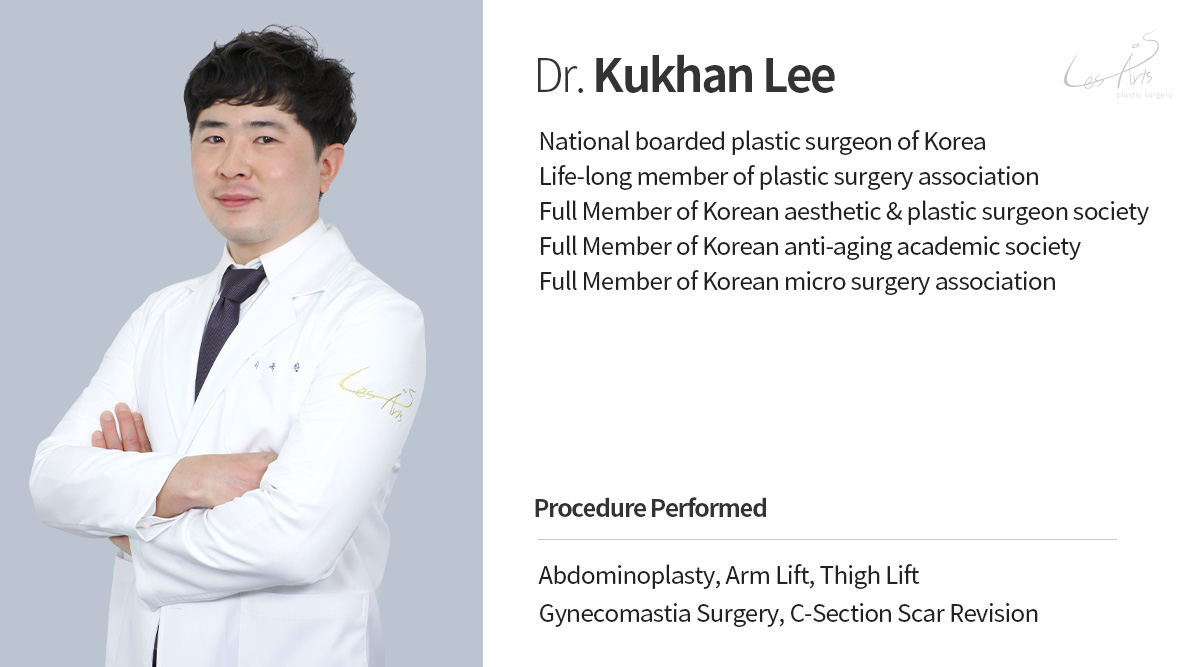
Hello, I am Dr. Kukhan Lee, Board-Certified Plastic Surgeon
specializing in abdominoplasty at Lesarts Plastic Surgery Clinic.
During abdominoplasty consultations,
many patients ask this essential question:
"If laxity recurs after a tummy tuck, is revision surgery possible?"
To state the clinical reality directly,
revision surgery is feasible in some cases, while anatomically unadvisable in others.
Surgical candidacy depends entirely on the current degree of abdominal laxity,
the scope of the prior surgery,
and the amount of residual, mobilizeable skin laxity available.
[Clinical Indications for Revision Abdominoplasty]
Patients frequently seek secondary revision consultations
following previous tummy tuck procedures due to the following concerns:
• Inadequate correction of primary trouble areas (under-correction)
• Unsatisfactory or elevated scar position
• Formation of lateral dog-ear deformities (standing cones)
• Asymmetry, contour depressions, or step-off irregularities
• Development of hypertrophic or keloid scarring
Depending on underlying etiology, these complications can often be
reliably and stably corrected through specialized secondary surgery.
Let us examine an actual patient case.
The patient was in her mid-40s (160 cm / 56.4 kg) with a history of Cesarean delivery,
who had undergone a mini tummy tuck and liposuction at another clinic 2 years prior.
Dissatisfied with her primary surgical outcome,
she consulted multiple centers before visiting our clinic,
emphasizing that the surgeon's specialized expertise and clinical credibility
were her most critical priorities in pursuing revision surgery.
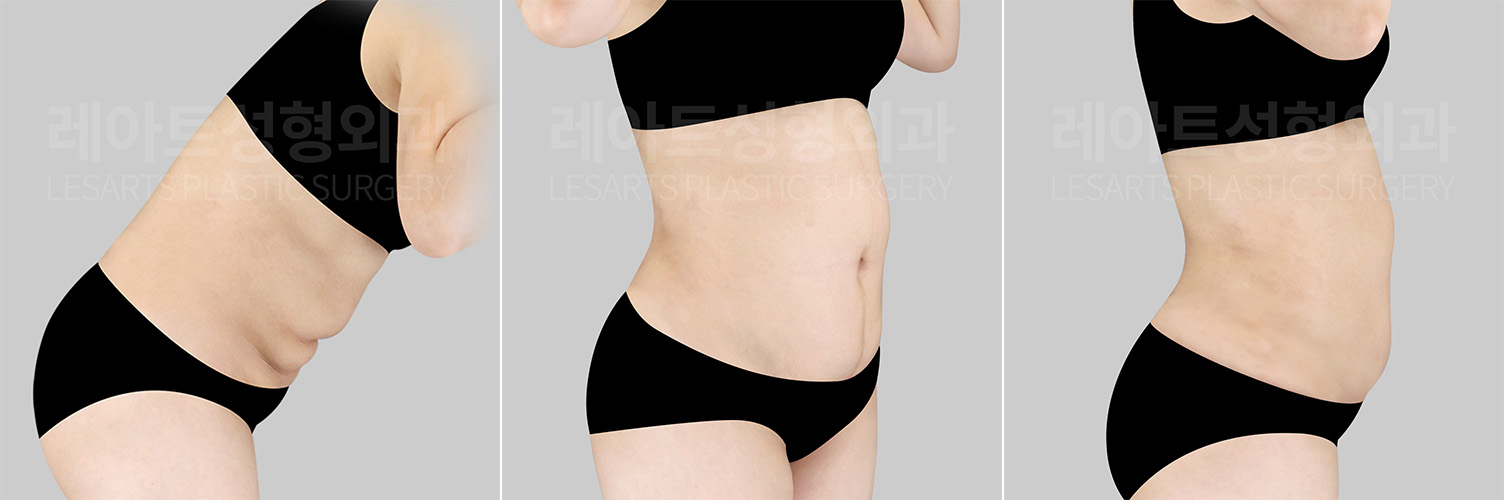
Upon consultation, the patient's primary complaints were:
• Inadequate tightening and contouring of the upper abdomen
• Texture and thickness disparities between upper and lower abdominal skin
• Firm, irregular internal fibrotic adhesions and step-offs
while fortunately, baseline dermal elasticity remained relatively favorable.
[Core Clinical Evaluation Criteria for Secondary Revision]
During her initial procedure at the previous clinic,
epigastric rectus plication and upper skin redraping were insufficiently performed,
and the previous incision line had widened significantly.
Furthermore, chronic seromas that recurred following the initial surgery
likely remained as organized pseudobursal capsules,
accompanied by substantial dense internal cicatricial adhesions.
To resolve these structural deformities
and re-establish a natural, smooth abdominal contour,
the following surgical steps were required:
1. Undermining broadly up to the epigastrium to advance skin downward,
2. Re-plicating and stabilizing the separated upper rectus abdominis muscles,
3. Excising the previous widened scar and placing a refined new closure line
in a lower, easily concealable position.
Additionally, internal fibrotic adhesions causing surface waviness
and pseudocapsular tissue required complete surgical release.
Because secondary revision abdominoplasty presents far more intricate anatomical planes than primary surgery,
it demands a higher surgical difficulty level
and requires extended operative time.

Abdominoplasty Revision Before & After – Dr. Kukhan Lee, Lesarts Plastic Surgery Clinic

Clinical Outcomes of Revision Abdominoplasty – Dr. Kukhan Lee, Lesarts Plastic Surgery Clinic
[Revision Abdominoplasty: Results & Clinical Progress]
Fortunately, because the patient possessed good residual dermal elasticity,
areas inadequately corrected during the primary surgery
were definitively resolved through comprehensive revision.
Performing a full abdominoplasty allowed complete excision of the previous scar,
while the umbilicus was aesthetically remodeled into an authentic vertical aperture.

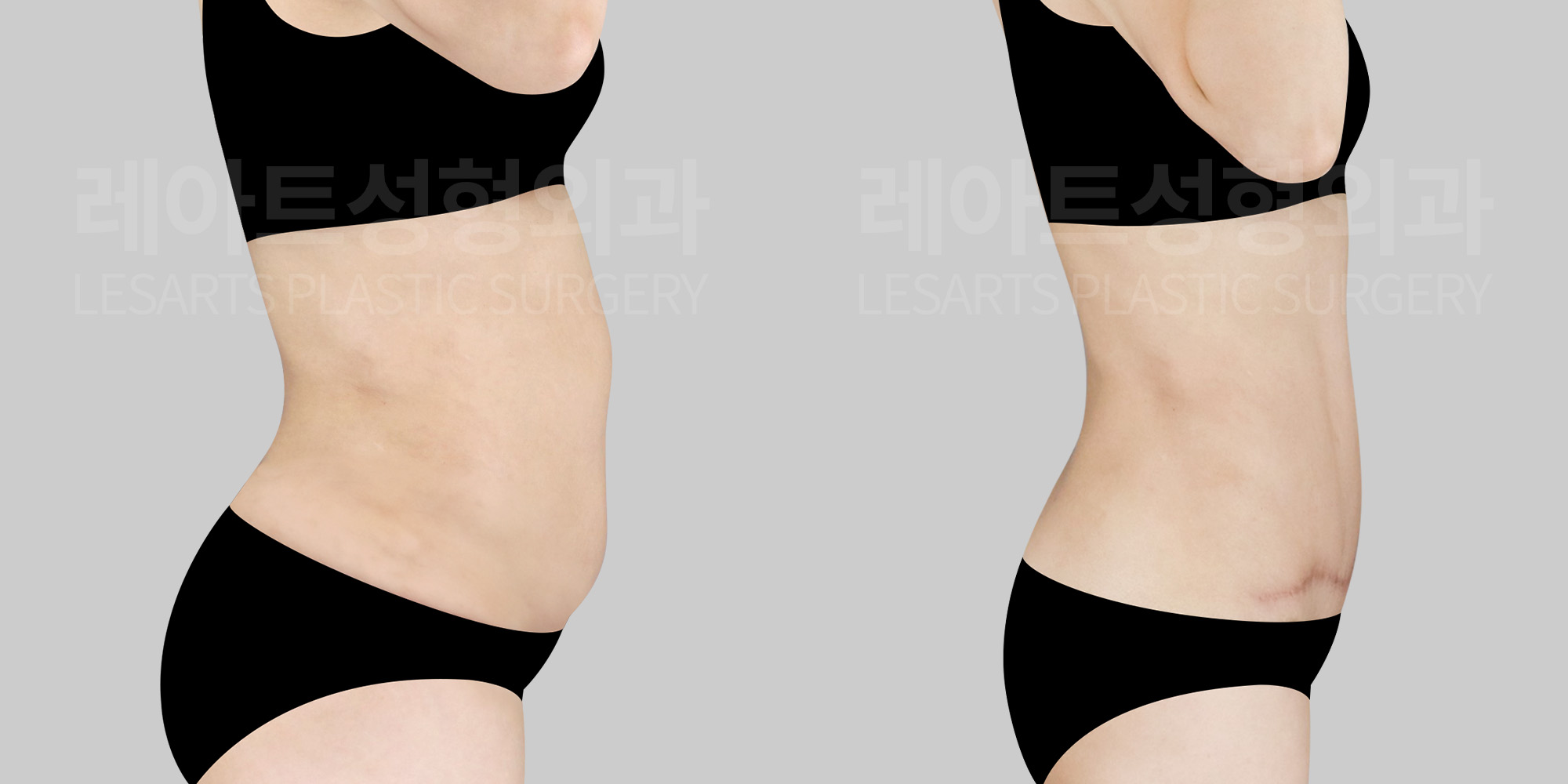
Disparities between upper and lower tightening,
contour asymmetries across the abdominal wall,
and irregular indentations caused by internal adhesions and seroma capsules
were simultaneously resolved through revision surgery.
Because the previous scar was completely resected and re-approximated under minimal tension,
disciplined postoperative aftercare focused on the new incision line
ensured stable, predictable healing.
Given her underlying keloidal tendency, we emphasized
the importance of continuous clinical scar monitoring and structured maintenance protocols.
Revision Abdominoplasty: When Is It Feasible vs. Challenging?
• Relatively Straightforward Revision Cases
o Revising scars due to keloids or hypertrophic scarring
o Correcting bilateral lateral dog-ear deformities
o Excising secondary residual lower abdominal laxity
→ These procedures typically remain within existing incision boundaries, carrying lower operative burden.
• Complex Cases Requiring Rigorous Clinical Evaluation
o Secondary tightening of persistent epigastric skin laxity
o Lowering an elevated pre-existing horizontal scar
→ Feasibility depends entirely on previous surgical dissection and available residual skin mobility, demanding thorough anatomical diagnosis.
In conclusion,
an unsatisfactory primary tummy tuck outcome does not mean
every patient can be revised using the exact same approach.
Evaluating current abdominal architecture and previous operative history
to determine whether revision is anatomically feasible and which technique is optimal must come first.
Because tissue laxity and previous surgical planes differ for each individual,
we recommend consulting thoroughly with an experienced specialist to establish a personalized revision strategy.
[ Learn More About Lesarts Abdominoplasty ]
Revision Abdominoplasty FAQ
Q1. Is revision surgery possible after an abdominoplasty?
Yes, it is possible. However, feasibility and procedural strategy depend on the severity of current laxity, previous surgical scope, and residual skin mobility.
Q2. What clinical issues warrant revision abdominoplasty?
Common indications include under-correction of laxity, elevated or unsatisfactory scar positioning, lateral dog-ear deformities, contour asymmetry, and hypertrophic or keloid scars.
Q3. Is revision abdominoplasty more difficult than primary surgery?
Yes. Navigating previous scar planes, internal fibrotic adhesions, pseudobursal seroma capsules, and altered blood supply increases surgical complexity and operative duration.
Q4. Can revision abdominoplasty improve a previous surgical scar?
In many cases, yes. By converting to a full abdominoplasty, the previous scar can be excised completely and repositioned lower within bikini borders under minimal tension.
Q5. Can persistent upper abdominal laxity be corrected during revision?
While achievable in suitable candidates, feasibility depends strictly on previous surgical dissection and residual skin mobility, requiring precise pre-operative clinical evaluation.
Dr. Kukhan Lee


Cases finding
similar to my profile
Customer Diagnostics


Select the surgery and
area you are interestedto see real
before andafter changes.


we
make you,
the art
Clinic hours
MON - FRI
10 am – 7pm
SAT
10 am – 4pm
Holiday
SUN, HOLIDAY
Location
Lesarts Moon Clinic Tower 4-5F, 40, Nonhyeon-ro 168-gil,
Gangnam-gu, Seoul, Republic of Korea

Medical institution name Lesarts Plastic Surgery
Address Lesarts Moon Clinic Tower 4-5F, 40, Nonhyeon-ro 168-gil, Gangnam-gu, Seoul, Republic of Korea
Representative Moon sung jun
